
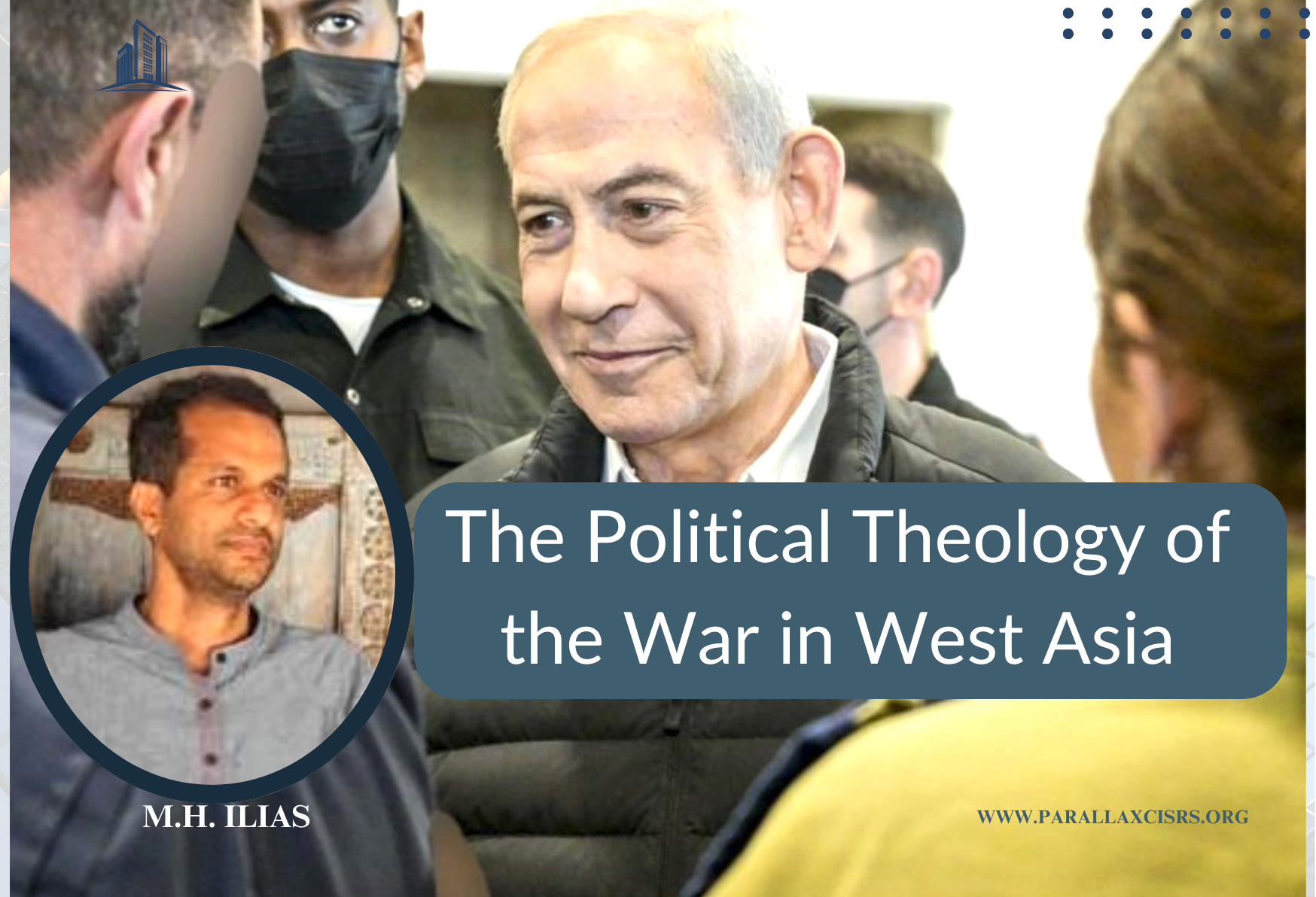
The Political Theology of the War in West Asia
M.H. Ilias
The use of theological vocabularies for attaining political ends would not surprise those who have closely followed Israeli politics from the beginning. The latest war is no different.
Gila Gamleil, the Israeli minister for innovation, science and technology and a leading member of Benjamin Netanyahu’s Likud Party, while signing off her address to the nation on X in the context of the US attack on Iranian nuclear sites last year codenamed ‘Operation Midnight Hammer’, used the greeting “Next year in Tehran.” Gamleil hinted at a more vigorous move, creating the condition for people to turn against the Islamic state and overthrow the regime, a campaign which the US and Israel intensified with the present attack. One wonders, however, why she was so particular in picking up the slogan “Next year in Tehran” – what purpose did its use serve and what are its theopolitical connotations in this context?
“Next year in Tehran” is actually a parody of “Next year in Jerusalem”, an expression that Jews across various traditions customarily use at the end of Passover, a major holy event commemorating the liberation of Israelites from servitude in ancient Egypt. This expression gathers a different sense in the modern context, symbolising a longing for peace, emancipation and hope, a wish for redemption of homeland and of course a ready reckoner for every Jew, both believer and non-believer alike, to easily connect with past sufferings and liberation from them. Invoking the biblical expression through its parody, in fact, transports us to a vexed issue of how religious metaphors, symbols, motivations and aspirations are refashioned in service of present political needs. Religious metaphors, as Gamleil shows us, are easy to bank on in a situation of crisis and operate in a most effective and authoritative way.
Dependency on biblical traditions by Israel, however, is not really unusual. In fact, reinvention of traditions in their archaic forms has been used often by the Zionist authorities in Israel when the other means of political manoeuvring fail to operate, and authorities need to find other ways for connecting with people in an ethnocratic nation.
Last year in June, Israel attacked key nuclear, military and residential sites in Iran under the codename ‘Operation Rising Lion’, which had significant religious and biblical, and not just military, connotations for Israel. The name symbolising strength and resilience, and often associated with divine protection from enemies, came from a verse in the Book of Numbers (23:24) in the holy book, Torah: “Behold, the people shall rise up as a great lion.”
The Netanyahu administration was otherwise in a deeper legitimacy crisis. Internal resentments were quite reflective of that. He fought for political survival, and that lay at the centre of Israel’s strategic turn to engage in an unending war first with Hamas-ruled Gaza and then with Iran. Just before the attack on Iran, Netanyahu in a symbolic gesture invoking biblical reference, visited the Western Wall in the Old City of Jerusalem, highlighting this move’s spiritual, protective and prophetic meaning.
Israel this time chose to use the codename ‘Operation Lion’s Roar’, a phrase that carries profound biblical and religious connotations for its parallel military operation in Iran jointly with the US. “Roaring Lion” draws on a religiously popular imagery, the Lion of Judah, which in Jewish theology stands for the tribe of Judah, characterised by strength, leadership and royalty, stemming from Jacob’s blessing in Genesis (49:9). Quite interestingly, the lion holds a somewhat similar position in the Persian civilisation, because of its Zoroastrian theological leaning, as a symbol of supreme power. But at times, it represents chaos or the dangers of untamed nature.
The use of theological vocabularies for attaining political ends may not look strange to those who have closely followed Israeli politics from the beginning. One can see a subtle or explicit element of it right from the establishment of the State of Israel in 1948. The Declaration of Independence, proclaiming the creation of the State of Israel, uses the prefix “re-” in several instances (like ‘re-establish’ and ‘re-assume’) with the purpose to connect to the Land of Israel, validating the return of the Jewish people to their national home, linking the ancient past with modern sovereignty. Ironically enough, most Zionists who had a pivotal role in the creation of Israel in the land of Palestine were staunch secularists, schooled in the late 19th century and early 20th century European Socialist Labour Zionism, but frequently put faith in religious text as a legal title deed to justify the colonisation of Palestine. Ilan Pappe, presenting it sarcastically, highlights this core irony in the ideology of Zionism: “Most Zionists don’t believe that God exists, but they do believe that He promised them Palestine.”
Theological rhetoric
An apparent trend of shifting from neutral or secular to religious or quasi-religious nomenclature for military operations by the US in the recent history traces its beginning to its war on Afghanistan in 2001-2002. Prior to this, most of the US military operations and humanitarian interventions used secular, mythological, mundane or geographically sensible names, e.g. ‘Operation Blue Spoon’ (for the Panama invasion in 1989), ‘Operation Desert Storm’ (for the operation to liberate Kuwait in 1991), ‘Operation Restore Hope’ (for humanitarian intervention in Somalia in 1992-1993) etc. The theologically rhetorical context began with the name ‘Operation Infinite Justice’, which the US originally wanted to call the invasion of Afghanistan in 2001, following the 9/11 attacks. It was later on rebranded as ‘Operation Enduring Freedom’, following pressure from the Gulf allies of the US. This sounded culturally insensitive to the Gulf Sheikhs, as in Islamic theology only Allah, being the absolute power, can deliver “infinite justice”. Attributing the role of God as the sole source of infinite justice to the US seemed un-Islamic to them.
President George W. Bush’s phrasing of “Crusade” to describe the “War on Terror” also invited the wrath of the Islamic world for its overt reference to the Christian-Muslim rivalry in the middle ages. Despite the US attempt at re-defining it in the then-contemporary context of war against terrorist outfits, what followed exposed the religious undertones of the campaign, reminiscent of papal missions launched against Muslim rulers between 1095 and 1291, with the pronounced aim of reclaiming the Holy Land (Jerusalem) from Islamic rule.
Donald Trump’s ascendance to political power coincided with the resurgence of faith as a means for solidifying political identity among the Christians in the US. Pew Research Centre statistics from 2017 show that conservatives, who consistently have been among the strongest supporters of Republican candidates, voted for Trump over Hilary Clinton by a huge margin of 77% to 16%. Christian nationalism reached its zenith to the extent of presenting “true American” identity as something synonymous with a particular brand of evangelical conservatism, pitched against Asian religious minorities, especially Muslims.
Though he could do it only in part during the tenure of his first presidency, Trump’s second term successfully juxtaposed the conservative Christian version of “American nationalism” into his political rhetoric, locating himself as a protector of faith and traditional values to consolidate his power. Trump designed and projected every campaign as a spiritual battle and framed parochial and sectarian anti-immigration policies, portraying himself as the defender of American Christian nationalism against perceived threats from within and outside. An emancipation from the secular and multicultural past that he inculcates in speeches and various invocations of it, touches very significantly upon questions of identity, of an ethnically defined nationalism, and of course of power and authority.
The war on Gaza, though initiated and executed by Israel with the “overtly covert” support of the US, provided a very conducive environment for the conservatives to express these sentiments more vociferously. For many among the conservatives, this was an opportunity, as many of their ancestors did towards the end of the 19th century, to support the return of Jews and settling them down in the land of Palestine, which they believe will precipitate the Second Coming of the Messiah, signalling the “End of Days” and the dawn of a peaceful Messianic Age. This messianic yearning, which resurfaces in different tonalities, prompts many American conservative Christians and Jews alike to stand in favour of the dispossession of the Palestinians from their land through the use of coercive means.
Similar kind of religious yearning has been echoed more vividly in a recent complaint against a commander in the US armed force, exposed by The Military Religious Freedom Foundation (MRFF), a US based watchdog working in the realm of religious freedom among the military personnel. MRFF, as quoted in The Guardian, says, “the US military commanders have been invoking extremist Christian rhetoric about biblical ‘End Times’ to justify involvement in the Iran war to troops.” The watchdog reportedly received a complaint from an officer in a unit that could be deployed “at any moment to join” operations against Iran. The officer complained, “their commander had urged them to tell the troops that this was ‘all part of God’s divine plan.” The commander cited verses from the Book of Revelation, referring to Armageddon, the symbolic gathering place for the final battle between God and the forces of evil at the end of the history, and the imminent return of Messiah, in support of his instruction. “He (the commander) said that ‘President Trump has been anointed by Jesus to light the signal fire in Iran to cause Armageddon and mark his return to Earth,” the complainant was quoted as saying.
Chain of coincidences
The present “wargasam” of Israel also reminds me of a story in the Book of Esther, which I read in a recently published book, Being Jewish After the Destruction of Gaza, by Peter Beinart, a professor of political science at the City University of New York. The story is about an attempted genocide by a Persian king who signs an edict exterminating the Jews in his country. An edict he issued under the influence of his right-hand and a pathological Jew-hater, Haman. But the decision, later on, was thwarted by the king’s Jewish wife, Esther, who appealed to the King through a series of “daring manoeuvres”, which finally lead to the hanging of Haman and Mordechai, Esther’s uncle, taking the job. Jews across the traditions celebrate the holiday of Purim, commemorating this episode of salvation from annihilation in the biblical history. But the story, as cited by Beinart, does not end with Haman’s death. Though Haman is gone, his edict to kill the Jews remains intact, difficult for the King to repeal it. Suggesting a way out, empowered Mordechai executes the edict by killing 75,000 people from the rival group.
It may be a mere coincidence, joint Israel-US strikes on the Iranian regime which resulted in the killing of Ali Khamenei, the country’s supreme leader, were taking place just as Jews around the world were set to celebrate Purim, a festival in memory of their escape from a Persian Jew-hating officer who sought their elimination from the earth, on the third day of it.
Chains of coincidences never end there. On the same day, Iranians were observing the ninth day of Ramadan, a month in which the Battle of Badr, a war against a group of infidels, the Quraysh, took place almost around 1,400 years ago. The 17th day of Ramadan is observed by Muslims cutting across the denominational lines in honour of the martyrs of the Battle of Badr.
Martyrdom means a lot to Shia theology. The memory of Karbala and the death of Imam Hussain in it are not theological motifs or abstractions. They are rather a powerful imagery to keep that memory alive in everyday life and use for the contemporary political purpose. The martyrdom of Khamenei has elevated him to a theopolitical icon, which may possibly help Iran regain its legitimacy, control and national cohesion. These were deeply contested as a result of democratic uprisings of regular sorts. These uprisings, led by a growing army of young women, students, professionals and intellectuals, were suppressed by the regime in an utterly authoritarian and undemocratic way.
(M.H. Ilias is professor at the School of Gandhain Thought and Development Studies, Mahatma Gandhi University.)(This brief reflection initially appeared in the Wire. It is republished with the author's permission.)
Become a member
Get the latest news right in your inbox. We never spam!






Comments
No Comments