
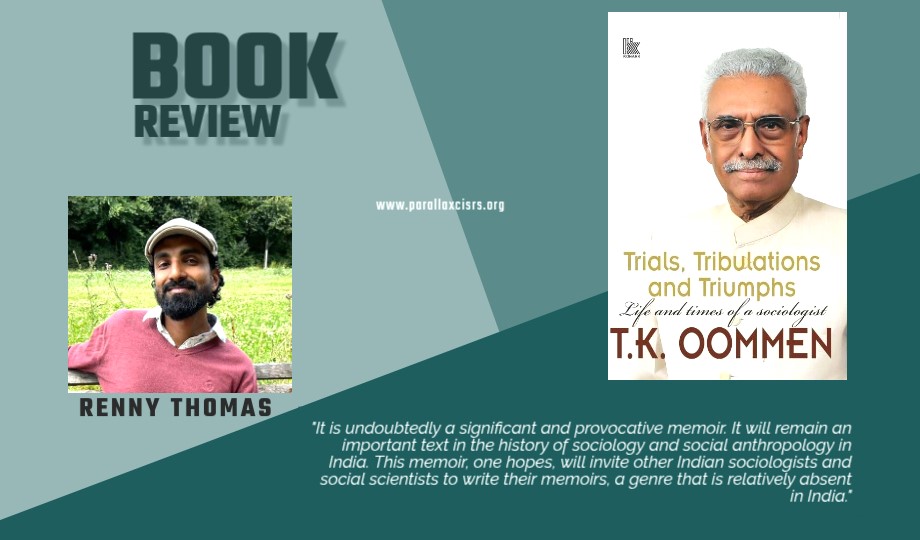
BOOK REVIEW
TK Oommen, Trials, Tribulations and Triumphs: Life and Times of a Sociologist, (New Delhi: Konark Publishers, 2018), Rs.690, pp. 304, (ISBN:978-93-220-0888-8)
Review by: RENNY THOMAS
Autobiographies and biographies of scholars tell us a story otherwise not available to us from their academic writings. Especially in the context of India, one rarely sees autobiographies and biographies of social scientists. On the other hand, scientists, bureaucrats and politicians write autobiographies as markers of their presence. As a sociologist, I have always wondered why Indian social scientists do not give any importance to writing autobiographies which can be seen not only as their life story, but also as a story of their disciplines. Although it is possible to get a brief glimpse of the lives and situations of sociologists and social anthropologists in India from the few available pieces of writing, it is important to note that we do not have many full-fledged autobiographies of Indian sociologists and social anthropologists.
It is in this context, following Andre Beteille's memoir (2012), that we have T. K. Oommen's autobiography. Oommen is well known not only as one of the leading Indian sociologists of our time, but also as an institution builder, one of the first professors of sociology at JNU, and the first Asian president of the International Sociological Association (ISA). Oommen’s memoir deals largely with his professional significant to the understanding of the history of sociology in India.
This memoir has 23 chapters and five appendices that include his farewell speech at JNU, Presidential Address to the ISA and a list of his published works. The chapters are divided into two sections. Part one of the book entitled ‘Torments entry into the field of sociology,’ his life at JNU, his terms as president of ISA and the Indian Sociological Society (ISS), and his various foreign visiting appointments and fellowships. Part two entitled 'Beyond Sociology' discusses various non-academic positions held by him such as the Planning Commission religious minorities, chairing the Gujarat Harmony Project and the Prime Minister's High-Level Committee among various other roles and responsibilities. These detailed chapters show Oommen’s contributions to academic professional associations and universities as well as the large chunks of time dedicated to working at the policy level. Perhaps this distinguishes Oommen’s methodology of doing sociology from that of his contemporaries.
The memoir very clearly narrates Oommen’s practice of sociology right from his initiation into the discipline. His sociology was perceived as non-sociological, as ‘social movements’ were not dealt with by sociologists of his time. He discusses his encounter with M. N. Srinivas, who was the then Head of the Department of Sociology, University of Delhi. Oommen was interviewed for a PhD position, and denied admission. In the interview, he was asked questions on the dowry system among the Syrian Christians of Kerala, because of his own social background (p. 10). Subsequently, Srinivas tried to rectify his ‘mistake’ by asking Oommen to enrol for a PhD from the Department of Sociology, Delhi University, with a UGC fellowship. It was communicated through Vatsala Rao, who was Oommen's professor at Poona University, Oommen writes,
Given Srinivas' influence it was indeed a possibility, but not a certainty. To add to the authenticity of the offer, it was suggested that I could work on 'Religion and Society among Syrian Christians of Kerala', a sequel to Srinivas's own study of the Coorgs their religion and society, under the supervision of M.S.A Rao who was also on the faculty of the Department of Sociology, but I was not inclined to accept the offer, telling Vatsala Rao that I was not keen to accept a 'consolation' offer, which was indeed perceived as arrogance of an immature young man (p.11).
This autobiography reveals how biases and prejudices were part of commonsense even for sociologists of that time. Oommen narrates his meeting with leading Indian sociologist G.S. Ghurye:
When I was ushered into Ghurye 's room and was introduced, Ghurye remarked, 'For a Syrian Christian, you are dark.’ Thinking that Syrian Christians cannot be identified on the basis of their pigmentation, since they are not a racial category, I told myself, 'This illustrious scholar can formulate generalizations without any empirical basis.' We conversed for twenty minutes about the state of sociology in India and his proclivity to make assertions without verifiable evidence was clear all along, a tendency evident in his writings too (p. 19).
Oommen also explains in detail Indian sociologists’ lack of professionalism, especially when it comes to appreciating the achievements of colleagues. In the context of being elected President of ISA he writes:
For the first time in the history of ISA, a president from the Afro-Asian world had been selected. Some Europeans and North Americans thought that I had been elected because I was ‘black’ and some Indians pronounced that I was elected because I was a Christian. Denigrating achievements of a person who is not ‘one of us' is a universal phenomenon (pp. 74-75).
This memoir by T. K. Oommen, one of the first internationally and nationally established non-Hindu Indian sociologist, also tells us of Indian sociology's domination by upper caste Hindu sociologists ever since its inception, and perhaps even today. In that sense, it narrates the very history of the discipline of sociology in India. The brief histories of the ISA and ISS will interest sociologists and historians of professional associations.
Although Oommen details his publications and academic engagements, surprisingly few details of his field work experiences find their way into the memoir. There are a few mentions, but without much detail. I would have expected a chapter only on his fieldwork experience as a sociologist/Anthropologist, and his relationship with his field and the people he met. I am reminded of an excellent memoir by distinguished American sociologist Renee C. Fox (2015), where she talks about her life as a sociologist through her field and fieldwork, without ignoring her career as a sociologist.
That being said, it is undoubtedly a significant and provocative memoir. It will remain an important text in the history of sociology and social anthropology in India. This memoir, one hopes, will invite other Indian sociologists and social scientists to write their memoirs, a genre that is relatively absent in India.
Note
1. See Srinivas (1996) for an autobiographical account of how he became a social anthropologist. Also see Karlekar and Mukheijee (2010). It has chapters by Indian sociologists such as T. N. Madan, Veena Das, Susan Visvanathan and a few others on their childhoods.
References
Beteille, Andre. 2012. Sunlight on the Garden: A Story of Childhood and Youth. New Delhi: Penguin.
Fox, Renee C. 2015. In the Field: A Sociologist's Journey. New York: Routledge.
Karlekar, Malavika and Rudrangshu Mukheijee (eds). 2010. Remembered Childhood: Essays in Honour of Andre Beteille. New Delhi: Oxford University Press.
Srinivas, M. N. 1996. Indian Society through Personal Writings. New Delhi: Oxford University Press.
Renny Thomas is an Assistant Professor of Sociology and Social Anthropology at the Department of Humanities and Social Sciences, Indian Institute of Science Education and Research (IISER) Bhopal, Madhya Pradesh. He is the author of Science and Religion in India: Beyond Disenchantment (2021), and co-editor of Mapping Scientific Method: Disciplinary Narrations ( 2022) and Decolonial Keywords: South Asian Thoughts and Attitudes ( 2025). He was the Taki Visiting Global Professor at New York University, New York (2024-2025) and has been a Visiting Fellow at the Department of Cultural Anthropology and Cultural History at the Friedrich Schiller University, Jena, Germany (2022-2023), and the Charles Wallace Fellow in Social Anthropology at Queen’s University Belfast, Northern Ireland, UK (2017-2018). His research interests and published works are broadly in the fields of Science and Technology Studies (STS) and Anthropology of Religion. He is currently the book review co-editor of Contributions to Indian Sociology (SAGE).
Source: India International Centre Quarterly, Vol. 45, No. 1 (SUMMER 2018), pp. 165-168 Published by: India International Centre Stable URL: https://www.jstor.org/stable/45129823
Become a member
Get the latest news right in your inbox. We never spam!



Comments
No Comments