
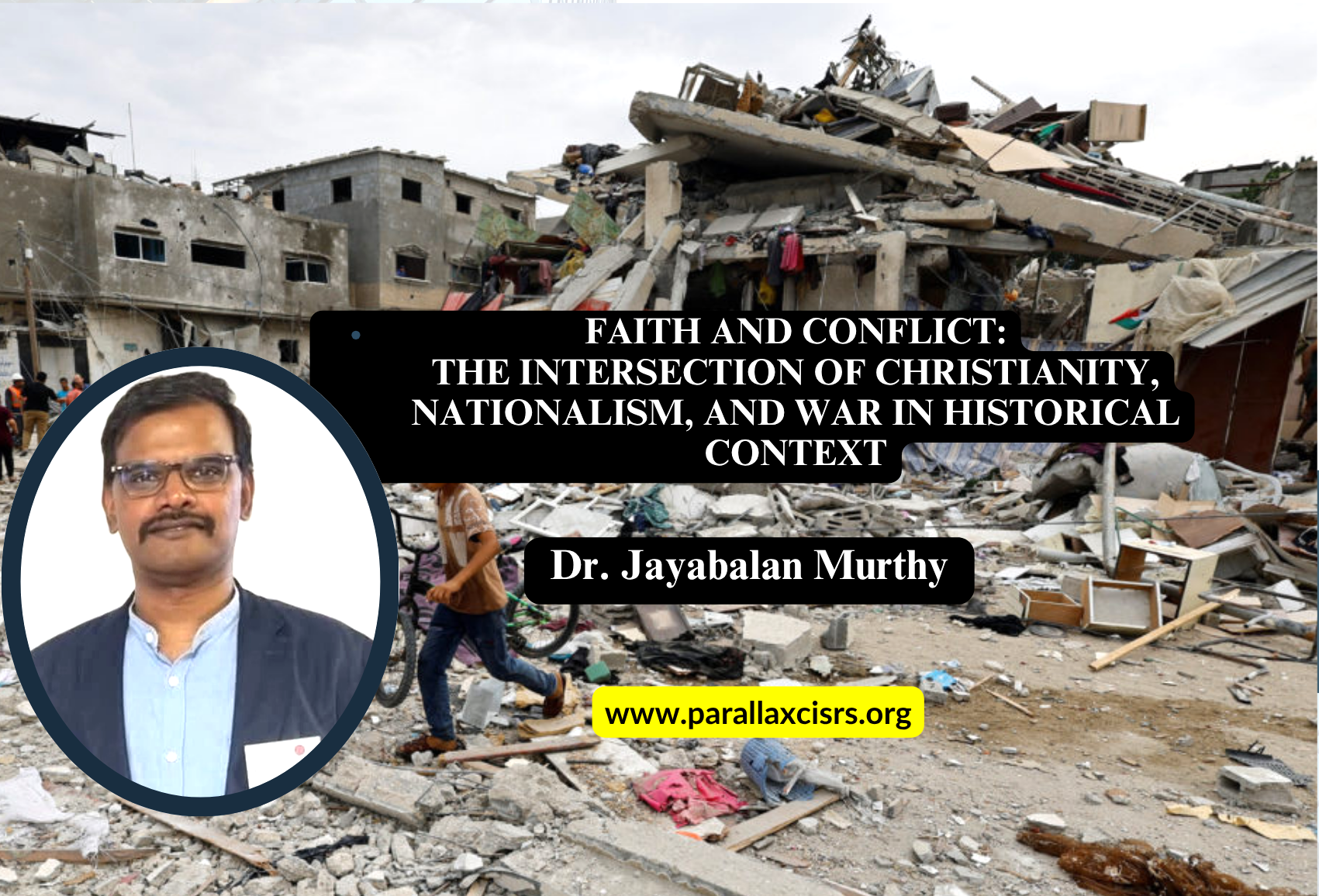
Faith and Conflict: The Intersection of Christianity, Nationalism, and War in Historical Context
Dr. Jayabalan Murthy
“God won’t listen to war leaders”, Pope Leo XIV went on to recall the prophet Isaiah’s words: “Even though you make many prayers, I will not listen: your hands are full of blood” (Is 1:15). “Jesus is the King of Peace, who rejects war, whom no one can use to justify war,” said the Pope. “He does not listen to the prayers of those who wage war but rejects them.” He lamented the many wounds of the human family in our world today, as people cry out to God with the “painful groans of all those who are oppressed by violence and are victims of war. „Christ, King of Peace, cries out again from His cross: God is love! Have mercy! Lay down your weapons! Remember that you are brothers and sisters!”[i]
Pope Leo XIV preached the above sermon on Palm Sunday. In this address, he articulates a clear theological critique of political leaders who invoke Christianity and biblical texts as instruments for legitimising war and acts of violence. Such practices are characteristic of a broader historical pattern in which religious fundamentalist interpretations have been mobilised during times of armed conflict in order to provide theological justification for violence.
My own doctoral research on the relationship between war and religion, based on sources from German archives and the British Library, reveals that comparable dynamics were already present during the First World War. Political leaders and church authorities frequently employed biblical language to frame military violence as morally and religiously legitimate. Within this context, German Christian missionaries were also implicated, as some used their prior geographical knowledge and linguistic competence to support wartime objectives.[ii]
Despite the passage of more than a century, these patterns have not fundamentally disappeared. Contemporary examples demonstrate the continued use of Christian language in political and military contexts, including public prayers offered by groups of pastors in support of political leaders and prospective military action, such as appeals related to potential conflict involving the United States and Iran. These developments underscore the enduring entanglement of religious discourse with nationalism and warfare, and they raise critical theological and historical questions concerning the responsibility of Christian theology when confronted with the instrumentalisation of faith in contexts of violence prayer Recent example is the USA defence secretary Pete Hegseth the used a Christian languages such like “May the Lord grant unyielding strength and refuge to our warriors, unbreakable protection to them and homeland and total victory those who seek to harm them and amen “[iii].
Such statements, even during the time of Modern wars, repeatedly revive an old and troubling question: What is the relationship between Christian faith, national identity, and political violence? The First World War offers a particularly instructive case. In that conflict, large sections of German Christianity, especially Protestant preachers, theologians, and mission leaders, interpreted war not merely as a political necessity but as a theologically meaningful event. Biblical texts, Christian symbols, and religious language were mobilised to sanctify national struggle, obedience to authority, and even imperial ambition. Examining this history is not merely an academic exercise; it speaks directly to contemporary conflicts in which religion continues to be invoked to justify war, loyalty to the state, and the moral legitimacy of violence.
Christianity and the Sacralization of the Nation
German Protestant thought during the First World War frequently argued that Christian ethics could not be applied to international politics. Drawing on thinkers such as the German military officer Bernardi in his book “Germany and the Next War”,[iv] and on many theologians, many argued that Christianity was fundamentally personal and communal, not political. The command to love one’s neighbour, they argued, applied within the nation but not beyond it. Love of the enemy was interpreted as a personal virtue, not a principle capable of restraining national conflict. War, therefore, was not only unavoidable but morally justified as part of an alleged “universal law of struggle.”[v]
This reasoning allowed Christian language to be transferred from the church to the battlefield. War was described as a moral test, a divine instrument, or even a means of spiritual purification. During the First World War, both German and British Preachers frequently interpreted biblical narratives, especially those from the Old Testament, as direct analogies to Germany’s national struggle. Germany was cast as a chosen people, its enemies as modern Amalekites or Philistines, and military sacrifice as a form of Christian obedience. In this way, national identity and Christian identity became fused, producing the conviction that to be German was, in some sense, to be Christian.[vi]
Authority, Obedience, and the Theology of Submission
A key theological foundation for this fusion was the Lutheran doctrine of Oberigkeit (authority), rooted in Romans 13. Many pastors and mission leaders taught that obedience to political authority was a Christian duty. Loyalty to the Kaiser and submission to the state were framed as expressions of faithfulness to God. This theology proved especially powerful during wartime, when dissent could be portrayed as both unpatriotic and un-Christian.[vii]
Mission societies largely reflected this tension. While some, such as the Goßner Mission, openly aligned themselves with German national interests, others, most notably the Leipzig Mission, attempted to distinguish between service to God and loyalty to the state. Yet even where caution existed, national assumptions remained strong. Missionaries abroad were often treated not simply as religious workers. Still, as representatives of German identity, a reality made painfully clear when German missionaries in British territories were interned or expelled during the war.[viii]
Mission, Empire, and Moral Blindness
The First World War also exposed how easily Christian mission could become entangled with imperial ideology. German mission leaders frequently argued that German culture, Protestant Christianity, and moral superiority belonged together. Missionary work was described as both a religious and a national calling. Although some voices warned against conflating the Kingdom of God with political power, these warnings were often overshadowed by claims that Germany had a unique divine role in world history.[ix]
This theological nationalism carried serious moral risks. It diminished the universality of Christian ethics, justified violence against perceived enemies, and obscured the suffering inflicted on others. In retrospect, it becomes clear that many theologians failed to apply Christian moral critique to their own nation with the same rigour they applied to foreign powers.
Parallels to the Present
The relevance of this history is repeated today. In contemporary conflicts, whether in Eastern Europe, the Middle East, Africa, Iran or elsewhere, religious language continues to be used to sanctify national projects, military campaigns, and political authority. Appeals to divine destiny, sacred land, holy struggle, or civilizational defence echo the theological patterns of the early twentieth century.
Christian churches today face the same temptation: to baptise national narratives rather than challenge them. When faith is reduced to a marker of cultural identity or national loyalty, Christianity risks becoming an instrument of power rather than a witness to the Gospel. History warns us that such alliances rarely end well, either for the church’s moral credibility or for those who suffer under justified violence.
Toward a Christian Ethics of Critical Loyalty
A contemporary Christian response to war must be grounded in theological humility and moral coherence. Christianity cannot consistently uphold ethical restraint and commitments to peace in the sphere of private life while simultaneously permitting or endorsing violence in the public and political realm without undergoing rigorous moral and theological examination. Although Christian traditions diverge in their positions on just war theory, pacifism, and political responsibility, they share a fundamental caution against the absolutisation of any nation, political leader, or governing system.
The Gospel resists identification with any particular people or state. Jesus’ command to love one’s enemies does not abolish political conflict, but it confronts Christians with a decisive ethical demand: the rejection of demonisation, dehumanisation, and the sacralisation of violence. In a similar manner, obedience to political authority must be understood as critical rather than unconditional, continually evaluated in light of justice, human dignity, and the Christian responsibility to protect the vulnerable.
Conclusion
The experience of German Christianity during the First World War demonstrates with particular clarity how readily Christian faith and biblical interpretation can be appropriated by nationalism, fear, and political ambition. When theological reflection is detached from ethical self‑critique and historical responsibility, Scripture risks becoming an instrument for legitimising violence rather than a source of moral discernment. This historical case thus serves as a cautionary paradigm for contemporary Christianity, revealing the dangers inherent in the uncritical fusion of religious conviction with national identity and political power.
In a world once again marked by armed conflict and deep polarisation, the task of Christian theology cannot be reduced to the provision of sacralised language in support of violence or state authority. Rather, it must cultivate practices of critical reflection, repentance, and hope, capable of resisting the absolutisation of any nation, ideology, or military cause. The church fulfils its public responsibility not by declaring wars holy, but by maintaining that no conflict, no political project, and no exercise of power stands beyond moral evaluation before the God who demands justice, mercy, and peace.
“He does not listen to the prayers of those who wage war but rejects them.” Pope Leo XIV
Dr. Jayabalan Murthy, Postdoctoral Researcher, Kirchliche Hochschule Wuppertal Germany
[i] Pope at Palm Sunday Mass: ‘Jesus does not listen to prayers of those who wage war’ - Vatican News
[ii] Jayabalan Murthy, First World War and Its impact on German Lutheran Mission societies in India, special reference to Leipzig Evangelical Lutheran Mission, (Göttingen: Cuvillier Verlag, 2023), 51-67
[iv] Bernhardi, Friedrich von. Germany and the Next War. Translated by Allen H. Powles. (New York: Longmans, Green, and Co., 1914).29
[v] Jayabalan Murthy, First World War and Its impact on German Lutheran Mission societies in India, special reference to Leipzig Evangelical Lutheran Mission, (Göttingen: Cuvillier Verlag, 2023), 75-100
[vi] Jayabalan Murthy, 79-87: see also Ariel J. Hoover, The dangers of Religious Patriotism: A German Example. “Restoration Quarterly. Vol. 29, No 2 (1987), 87-96; Ariel J. Hoover, “God and German Unification: protestant Patriotic Preaching During the Franco-Prussian war, 1870-1871. “Fides et Historia. Vol 18, No 2 (June 1986), 20-32; Ariel J. Hoover, Religion and National Stereotype: A German Protestant Example. “History of European Ideas. Vol 8. No.3 (1987), 297-307.: Arlie, J. Hoover, Religion and National Stereotype: A German Protestant Example.” History of European Ideas. Vol 8, No 3 (1987), 297-307.
[vii] Jayabalan Murthy, First World War and Its impact on German Lutheran Mission societies in India, special reference to Leipzig Evangelical Lutheran Mission, (Göttingen: Cuvillier Verlag, 2023) ,88
[viii] Ibid.,
[ix] Ernst Otto, Hundert Jahre Missionsarbeit: Das sächsische Haupt=Missionsverein 1819 bis 1919, (Dresden:Ludwig Ungelenk, 1919), 146.; see also Jayabalan Murthy 75-100
Become a member
Get the latest news right in your inbox. We never spam!













Comments
No Comments