
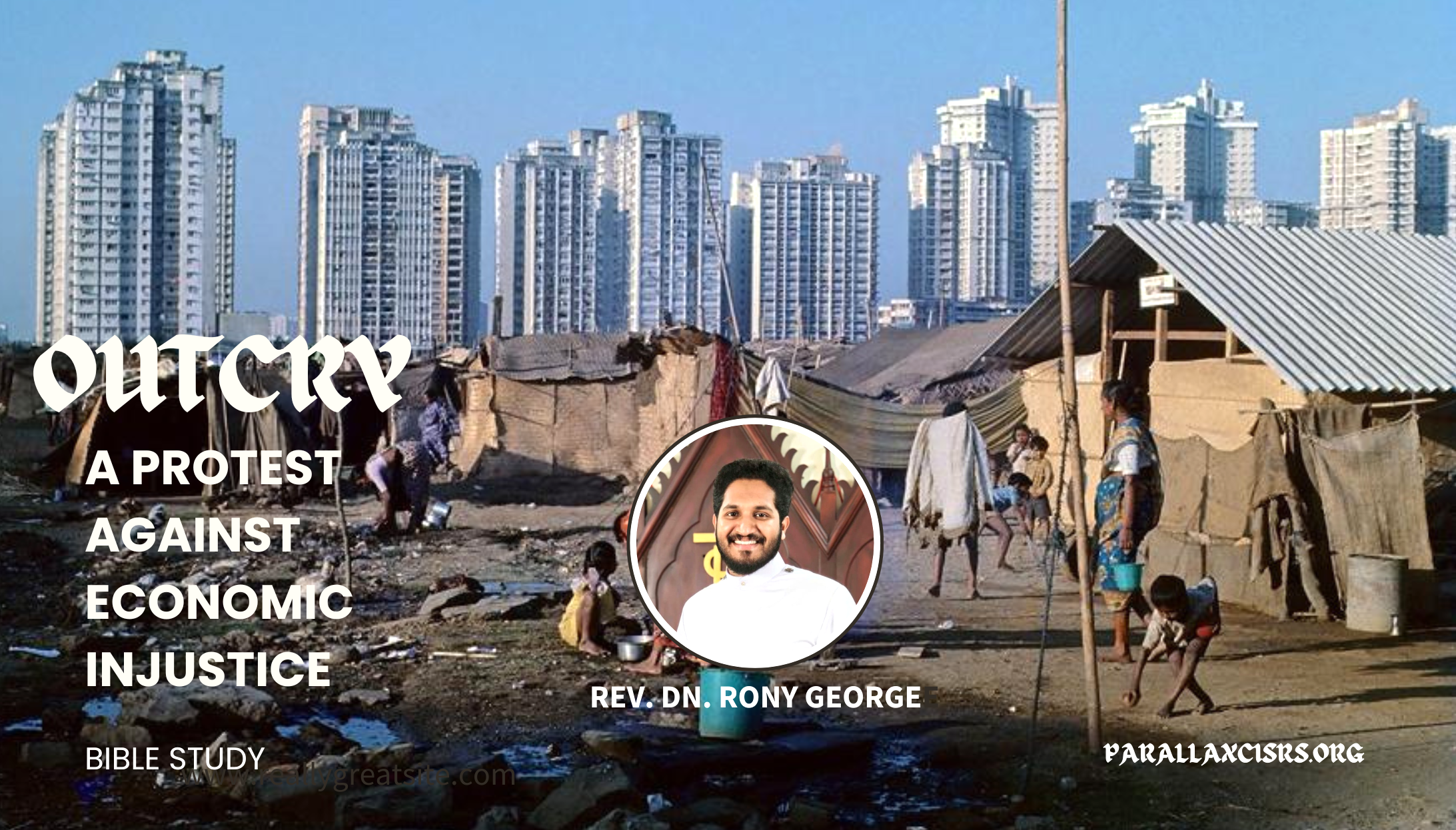
Outcry: A Protest against Economic Injustice
Bible Study
Rev. Dn. Rony George
“As a citizen of India, I have to pay tax on the money I earn and I have to pay tax on the money I spend, I have to pay the tax on the things I buy and I have to pay on the things I sell and then I pay tax on things that are already taxed from the money that was already taxed.” This is the statement by Mr. Abhishek Banerjee in the recent parliament session. I believe that this is not only an individual experience but an experience of everyone who identifies as Indian.
India witnessed an alarming increase of economic injustice as under the current political strategy and economic policies, the common people are drained in every possible manner. There is absence of equity in the income tax regulations where the middle class are paying more than the corporates, and 64 per cent of India’s GST collection is contributed by the bottom 50 per cent of the population. The middleclass livelihood is dried which pushes the lower class in even more difficult situation of survival.
Similar situation is reflected in Nehemiah 5: 1-5 as it highlights the outcry of the people experiencing economic injustice. Nehemiah 5: 1-5 is situated in the post exilic times. During that period, Judah was under the Persian empire and subjected to Persian administrative policy and had Nehemiah as the governor.
The chosen pericope is often attributed to highlight the internal conflicts that arose during the rebuilding of Jerusalem wall. The issue initially seems to be the exploitation of the struggling Jews by the elite Jews. But the text’s background should be rather situated against the broader Persian’s imperial motives. The Persian King’s generous act of granting permission and resources for rebuilding the wall must have been a political strategy. The empire needed those walls to be rebuilt since it will make Jerusalem their stronghold to monitor the revolution against them by other nations. With such selfish political motive, the sanction to rebuild the wall by the empire at the expense of the common people’s labour and contribution through high taxation reveals how the rebuilding of the wall benefitted the ones in power. This situation added more conflicts between the Judean wealthy aristocrats and the common people. Against such political economic background, the passage has to be read.
In our context therefore, the increased absence of proper discussion on the economic issues as breaking news in national medias or frontline newspaper is a threatening scenario. In such situation, how can we approach the realities guided by the Word of God?
Outcry: A Protest against Economic Injustice
From the first verse, we see the complaint is lodged by people who consider themselves as Jews who are being discriminated by their own fellow Jews. The term “Outcry/ Ṣa‘āqat (in Hebrew)” points to the deep crying out for help also found in the Exodus event when the Israelites cried out to God in their hard labour (Exodus 3: 7). To cry aloud during distress was a common practise in Israelite culture. It was a protest for initiation of collective responsibility and support. The outcry here is against “their Jew brothers” who represents a close circle of social and economic elite centred on the Persian administrative centre at Jerusalem.
It was not simply an outcry; it was a voice of protest. The social background of the text indicates that there was a general hardship experienced by the common people, and “a privileged section of the population,” seized this opportunity to exploit the less fortunate by charging them interest (v.7), which was a violation of the covenantal laws. This exploitation was made worst by the political and economic tactics of the Persian government as they increased the gap between the elite Jews and the other Jews through their excessive taxation as noted in the next verses. Verse 1 further adds the outcry of the wives which indicate the intensity of the protest and the seriousness of the people. The act of Ṣa‘āqat/ Outcry was a protest for change, a realization that things are not fair and it demanded justice.
India’s degrading situation demands an outcry. The common people are the ones who are suffering while the government and the corporates live in high places. For example, there has been an increase in the list of billionaires in India like never before since 2015. On the other hand, the value of common people’s lives is degrading as even basic necessity of healthcare are compromised because the government hospitals are crumbling under maintenance. Also, the government’s claim about the commendable growth of GDP is questionable when there is rampant unemployment that Indians are in queue to get jobs even in war- torn countries like Israel and Russia.
Walter Brueggemann stated in his book, Prophetic Imagination, “bringing hurt to public expression is the most important step towards prophetic criticism.” Ṣa‘āqat or outcry therefore, is a need of the hour. It calls for us as common people to acknowledge the injustice and voice out our outcry in our spaces against this oppressive reality. Outcry challenges us to come together in action and address the injustices we are facing.
Outcry: Addressing the Forced Injustices
The rebuilding of Jerusalem wall, as noted earlier, must have been a political move of the Persian government for maintaining their own political stronghold. It was implemented at the expense of the common people. There are three main issues faced by the people as clearly stated in v. 2-5.
Firstly, the issue of feeding numerous sons and daughters. They had a large family and because of their inability to devote their time in working on their fields, probably because of the wall building project, the family is seen to face shortage of food.
The second group had to tackle with the issue of loan and famine. The practise of mortgage was common in financial transactions and familial responsibilities. These people were probably middle-class people as they had certain commodities which could be mortgaged. But their lives were made miserable by the excessive taxation worsened further by the labour demand of the wall building project.
The last group had to deal with the issue of taxation and debt. When we look at large empires such as the Persian, it was expensive to maintain its administrative court and army. Those finances were generated from the common people through tax imposition. The Israelites therefore, while fulfilling the demand of unpaid labour in the wall project, had to borrow silver to pay the king’s tax. This drove them to the wealthy landowner who charges high interest rate for financial assistance. Under this tax system, the people experienced injustice as they were being forced to sell even their own children to serve as slaves.
This systematic articulation of the injustices faced was done when the people came together in protest and address the issues they faced. These were people from different walks of life with different social standings, as some had no grains to feed the family, the other had mortgage their fields and some had taken loans. These people came together against the structuring of the society that benefits the rich and those in power.
This issue is not confined to the passage alone. We witness similar structuring in India as the upper-class elites who holds 72% of India’s wealth pay only 3-4% of the total GST. This is a clear indication of the economic policies that favours the rich and the corporate giants.
What is needed to be done in India is quite a multi- layered discourse. We, as followers of Christ who boldly counter the evils of his times, should be responsible in challenging the system. Coming together in outcry and addressing the issues unmask the reality leading to acknowledgment of systematic inequalities, creating space for social change, and most importantly the empowerment of common people which is recognised in the power of outcry and people coming together in deep solidarity.
Outcry: A Call for Organizing Deep Solidarity
The reason behind Nehemiah economic reforms that follows in the next pericope from v.6 is because the people along with their wives collectively cried out to Nehemiah. These issues that were addressed was not a voice of an individual but of people coming together as one and uniting together in their experiences.
In the passage, there is a constant reminder towards realising the equality of all as Jews. V.1 and 5 emphasizes this through, “their Jews brothers” (v.1) and “Yet now our flesh is as the flesh of our brethren, our children as their children” (v.5). The people demanded equal treatment and found strength in their togetherness despite their different experiences under the oppressive power. They acknowledge the power in standing together. It energized them to question the subjugation of their children and inhabiting of their land by the powerful forces.
We witness here deep solidarity which recognises that the system works for the few rather than for the many and that nothing will change unless more of the many come together. It allows people to come together despite of the many differences to work together for common cause. So now, how should our faith-oriented praxis look like in confronting the tyranny of economic injustices in India?
Despite the extensive taxation imposed what do we get in return? For health care; we should buy our own health insurance, for proper education; we should send our kids to private schools, for water; we should install submersible pumps from our own money, for the poor failure of electricity; we are forced to rely on inverters.! Friends, we the Indians are in a situation where to even use the public toilets we have to pay from our own pockets. Where is all our tax money used?
The call for deep solidarity as followers of Jesus Christ is the need of the hour. As Joerg Rieger, a German -American professor of theology highlighted, Jesus’ ministry and teaching about loving God and loving neighbours was a specific way of organizing people’s power in establishing practical interrelationship. It was rooted in the recognition of each one as part of the other. Jesus Christ above all other else was an organizer, who organized people to form relationship with each other forming deep solidarity. It is a critical call to the churches to participate in the struggles of everyday life of the people, to not be ignorant of the oppressive economic policies and understand that unless we are together in addressing the problems nothing will change.
Rev. Dn. Rony George is the assistant manager at CMS Industrial School in Kottayam.
Become a member
Get the latest news right in your inbox. We never spam!









Comments
No Comments