
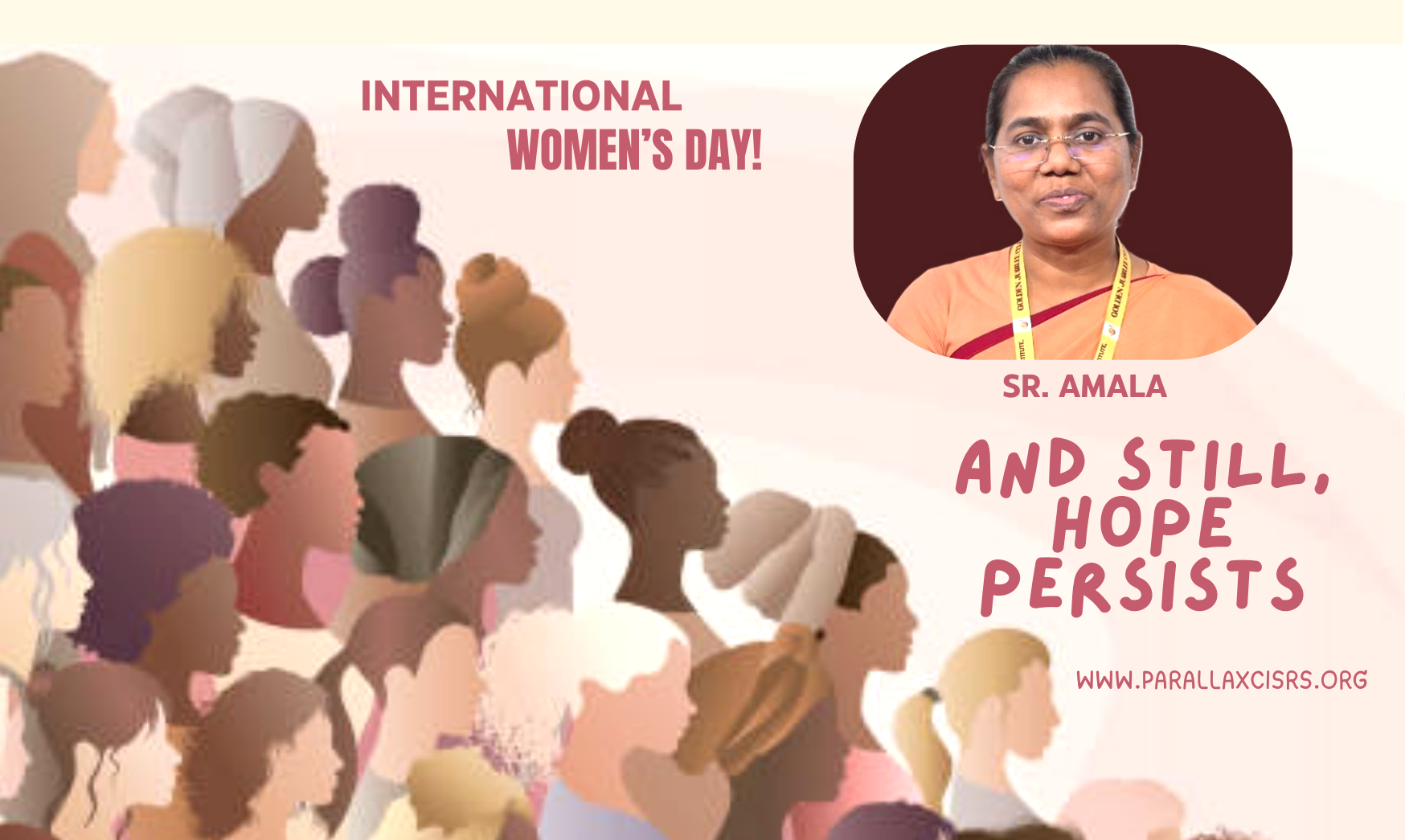
International Women’s Day
And still, hope persists
Sr. Amala
As a woman, I do not write this from a distance. I write from the wounds, the questions, the silences, and the resilience that women carry every day. International Women’s Day did not arise from a spirit of celebration; it emerged from struggle. If women truly lived with dignity, safety, and equality every day, there would be no need to mark this day on the calendar. Like many global observances, Women’s Day exists because something is still broken. The world has not yet learned how to honor women unconditionally.
I remember a question raised during a parish discussion: “If women are oppressed, why is there a Women’s Day and not a Men’s Day?” This question lingers in my mind, not because it seeks understanding, but because it reveals how deeply inequality has been normalized. We mark days in response to pain. Women’s Day exists because being a woman continues to be a risk—socially, culturally, and often physically.
In 2026, this reality remains painful and undeniable. Across the world, nearly one in three women will experience physical or sexual violence in their lifetime. Domestic violence continues to destroy lives behind closed doors. Women die by suicide, not because they are weak, but because they are exhausted by abuse, silence, and invisibility. Single mothers carry the weight of survival alone, often without social protection or respect. Girls leave school not because of a lack of ability, but due to fear, early marriage, poverty, and restricted opportunities—closed doors before they can even knock. When violence occurs, society rarely asks the right questions. Instead, it turns to women and asks: Why were you there? Why that dress? Why that time? Why with him? These inquiries do not seek truth; they seek to exert control. They expose a culture that polices women’s bodies while leaving violent structures untouched.
Even today, regardless of education or competence, many women are taught, either explicitly or subtly, that obedience is their highest virtue, especially within marriage. Yet lived experience tells another story. Families and societies flourish not when women are controlled, but when they are respected, listened to, and trusted. From a feminist perspective, I do not seek domination over men; I seek justice. Feminist interpretation names the systems—patriarchy, caste hierarchy, clericalism, and cultural conditioning—that have reduced women to secondary beings. It reminds the world that women are not merely helpers in history; we are its bearers.
Scripture proclaims that every human being is created in the image and likeness of God. Equality is not a modern demand; it is a divine truth. When women are excluded from decision-making, silenced in suffering, or taught to shrink themselves, it is not only women who suffer; humanity itself loses its sacramental wholeness. As a woman of faith, I dare to name what is often left unspoken: a woman’s life mirrors the Sacrament of the Eucharist. From the womb, her body becomes a sacred space where life is formed. From the wound, her body becomes a site of sacrifice.
Like the Eucharist, a woman’s body is taken, often without consent. Like the Eucharist, she is blessed and praised for her patience, sacrifice, and endurance. Like the Eucharist, she is broken by violence, expectations, silence, and exploitation. And like the Eucharist, she is given, again and again, for the life of others. Yet unlike the Eucharist on the altar, women are rarely adored, protected, or revered after being broken. Think of our mothers. Think of women who rise before dawn, sustain families through unpaid labor, absorb emotional pain silently, endure abuse quietly, and still keep life moving forward. Women become nourishment for the world, consumed yet seldom acknowledged.
And still, hope persists.
I think of the image of a baby elephant tied with a chain. As it grows, the chain loses its strength, but the memory remains. Many women live with such invisible chains—limits internalized over generations. But once these chains are questioned, through education, solidarity, and safe spaces, women can rise naturally, powerfully, and faithfully. International Women’s Day must move beyond flowers, slogans, and symbolic gestures. It must become a conversion of conscience—personal, social, and institutional. A conversion that teaches boys to respect, men to share power, institutions to listen, and churches to walk with women rather than speak over them.
Women should not be honored one day and controlled the rest of the year. Dignity is not a gift; it is a right. As a woman, I believe deeply that women are co-creators with God. From womb to wound, from silence to sacrament, our lives carry the sacred. In our bodies, life is nurtured. In our hands, families are shaped. In our courage, the future is formed. So on this International Women’s Day, let us stop asking, “Why Women’s Day?” Instead, let us ask, “Why is the world still unsafe for women?”
May this day move us beyond celebration to conversion, until every woman can live fully, freely, faithfully, and joyfully without fear. Happy International Women’s Day, today and every day.
(Sr. Amala is a member of the Congregation of the Sisters of St. Anne of Tiruchirappalli, currently pursuing a Licentiate in Theology with a specialization in Missiology at St. Peter’s Pontifical Institute, Bangalore).
Become a member
Get the latest news right in your inbox. We never spam!




Comments
No Comments