
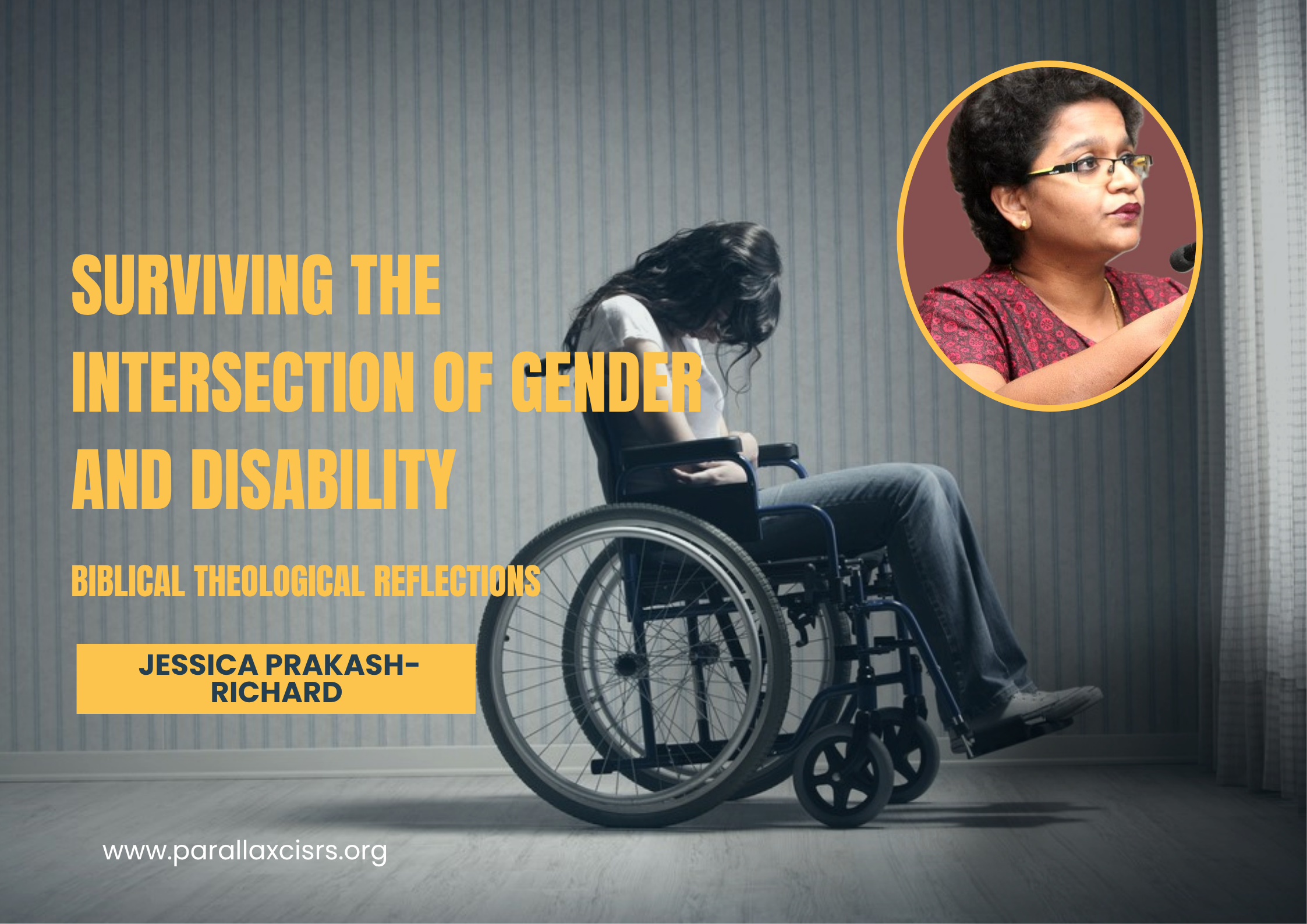
Surviving the Intersection of Gender and Disability: Biblical Theological Reflections
Jessica Prakash-Richard
The context of the text I have chosen to reflect on today, Isaiah 42: 1-4, is that Israel had breached God’s covenant, and God had sent them into exile in a foreign land. Looking into the future Isaiah saw restoration and deliverance (even though their promised restoration also was going to be through what biblical history writers would consider a “pagan” king of Persia - King Cyrus.)
I draw your attention to two phrases “…a bruised reed” and “a dimly burning wick” - two phrases I will use to try to anchor both the study of this text and the reflection based on it to relate it to the theme of this gender equity forum - Journeying together as a resilient community.
Let us briefly look at the Hebrew words used in the text and their meanings:[1]
A Bruised: Here in Isa 42:3 it is used in the sense of ‘to break in, or break down, or to be broken” and when used figuratively in other texts it refers to “to oppress or to treat violently”[2]
Reed:The Hebrew word for ‘reed’ used here referred both to “cane of the kind that grew in rivers and marshes” and also to “an aromatic and sweet smelling calamus”
He will not Break:The Hebrew word for ‘break’ is used also to mean “to break or quench one’s thirst,[3] and “to break one’s mind, or to affect with sadness,” but here in Isaiah it is used to mean “to break in pieces, crush” and “to break thoroughly”
A dimly burning wick: And the wick made of flax or cotton that was waxing dim or gradually growing dim with more smoke than fire.
Consider these two images: a bruised reed or a broken cane in a field, and a dimly burning wick.
Imagine walking through a field and seeing “a bruised reed” or a broken cane -the most common reaction would be to totally pull out or destroy a broken reed. When we see a candle with a dimly burning wick that is almost going out and therefore has more smoke around it than the flame that gives light - the most common reaction is to totally snuff it out and light another fresh candle.
Isaiah was addressing a people who were already bruised from all that they were going through in exile. Their hope was flagging. Only dimly burning, almost going to die out. They were a vulnerable, fearful people, who felt damaged, destroyed, and decimated. (I believe this sound a lot like many of us here today - who are working with or accompanying people who are bruised and ourselves also feeling like we are gradually losing hope)
To such a people (and to us today) Isaiah talks about a coming deliverer of whom he says “Here is my servant, my chosen, who will bring justice to the nations …who will not break a bruised reed . . . who will not snuff out a dimly burning wick”
Isaiah is saying, this coming deliverer of justice will be one with such empathy and compassion that even a bruised reed or broken cane he will not break off but will nurse it and nurture it again … even a dimly burning wick, he will not snuff out, but he will stoke it to make it burn brightly once more.
This deliverer will not “cry or lift up his voice or make it heard in the street”: the Hebrew words used mean he will not “cry out in a loud voice or call out to summon others either to help” or to “lift up oneself to be elevated.”[4] This deliverer will not create a hype to draw attention and create fame or celebrity status for himself.
And then we come to the most important aspect for our consideration:
This deliverer will not “fail or be discouraged”: the Hebrew words literally say “be disheartened or crushed until he has established justice” - Meaning, he will not grow weak, or dim, or faint, or falter, or be weak or restrained, or fail in strength or be cast down in mind especially like a lamp about to go out.
The same word “raw-tsats” (used for bruised reed) meaning “bruised, crushed, or discouraged” is used to also talk about the deliverer – that he will NOT be crushed, broken, or discouraged. And, until when will this deliverer NOT be broken or discouraged? Until he has set in place or constituted justice or placed a foundation of justice and the coastlands await his teaching.
The word translated as Justice[5] is most translated as ‘judgement’ in KJV usage, but is used in Isa 42: 1,3,4 simply to mean the divine law or divine religion - i.e., that which is lawfully due to any one (privilege).[6]
So, the deliverer will not be discouraged or fail but will continue to work with compassion, empathy, and meekness, not crying out loudly for help or seeking to be elevated in status, because it is the vision—until justice is done, until everyone gets their due, their right, their privilege—that VISION gives the deliverer the resilience to keep going.
Traditionally these servant passages in Isaiah are interpreted to allude to Jesus and Matthew quotes this same text to refer to Jesus (Matt 12:18-20). In the context of Isaiah itself[7], “the servant of God” or “my servant” (later understood to imply Jesus), is represented as “the chosen of God, ambassador(s) of God, and friend of God[8].
Thus, here the reference is to the intimate friend and ambassador of God, aided by God’s spirit, who will be the restorer of the tribes of Israel and the “instructor of the nations.”
In the model of Jesus as prophesied by Isaiah as the servant-deliverer, I invite us to see ourselves as the intimate friends of God, the chosen of God, the ambassadors of God, aided by God’s spirit, and reflect on three aspects drawn from this passage:
1) (Who are) the bruised reed and dimly burning wicks in our context today,
2) (How do we build) the resilience to faithfully bring forth justice, and
3) (How can we be) deliverers who do not get discouraged and crushed until justice is established
Moving from tedious Hebrew word-study, allow me to share some stories that will help us understand these three aspects and the responses to intersectionality of oppressions in today’s context in which we are called to journey together as a resilient community.
Surviving the Intersection of Gender and Disability: the bruised reed and dimly burning wicks in our context today
In early Dec 2020 when we were still in lock down mode, I received a request from an associate in the Engage Disability network in the NEI region for guidance to start computer classes for girls who were visually impaired. My friend was anxious to get this started right away for these girls as she felt an urgency to keep them occupied during the winter break after they had finished their exams. As we had expertise in the ED network in the South region, I connected her to these organisations. Another friend with visual impairment from another region in the NE who had completed theological studies in UTC Bangalore, happened to be in that region and we connected him to this group too and he was able to travel from to their place to teach the girls as he was already familiar with using the JAWS software that makes computers accessible for those with VI.
By mid-Dec 2020 I received pictures of these computer classes for the girls well underway. My friend reported that the girls were thrilled and were practicing typing and were catching up fast. My friend also sent me a video of the girls singing in the programme on 3 Dec 2020, the World Disability Day, in their center. They sang with such soul and depth in the most beautiful voices while one of them also played the key board. My friend’s center has since started spoken English classes, mobile technology, and other vocational classes to provide options for the girls with visual impairment to choose from gradually.
Much later my friend shared that these girls were victims of verbal, physical, and sexual abuse in a blind school where they studied that was shut down by Child protection Department in May of that year. The abuser was a teacher and principal of the school and himself a visually impaired person, the home was deregistered and the abuser jailed. The two youngest girls had been abused the most and continued to have physical problems related to the abuse.
When the police and social workers rescued them from the home these smallest girls had told them: “We are blind but God is not blind. God heard our prayer”
When I asked my friend when she shared this story of abuse behind the beautiful singing girls, “how do you cope and keep going and even manage to give these girls hope?” she said:"I continue to learn from these little ones, I get courage and motivation from them, they keep us going. Talking about gender-based violence is not so difficult, working on the ground is indeed full of challenges, difficulties, and obstacles, but we cannot give up, and our faith in God keeps us going."
The little visually impaired girls were bruised reeds … vulnerable, fearful, losing hope . . . but they believed that God the deliverer of justice would come …God did not allow them to be broken, did not allow their dimly burning wicks to be extinguished.
Trauma was NOT the last word in the story of these children, these bruised reeds!
My friend and the community that rescued them and ensured their safety with options for them to thrive, are the community that fostered resilience in the little ones and in the process also learnt resilience from the little ones - a community journeying together in resilience despite the bruises and dimly burning wicks that they witnessed around them, and felt in themselves too. Like Jesus they were NOT discouraged until justice was established.
Love and hope remained, and they continued to faithfully build the foundations of justice - the right, the privileges due to these children.
I intentionally situate these glimpses of resistance, resilience, subversive courage, and agency in the context of the intersecting inequalities, discrimination, oppression, Brahminical supremacy, militarization of civil spaces and muzzling of voices of dissent - which is our context in India.
I do so intentionally so that we may see these stories inspiring us in the path of the biblical tradition of the servant-deliverers that we are called to be: Living among, working with, and accompanying the bruised reed, and the dimly burning wicks, and being bruised ourselves, being dimly burning wicks ourselves, and yet in the example of the servant-deliverer Isaiah prophesied, not becoming discouraged until justice is established. And in this journey to the vision of ensuring that which is lawfully due to any and every one (privilege), we learn to be resilient together as a community.
Will we be the bruised reeds who, with resilience, will not be broken until justice is done?
Will the Church dare to join the women in the work of executing the vision of the revolutionary Magnificat?
Dare we open ourselves to be ministered to and led by the disabled among us?
Dare we embrace the power of women among us today to lead us towards social transformation and justice for all?
We are the chosen, intimate friends of God in whom God’s soul delights,
And whose spirit is upon us, to establish justice. . .
A bruised reed may we never break,
A dimly burning wick may we never quench,
May we not be discouraged in establishing justice,
May we faithfully journey together with resilience to bring forth justice to the last, the least, and the lost – Amen
(This Biblical Theological reflection was delivered at the YMCA Asia Pacific Alliance of YMCAs Gender Equity Forum in September 2023.)
(Jessica Prakash-Richard works in advocacy and capacity building in faith-based spaces in the areas of gender, sexual diversities, child rights, and disability rights. With degrees in English Literature and Divinity, a Masters in Women’s Studies, and a MTh. in Gender & Religion, she identifies as an Indian feminist theologian and activist. She is currently National Coordinator, Engage Disability; President of Association of Theologically Trained Women of India - ATTWI; Founder Editor of TheoEdits, and Consultant at TouchStone Consultancy.)
Notes:
[1]Gesenius’ Hebrew-Chaldee Lexicon to the Old Testament Scriptures Translated by Samuel Prideaux Tregelles, London: Samuel Bagster and Sons, Paternoster Row, 1858 as provided in the Blue Letter Bible lexicon pages. www.blueletterbible.org
[2]‘Raw-tsats’ - the Hebrew word for bruised - has been severally translated through the Hebrew Bible as “oppressed, broken, break, bruised, crush, discouraged, and struggle together.”
[3] Psalms 104:11; 69:21 and 147:3
[4] Isa 40:14, Ps 94:2
[5] mispat - mishpawt
[6] Right of redemption or regal rights and privileges (Jer 32:7).
[7] (Isa 42:1-7; 49: 1-9; 50:4-10; 52:13-53:12)
[8] (Isa 42:19)
Become a member
Get the latest news right in your inbox. We never spam!


Comments
No Comments