
Church and Homophobia
Steven S George
"I would not worship a God who is homophobic”
- Archbishop Desmond Tutu
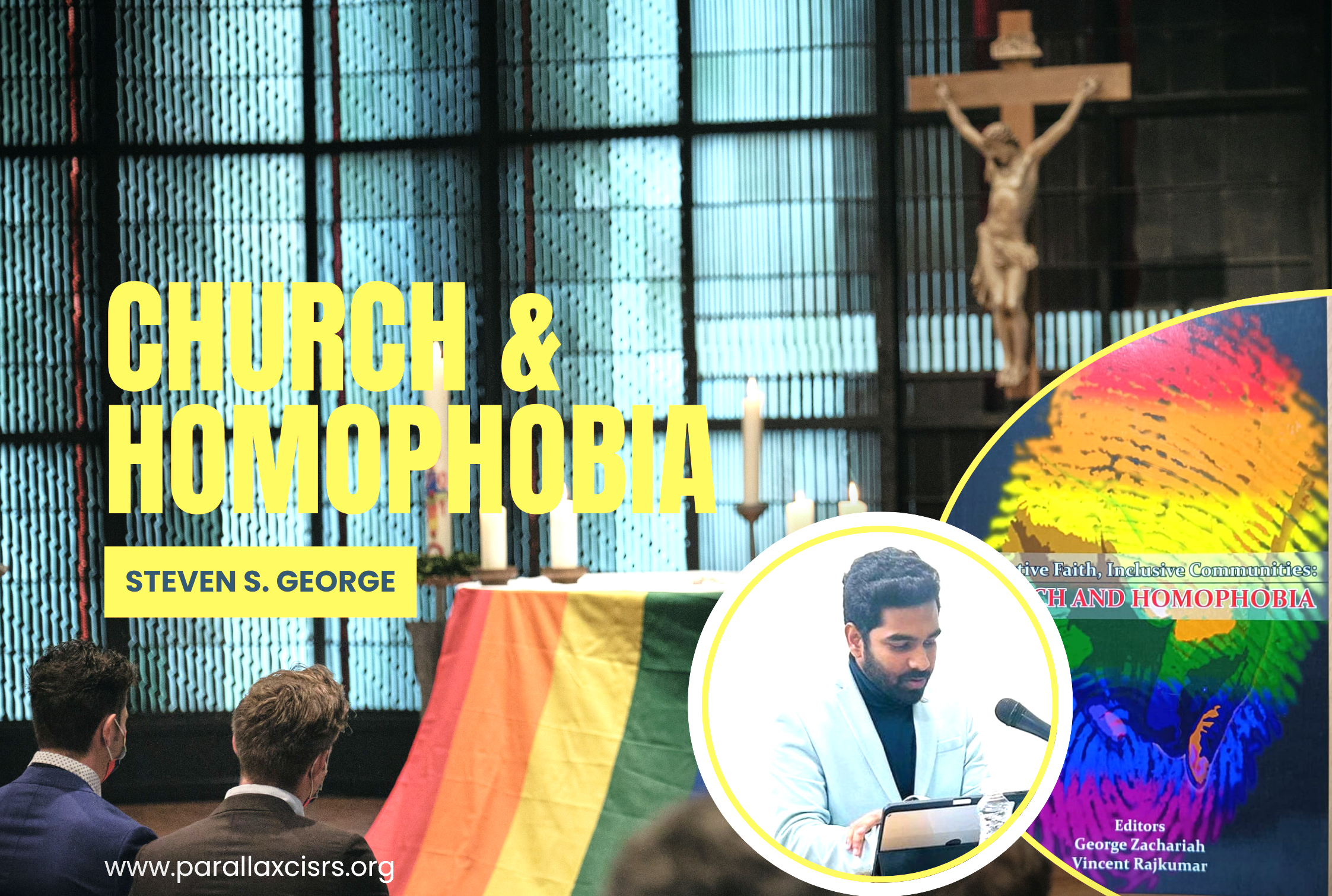
Different churches have different stands on the question of queerness and homosexuality within India and the outside world. There is resentment that comes from majority of the churches and the main point of contestation is the lack of any decisive position on the queer question. There are four categories that James B Nelson’s classifies for understanding and classifying Christian responses towards homoeroticism and same-sex unions. George Zachariah, in his introduction of Church and Homophobia: Disruptive Faith, Inclusive Communities has mentioned Nelson’s classification: (1) Rejective-Punitive Position - A position which unconditionally rejects homosexuality as sinful and immoral, and bears a punitive attitude towards homosexuals; (2) Rejective-Non-punitive position understands homosexuality as a physical, psychological, and social sickness in which homosexuality must be condemned but not the homosexual person; (3) Qualified Acceptance of Homosexuality is more empirical informed and pastorally sensitive, but is also grounded and natural law which seas same-sex relations as a perversion. In this approach homosexuals are supposed to make the best of the painful situation without idealising them or pretending that they are normal; (4) Full Acceptance Position understands he's found it on sexual ethics on love commitment interest, tenderness, respect for the other in the desire for ongoing and responsible communion with the other.
Pope Francis, the bishop of Rome and leader of the global Catholic Church, has garnered attention for his views on homosexuality, demonstrating a nuanced understanding of Christian communities worldwide. He has stated that “homosexuality is a sin but not a crime.” While he encourages society to love LGBTQ+ individuals, he does not endorse same-sex marriages (Winfield, 2023). Although Pope Francis emphasized that the Catholic Church cannot permit sacramental marriage for same-sex couples, he has shown support for civil union legislation that provides same-sex couples with legal protections related to pensions, inheritance, and health care (Pullella, 2023).
However, there are three significant issues with Pope Francis' position. First, the call to love LGBTQ+ individuals underscores that the queer community has historically faced hatred from Christian communities, and their suffering has largely stemmed from Christian doctrines. Second, many laws and constitutions worldwide are rooted in colonial laws, which means that the criminalization of homosexuality is often based on biblical and Christian teachings. Third, the churches have yet to issue a formal apology for their historical persecution and unjust treatment of queer individuals. Ultimately, the Pope's stance is diplomatic and non-punitive, but it falls short of full acceptance.
There is a strong oppositional force that governs the tokenism of the Catholic churches worldwide because the idea of membership within the Church is through the concept of family and marriage. According to Genesis 1:27-28 “But the masterpiece that reveals more about God than anything else shows up when God made something called “family”” (Focus on the Family, 2017). The genesis story as preached is shows the importance of marriage within Christianity (Ash, 2022). Unless there is no acceptance of union legislation of same-sex marriage within the church, there is no acceptance of queer people within church. Does this reflect that the church and queerness will always be an anti-thesis to each other? Archbishop and human rights activist Desmond Tutu throughout his life seemed for an end to punishing people because of who they are or whom they love, saying “I oppose such injustice with the same passion that I opposed apartheid” (Tutu, 2014). There is a larger implication of Tutu’s comparison of homophobia with apartheid as both are grounded on segregation that was considered legal by the institution. Overall, there has not been a strongly decisive stand on the queer question at large despite people being divided on the question.
British colonisation and its laws introduced sodomy laws across the world. Section 377 was introduced by British India, modelled on the Buggery Act of 1533. This section of the Buggery Act was drafted by Thomas Macaulay in 1838 and was brought into effect in 1860. It defined ‘buggery’ as an unnatural sexual act against the will of God and man, thus, criminalising anal penetration, bestiality and homosexuality, in a broader sense (The Indian Express, 2018). The Buggery Act 1533, passed during the reign of King Henry VIII, moved the issue of sodomy from the ecclesiastical courts to the state. The act did not explicitly target sex between men, as it also applied to sodomy between men and women and a person with an animal. Convictions between men for sodomy were by far the most common and well publicised. Convictions under the Buggery Act 1533 were punishable by death (The British Library, 2019). The root cause of all of this is based on the biblical interpretation of Genesis 19:1-29 in which Sodom and Gomorrah were destroyed by God. It is believed that the sin of Sodomy was homosexuality.
Scholars have contested the age-old belief of the interpretation of the sin of sodomy. Zachariah mentions that the biblical reference to Sodom’s wickedness does not list homosexuality as the cause for God's wrath rather; it is the lack of justice done in the name of the orphans and widows. The Sodom's sin was the lack of demonstrating hospitality to strangers; it does not refer to a loving relationship between two individuals, rather the unwillingness of the people to show hospitality to the visiting strangers, and the cruelty of raping the guests. It was the same sex gang group penetrated by heterosexual men, which is different from same-sex relationships of people with homosexual orientation (Zachariah, 2015). The nuanced interpretation of Sodomy is of glaring significance, as it destabilises the notion of homosexuality as a sin sanctioned within the Bible. The reference of Sodom and Gomorrah is the most important one for conservatives and supremacists who believe in a heteronormative patriarchal outlook towards the world. The interoperation of this sin led to inclusion of sodomy laws and considering homosexuality as a crime to an extent of punishing people with death penalty in some countries in different ages. From a human rights and justice perspective every human being should have a right to choose their way of living. Even in hindsight one can definitely argue that sodomy laws were unjust, cruel, and unconstitutional. But if we focus on the Biblical interpretations, one would realise that it was a terrible mistake perhaps a deliberate conservative misogyny propagated by the state and the church in order to control people and their choices.
There is a recurring use of science, nature, Bible, and laws in framework of historically subjugating and repressing homosexuality. Although, science and law are supposedly been proponents that believe in objectivity and evidence, these studies show that they were rather functioning within subjective relativism and moral conservatism that were convenient for the legislators and the scientists. K.S Jacob makes an interesting comment in his chapter, “the church and many Christian study have rejected many of these biblical standards, including slavery, apartheid, values, and racial discrimination and also wholeheartedly embraced capitalism with its lack of equity and quest for quick profits. Many conservative Christians and churches continue to focus on people, sexuality, rather than highlighting the humanity” (Zachariah, 2015). This point calls for a reassessment of Christian life in the contemporary age. Are people really, truly following the Bible as a doctrine? Or do they selectively refer to the Bible as per their own convenience not being true to biblical preaching? Or the third and more radical question, can we go beyond the Bible accepting that there are certain problems within that particular book too?
There are four major points that this short response highlights. First is the wrong interoperation of the tale of Sodomy and Gomorrah which led to believe that homosexuality is a sin. The real cause of disorder was non-consensual sex which is basically rape by heterosexual men towards their guests. Homosexuality by all means is consensual love between two or more individuals. Law has been prejudicial towards homosexuality based on state’s on moral repugnancy. Therefore, the crime exists in violation and non-consent and not in the certain way of living. Second is that science and nature debates are not only unscientific but extremely cultural. There has been a lack of objective approach towards homosexuality and queerness by modern science and psychiatry. Third, while we can definitely argue that the interpretation has been wrong, the science has been conservative, the biggest question is do we really need evidence to be just and human. What is important today is to go beyond the notions of binaries as we are running out of time as a progressive society. Going beyond the binaries means to initiate into a mode of hybridity in thinking that is creative and conceptual, that nurtures resilient strain of solidarity and support. The human rights approach juxtaposed with the language of hybridity becomes a powerful symbol of resilience that we need in the contemporary times.
Steven S George is a Ph.D. Scholar at the Department of English, Jamia Millia Islamia working on Dalit Christians narratives in Kerala. He was a Visiting Scholar at the University of Witwatersrand working with Prof. Dilip Menon on Oceanic Studies exploring the relationship between South African and Indian Christian movements.. He was a Fellow in Michigan State University working with Prof. Sean Pue on Digital Humanities. He is a theatre director and playwright.
References
George Zachariah & Vincent Rajkumar. 2015. Church and Homophobia: Disruptive Faith, Inclusive Communities. Bangalore & Delhi: CISRS & ISPCK.
Become a member
Get the latest news right in your inbox. We never spam!




Comments
No Comments