
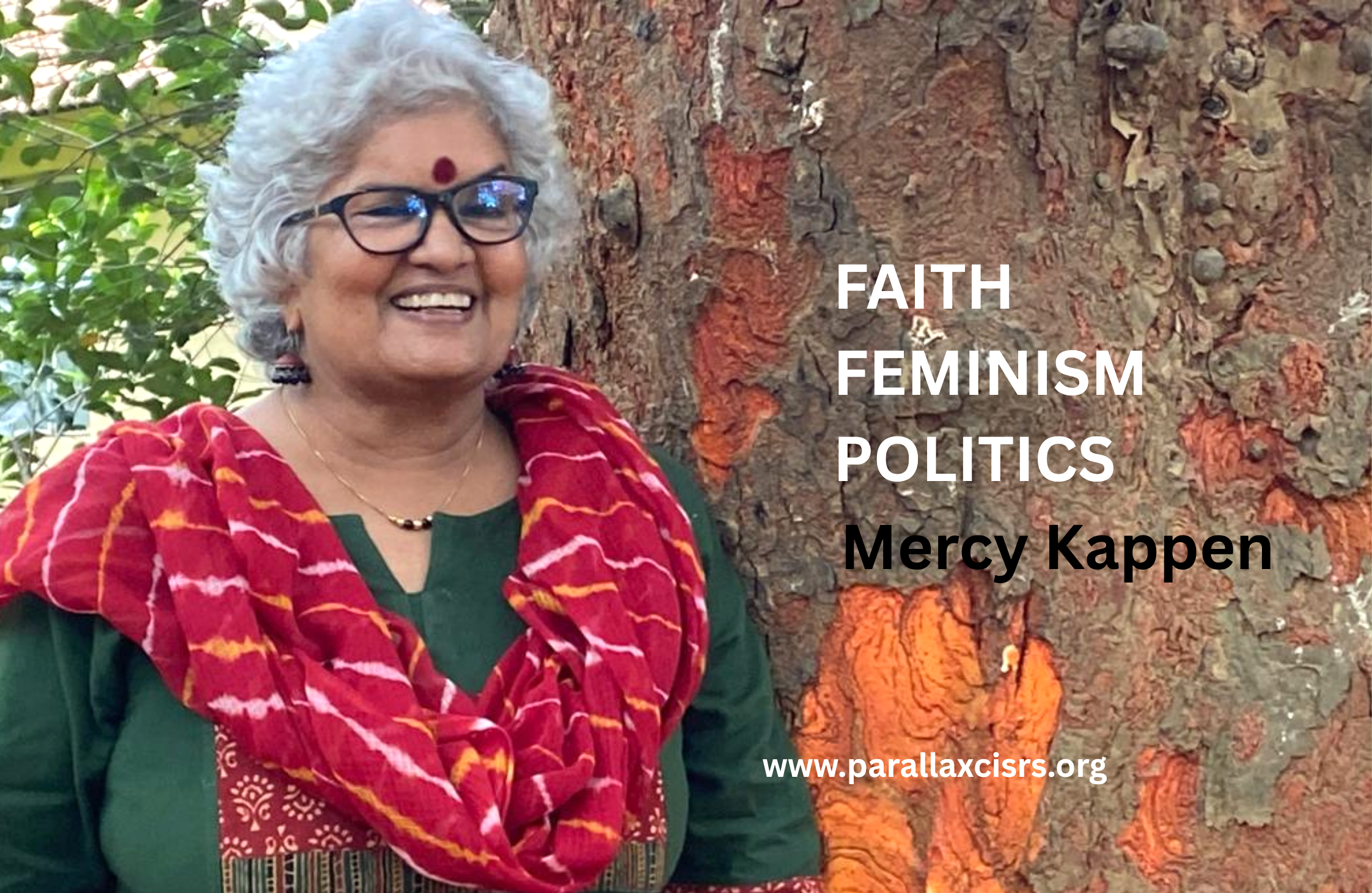
Faith, Feminism and Politics
Mercy Kappen
The intersection of faith and politics is a complex and often contentious area. Intersectionality provides a powerful lens for examining this interplay, revealing intricate power dynamics, injustices, and the potential for transformative action. This short reflection offers a basic understanding of this critical theme and explores an intersectional feminist framework for analyzing the complexities of faith and politics.
Defining Intersectionality
Intersectionality is a term coined by legal scholar Kimberlé Crenshaw in her seminal 1989 essay “Demarginalizing the Intersection of Race and Sex: A Black Feminist Critique of Antidiscrimination Doctrine” (Crenshaw, 1989). She argues that social identities like race, gender, class, sexuality, and disability are interconnected and mutually constitutive. These identities do not exist in isolation; rather, they interact, creating unique experiences of oppression and discrimination.
Crenshaw’s work emerged from her analysis of legal cases where Black women faced discrimination on the basis of both race and gender. Existing legal frameworks treated these as separate issues, resulting in their experiences being rendered invisible and their needs unmet. Intersectionality moves beyond a single-axis analysis of oppression. It acknowledges that systems of power operate together, not in isolation, and that centering the voices of those at the margins is crucial. Those who experience multiple oppressions possess unique and critical insights into the nature of power and injustice.
Intersectionality is not simply about adding up different forms of oppression; it is about understanding how they interact and create qualitatively different experiences. For example, the experience of a Black woman is not the sum of being Black and being a woman, but a unique experience shaped by the simultaneous interaction of race and gender. Similarly, consider the experience of a Dalit woman in India. She faces discrimination not only because of her gender but also because of her caste. Her experience is further compounded by factors such as class, location (rural vs. urban), potential disabilities, and possible religious discrimination if she is a member of a religious minority. This highlights how the social structures of India create a unique form of oppression for Dalit women. Understanding these interactions is crucial for developing effective strategies to address the complex challenges faced by marginalized communities.
Intersectionality in the Indian Context
While Kimberlé Crenshaw coined the term “intersectionality” in 1989, Savitribai Phule (1831–1897), India’s foremost feminist icon and the first female teacher and social reformer, was the first one to implement the principles of intersectionality in its most practical sense.
“Awake, arise, educate
Smash traditions-liberate!”
—Savitribai Phule
The term “intersectionality” was not coined even in Dr. B.R. Ambedkar’s time. However, his work and philosophy implicitly recognized the interconnectedness of caste, gender, class, and other forms of discrimination. Ambedkar’s work demonstrates a clear understanding of the interconnectedness of social oppressions. He recognized that Dalits faced discrimination based on their caste identity, intersecting with other forms of marginalization, such as gender and class, with particular attention to the unique oppression faced by women within the system. He also recognized the role of religion in maintaining the caste system. His analysis of “graded inequality” inherent in the caste system illustrates how various forms of social oppression are intertwined (Ambedkar, 1936). His work, including “Annihilation of Caste,” and his focus on the exploitation of Dalit women, who faced both caste-based and gender-based violence, further exemplify his intersectional awareness. Ambedkar, therefore, provides a powerful historical example of an intersectional approach to social justice, acknowledging that addressing the oppression of Dalits required a comprehensive analysis of the interconnected systems of power that maintained their marginalization.
Hindu society is built not on unity, but on graded inequality. The caste system is not just a division of labour—it is a division of rights, of status, of humanity. And the restrictions on food, water, touch, and interaction are not just customs—they are visible chains of oppression meant to remind us of our place.
—Dr. B. R. Ambedkar
Several contemporary scholars and activists in India have significantly contributed to this discourse. Gopal Guru has written extensively on the complexities of caste, critiquing mainstream analyses that fail to account for the multiple axes of oppression faced by Dalit and Adivasi communities (Guru, 1995). Uma Chakravarti examines the intersection of caste and gender, highlighting how patriarchal structures are deeply intertwined with caste hierarchies (Chakravarti, 2003).
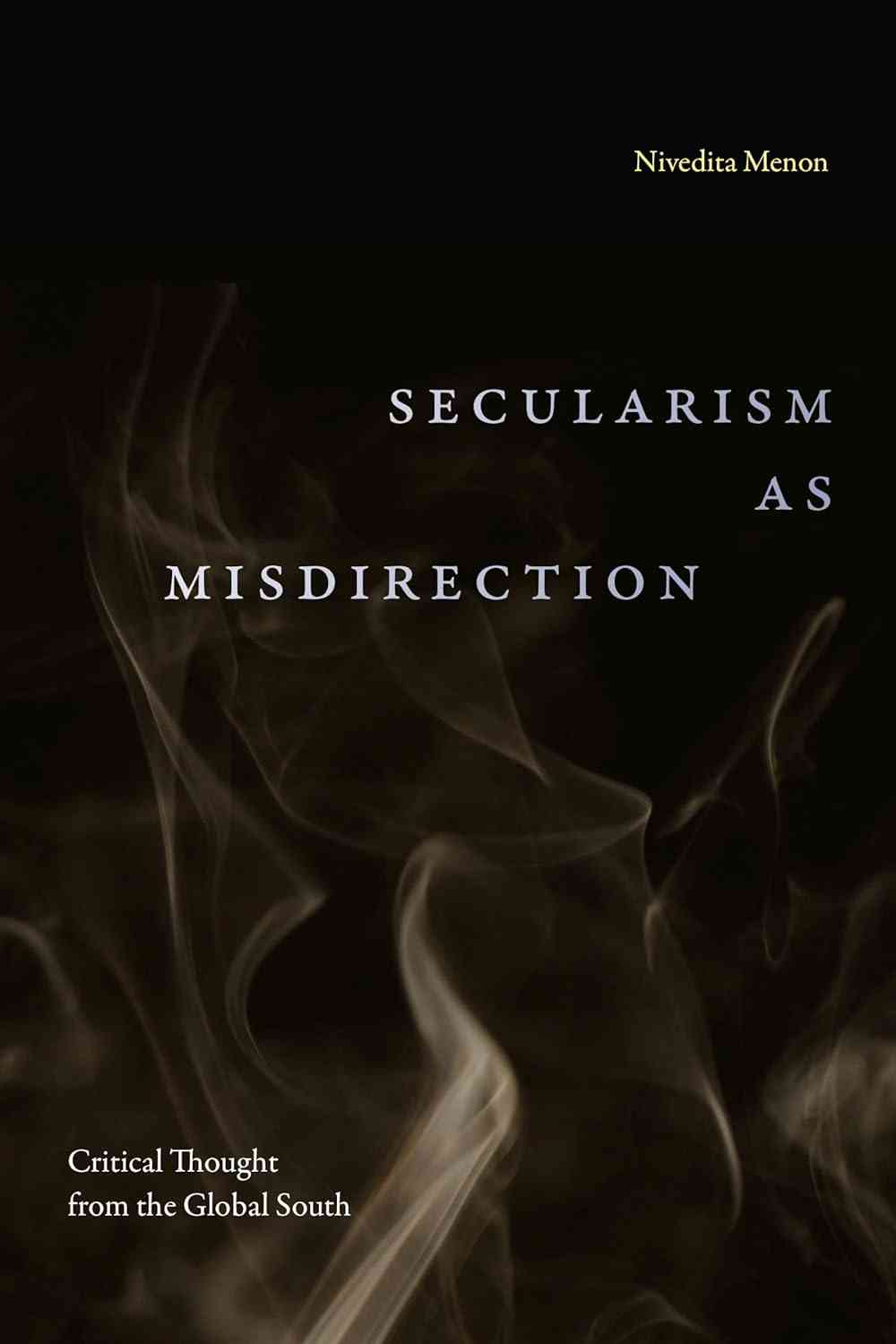
Nivedita Menon addresses the complexities of gender, sexuality, and politics, critiquing dominant narratives that often erase the experiences of marginalized women (Menon, 2012). Sharmila Rege’s work on the “Dalit Feminist Standpoint” provides a crucial lens for understanding the intersection of caste and gender, revealing the unique oppression faced by Dalit women and challenging single-axis analyses (Rege, 2006). Her scholarship demonstrates how patriarchal structures are deeply intertwined with caste hierarchies, contributing to distinct forms of violence and discrimination, challenging both mainstream feminist and Dalit movements to acknowledge the specific realities of marginalized women and advocate for a more inclusive and intersectional approach to social justice.
Ruth Manorama has dedicated her life to advocating for the rights of Dalit women, highlighting the intersection of caste and gender-based violence and the need for intersectional approaches to social justice. By integrating the contributions of Indian scholars and activists and acknowledging the intersectional relevance of Ambedkar’s work, we can develop a more nuanced and contextually grounded understanding of faith, politics, and social justice in India.
Intersectional Feminist Perspectives and Politics
An intersectional feminist approach challenges traditional power structures in politics to achieve a more just and equitable society by centering marginalized voices and dismantling systems of oppression. The specific features of the approach include:
Challenging Power Structures: This approach demands the inclusion of marginalized voices in decision-making processes, dismantling the dominance of historically privileged groups. These voices include Dalit women, Black women, LGBTQ+ individuals, people with disabilities, and those from lower socioeconomic backgrounds. This involves actively seeking out and amplifying the perspectives of those excluded from political discourse and challenging how political institutions and processes are designed and implemented, as these structures often privilege certain groups while marginalizing others.
An intersectional feminist approach calls for a fundamental transformation of these structures to ensure inclusivity and equity. This may involve reforming electoral systems, implementing affirmative action policies, creating more accessible political spaces, ensuring political representation by advocating for the election or appointment of representatives who understand and can effectively champion the cause of marginalized communities, and supporting the leadership development of individuals from marginalized communities by providing them with the resources and training they need to participate fully in the political process. This goes beyond simply increasing the number of women in politics. It requires the election of representatives committed to intersectional justice and challenging the status quo.
Addressing Systemic Disparities: Addressing systemic disparities in areas such as healthcare, education, employment, and criminal justice is another crucial aspect of an intersectional feminist approach to politics. These disparities are often rooted in the intersection of multiple forms of oppression. For example, Dalit women in India face higher rates of maternal mortality and discrimination within the criminal justice system due to the intersection of caste and gender. Addressing these systemic disparities requires policies and programs specifically designed to target the root causes of these inequalities, considering the intersectional nature of oppression. This may involve investing in community-based healthcare initiatives, providing culturally sensitive education, promoting equal employment opportunities, and reforming the criminal justice system to eliminate discriminatory practices.
The Role of Social Movements: Social movements play a vital role in fostering solidarity and collaboration across diverse groups working towards social justice. Intersectionality provides a framework for understanding how different movements can work together to achieve common goals. For example, the Black Lives Matter movement has highlighted the intersection of race and police brutality, while LGBTQ+ rights movements have addressed the intersection of sexual orientation and gender identity with other forms of oppression. In India, movements advocating for the rights of Dalit women have brought to the forefront the intersection of caste and gender-based discrimination. These movements demonstrate the power of collective action in challenging systems of oppression and demanding social change.
An intersectional approach advocates for a more inclusive and comprehensive understanding of gender inequality, recognizing that feminism must address the interconnected systems of oppression that affect all women, not just those in privileged positions. It calls for a fundamental transformation of political power dynamics and participatory models to ensure that the voices and experiences of all women are centered in the pursuit of justice.
Faith, Power, and the Quest for Justice
The relationship between faith and politics is inherently complex and often fraught with tension. Faith traditions can be powerful catalysts for positive social change, inspiring individuals and communities to work towards a more just and equitable world, as demonstrated by leaders like Martin Luther King Jr. However, religious institutions and faith traditions can also be used to maintain and perpetuate oppressive power structures. Throughout history, religious doctrines and interpretations have been employed to justify various forms of discrimination and inequality. For example, Christian theology was used to legitimize gender discrimination and oppression, and Hindu scriptures have historically justified the caste system in India, perpetuating social and economic inequality.
Liberative Faith and Dismantling Oppression: An intersectional perspective calls for a liberative faith, rooted in the lived experiences of the marginalized and committed to dismantling systems of oppression. This involves a critical examination of religious texts and traditions, challenging interpretations that reinforce inequality, and reclaiming those that promote justice and liberation. Liberation theology and intersectional feminism share a common goal: dismantling systemic oppression and challenging power structures that perpetuate inequality. They achieve this by analyzing how these structures create and maintain inequality, giving voice to marginalized communities, and prioritizing their experiences. They scrutinize the role of institutions, including religious institutions, in perpetuating inequality, and emphasize the importance of praxis, the integration of theory and action, as a means of achieving social transformation. While liberation theology provides a powerful moral and theological lens for social justice, intersectional feminism offers a nuanced understanding of how different aspects of identity interact to shape experiences of oppression, creating a more holistic and comprehensive approach to social justice that is both ethically grounded and analytically rigorous.
Challenging Patriarchy within Religious Institutions: Religious institutions often reflect and reinforce patriarchal structures, leading to gender inequality and the marginalization of women within faith communities. This is evident in the exclusion of women from leadership positions in many religious traditions, as well as the use of religious texts and doctrines to justify male dominance and female subordination. For example, some religious interpretations restrict women’s roles in religious rituals, leadership, and decision-making. Women may be excluded from the priesthood or other positions of authority. Religious texts and doctrines can be selectively interpreted to legitimize discriminatory practices against women, including restrictions on women’s dress, movement, and participation in public life.
Patriarchy is a system of power relations, deeply embedded in societal structures and institutions, including religious institutions, where men hold primary power and authority, and women are subordinated. Dismantling it requires systemic change, challenging discriminatory laws, policies, and practices, advocating for women’s equal rights in all spheres of life, including economic, political, and social spheres, and transforming cultural norms and stereotypes that reinforce gender roles. Challenging and dismantling oppressive systems necessitates a radical transformation of existing power structures. This also involves critically examining how faith is used to maintain power and privilege, often at the expense of marginalized communities. We must develop alternative theological perspectives and ethical frameworks that promote justice, equality, and liberation for all. This may involve reinterpreting religious texts and traditions, considering the experiences of the marginalized, as well as creating new forms of religious expression and practice that are inclusive and empowering.
Centering Marginalized Voices
Savitribai Phule, a 19th-century Indian social reformer, worked tirelessly for the education and empowerment of women and marginalized caste communities, facing immense opposition from traditionalists. She persevered in her efforts to create a more just and equitable society. Her work challenged the dominant social norms that denied education and basic rights to women and marginalized castes.
The Importance of Listening and Amplifying Marginalized Voices: Centering marginalized voices requires more than simply including them in the conversation. It demands active listening, creating safe spaces for them to share their experiences, and challenging dominant narratives that often silence or erase their perspectives. It also means that people with privilege must use that privilege to create space for those who are marginalized, actively supporting their leadership and amplifying their voices. Centering marginalized voices in faith-based political engagement requires recognizing their expertise, valuing their perspectives, and empowering their leadership. This involves ensuring that they are not only present but also actively involved in shaping the agenda and direction of faith-based social justice initiatives. It also requires challenging power dynamics within faith communities and organizations, creating more equitable and inclusive spaces for participation.
Challenging and Reclaiming Religious Narratives: We need to challenge patriarchal interpretations of scripture and reclaim silenced narratives within religious traditions. This approach involves critiquing how scripture has been used to justify inequality and maintain power structures, often excluding or marginalizing the experiences of women and other marginalized groups. Contextualising scripture is key, considering its historical, cultural, and social context. Interpretations are shaped by the interpreter’s perspectives and biases. This approach prioritizes the experiences of the oppressed, reading scripture through their lens. It uncovers alternative interpretations that champion justice, equality, and liberation. This approach centers the experiences of the oppressed, reading scripture through the lens of those who have been marginalized and excluded. It seeks to uncover alternative interpretations that prioritize justice, equality, and liberation for all. This involves a careful and critical examination of scripture, recognizing its complexity and the potential for diverse interpretations.
Conclusion
An intersectional feminist lens provides a powerful framework for understanding the complexities of power, oppression, and the potential for liberation within the intersection of faith and politics. It reveals how social identities intersect to create unique experiences of marginalization, challenging traditional power structures and demanding a more just and equitable world. It also necessitates a critical examination of the often complex relationship between faith and politics, acknowledging the potential for both oppression and liberation within religious traditions. Centering the experiences of marginalized women is crucial in achieving true justice and transformation in both faith and politics. The challenge before us is not simply to reform existing systems, but to envision and create entirely new paradigms of faith and politics: paradigms where power is shared, justice is centered, and the inherent dignity of every individual is not just recognized but celebrated.
Mercy Kappan is the Executive Director of Visthar. Mercy is an educationalist and activist. She has played a crucial role in designing and facilitating capacity-building initiatives integrating gender and diversity into organizations and programs.
References
Ambedkar, B.R. 2014 (reprint). Annihilation of Caste. Navayana Publishing.
Chakravarti, U. 2003. Gendering Caste Through a Feminist Lens. Stree.
Crenshaw, K. 1989. Demarginalizing the Intersection of Race and Sex: A Black Feminist Critique of Antidiscrimination Doctrine. University of Chicago Legal Forum.
Menon, N. 2012. Seeing Like a Feminist. Penguin Random House India (in association with Zubaan Books).
Become a member
Get the latest news right in your inbox. We never spam!







Comments
No Comments