
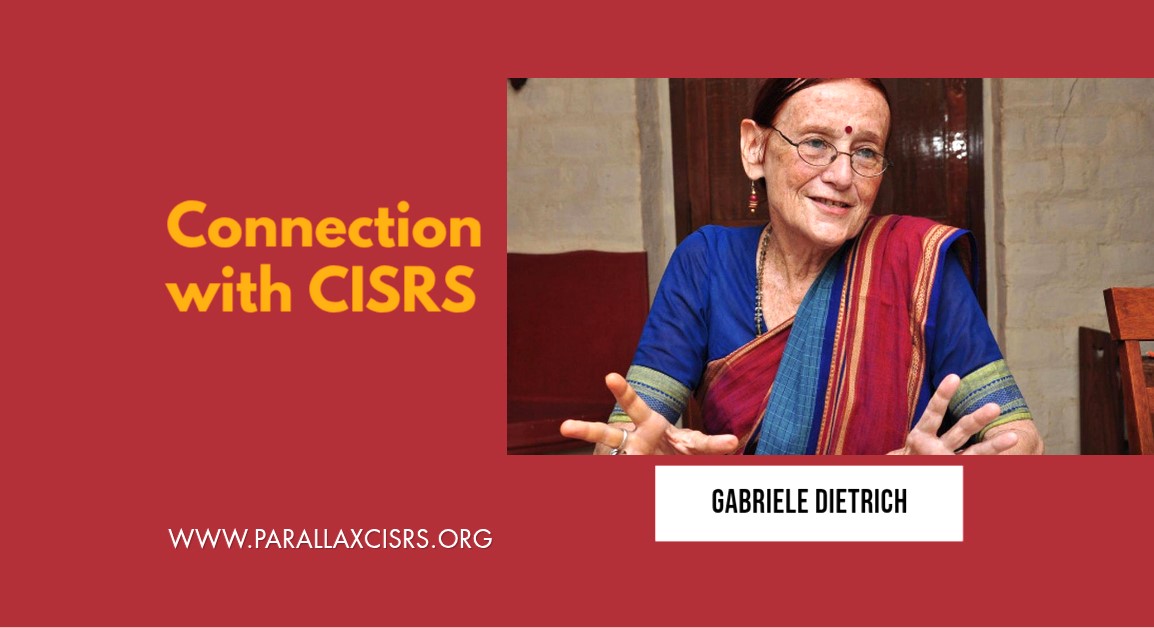
Connection with CISRS
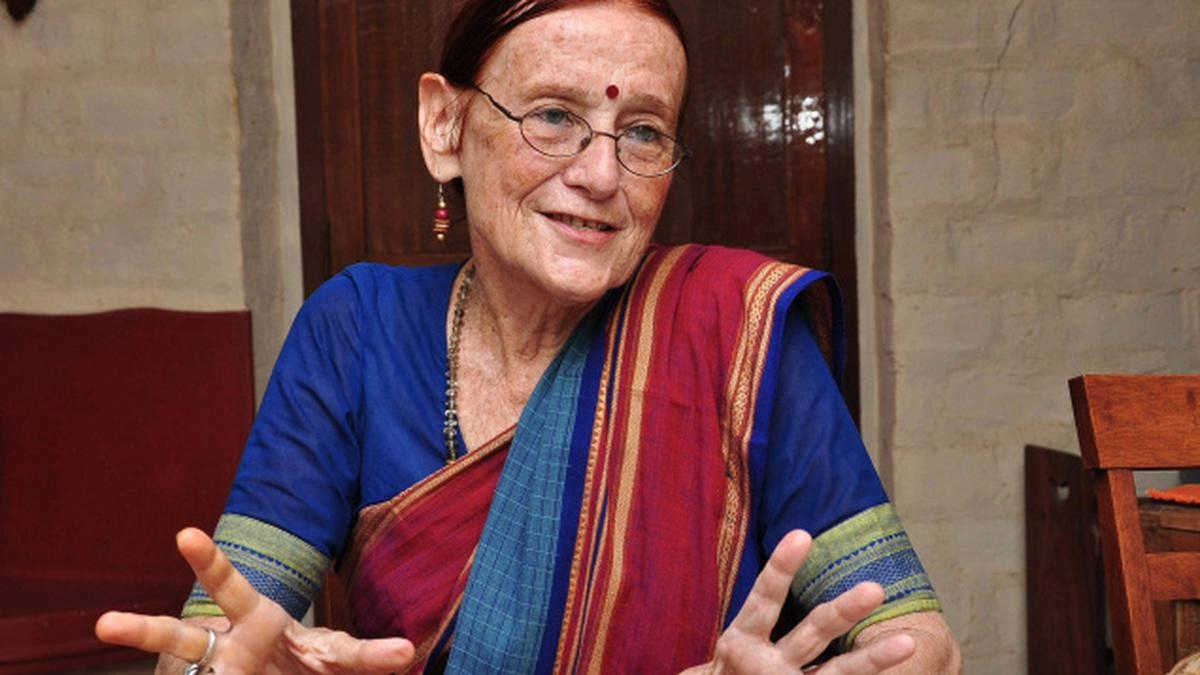
Gabriele Dietrich
My stint with CISRS was from January 1972 to January 1975. It had been decided to put me in charge of a study program on religion and development. I first reviewed some of the ongoing debates on religion and development, for instance Gunnar Myrdal’s “Asian Values” and some of the research on the applicability of Max Weber’s thesis on the Protestant Ethic and the Spirit of Capitalism. There were American and Indian scholars, who strongly felt that Hindu capitalists could perform as well as any other variety.
My own background had been in the students’ movement, which was deeply inspired by the struggles against American imperialism in Vietnam and the South African struggle against Apartheid. I was therefore deeply convinced that “development” could not be planned from above and certainly was not rooted in a relentless pursuit of economic growth. People’s struggles for social justice were absolutely crucial. Dr. S.L. Parmar’s definition of development as “social justice, self-reliance and economic growth”—in that order!—proved an inspiration during those years and also made a lot of impact at the level of the WCC. I strongly felt that social justice could be achieved when people got organized for their rights. It so happened that due to a contact with Chris Saddler, who stayed with Krishnammal Jagannathan in the villages of East Tanjore at that time, I came to understand about the land struggle in the area.
Jagannathan and Krishnammal had moved into the area in December 1968, after 44 Dalits (at that time they were still called Harijans) had been burnt alive by a landlord of the village of Kizhvenmani in the course of a wage struggle. People had been organized by the CPI, the CPI(M) and later by the Sarvodaya movement. The situation was very volatile, but Krishnammal had organized a lot of constructive work, bringing women together and also helping them to acquire some land, to enhance their standing vis-à-vis the landlords. Jagannathan and Krishnammal had received their formation in the Bhoodan and Gramdan movement of Vinobha Bhave. They later joined the struggle of Jayaprakash Narayan for “Total Revolution” in Bihar and Krishnammal played an important part in the Bhuddhagaya movement which took over mutt lands and distributed them to the community, including women.
It was obvious that there were different party political interests involved in the Tanjore area, but the decisive force was the spirit of struggle for land and dignity in the local organizations. People related to each other across ideological divides. I moved about in the area partly with the help of TTS. During my immediate research work, six students of TTS helped with data collection and interviews.
This was a period in which the ideological options within CISRS were also broadly laid out. M.M. Thomas himself, while having strong Marxist feelings, was also inspired by Lohia socialism and was generally critical of the history of Stalinism. One of the close friends of all of us at that time was Ajit Roy, the editor of the Marxist Review, who had decided to work for Left unity ever since the Left had split in the early 1960s and the Naxalbari movement in the late 1960s had fragmented. Both M.M. Thomas and Ajit Roy took strong democratic positions during 1975, when the strengthening of the JP movement led to the declaration of the Emergency. As Jagannathan and many other Gandhians suffered severely under jail sentences, MMT’s regular circulars, which were later published under the title Response to Tyranny, were a strong inspiration to many critical local groups. This was also a period in which a strong upsurge of different women’s movements made its strength felt all over the country. It was also a period when there was a lot of debate on non-party political formations. M.J. Joseph in Thiruvalla was involved with a Dynamic Action group and started building up some of the work which later led him into the PSA program.
In the early 1970s, Abraham Ayrookuzhiel also returned from studies in England and started working with CISRS. His interest in religious studies was very concrete and down to earth. He started to take strong interest in Dalit history. In this period the Dalit Panthers started to make a strong impact in Bombay, and it struck us that the awakening of Dalits was something that had been widely ignored in the churches.
The period from 1975 to 1977, characterized by the suspension of democratic freedoms, led to a lot of resistance which often transcended ideological lines. Gandhians and Marxists could be found in the same jails. In TTS, this became visible in the jail ministry and also in the formation of a human rights forum. When elections were declared, there was a campaign under the title “Why the Ruling Congress Should be Voted Out of Power.” After the defeat of Indira Gandhi, there was a CISRS consultation in Ernakulam in 1977, which tried to assess the democratic openings for people’s movements in the new situation. For a short while it appeared as if new democratic forces could influence power, but the disarray of the socialist forces brought many expectations to naught. The attempt to spread out social action groups during the 1980s led to more NGO-ization of social movements. But many new organizations were built up relentlessly over the years.
One of the very encouraging phenomena consisted of the fact that Dr. M.M. Thomas, during the 20 years after his retirement, kept strong contact with young people and many of his old associates. When NAPM was formed in the early to mid-90s, there was an unbroken contact with him. When Medha Patkar came to Thiruvalla in January 1996, we stayed at Pennamma Bhavanam, and MMT presided over the public meeting at the Syrian Christian hall, Thiruvalla SCS campus, in the same place where we had to lay his body in early December 1996. MMT’s funeral itself was a lively expression of solidarity from people’s movements all over the country.
(Gabriele Dietrich is an activist theologian who still continues to engage with various social movements in India.)
Become a member
Get the latest news right in your inbox. We never spam!


Comments
No Comments