
Queer Ecology: Exloring Expansive Creativity
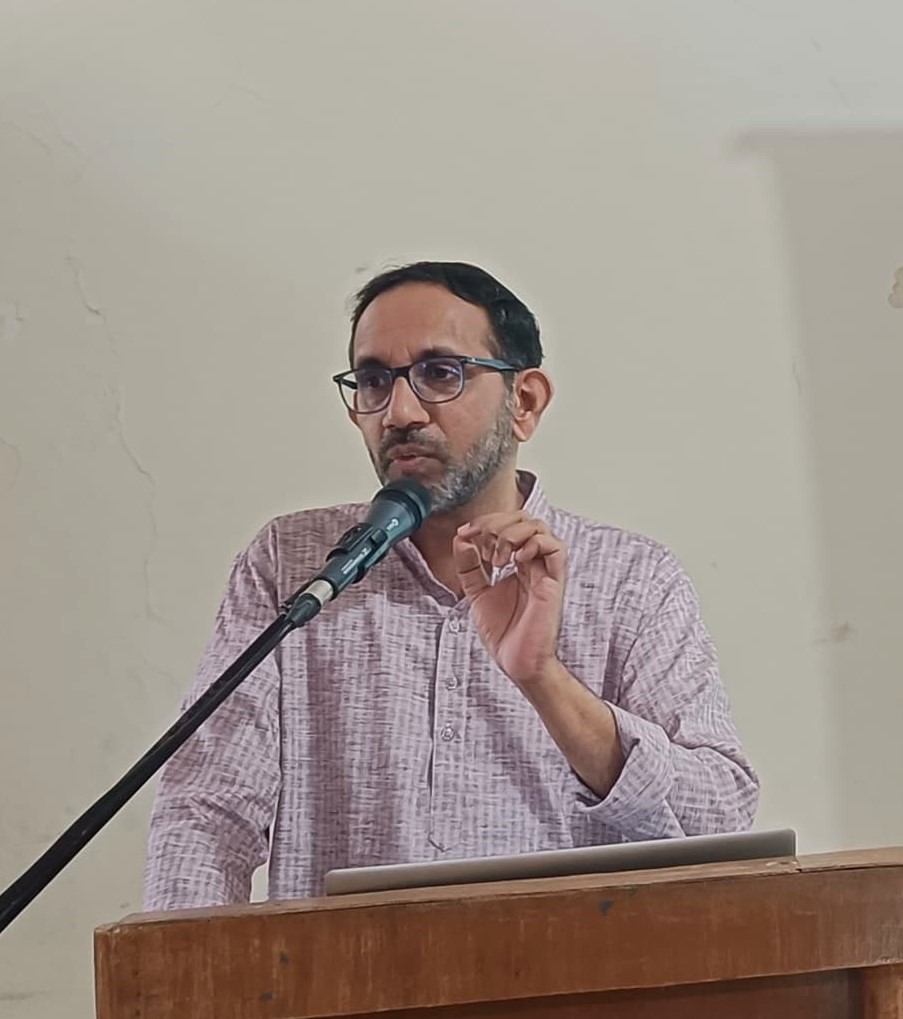
Rohan P. Gideon
Introduction
Queer ecology is a versatile phenomenon of the queer nature and offers principles and directions that not only contest heteronormative and anthropocentric narratives but also creatively critique the conservative idea of the natural. It also recognizes the interconnectedness between the artificially segregated categories such as “natural” and “unnatural.” Queer ecology is a political notion about the fluid relationship between ecology and queer politics, and at the same time the finer constituent factors and their interpretations, both by the organic bodies as well as their interpreters. With the interconnectedness comes the rejection of the anthropocene. Timothy Morton articulates this well: “It’s not that ecological thinking would benefit from an injection of queer theory from the outside. It’s that, fully and properly, ecology is queer theory and queer theory is ecology” (2010:281).
In our immediate contexts, there is an increasing tendency for cis-bodies to represent queer bodies, both affirmatively and polemically. This leads to the shrinking and silencing of the agency of queer beings/becomings. This is true of the ecosphere too. Anthropocentric systems represent the ecosphere, both affirmatively and polemically. The principles behind such representations need critical revisiting. This paper is a theoretical analysis that attempts to embrace the “queer” imagination present in the ecosystem, usually presented as unusual, peculiar, curious, weird, abnormal, extraordinary, puzzling, suspicious, offbeat, freaky, unlawful, mystifying, indecent, and so on.
Queer Ecology: Descriptions and Broad Principles
The far-reaching principles of queer ecology speak of nature and of living “in recognition of and gratitude for the manifold connections we share with it.” (Heuvel 2023: 199). Catriona Mortimer-Sandilands and Bruce Erickson, in the opening words to their work Queer Ecologies: Sex, Nature, Politics and Desire, set out the purpose of queer ecology:
The task of a queer ecology is to probe the intersections of sex and nature with an eye to developing a sexual politics that more clearly includes considerations of the natural world and its biosocial constitution, and an environmental politics that demonstrates an understanding of the ways in which sexual relations organize and influence both the material world of nature and our perceptions, experiences and constitutions of the world (Erickson 2010: 5).
In our attempt to re-see the natural around us, queerness—both in human bodies and in creation—aids us in developing a scientific temperament that acknowledges diversity, fluidity, constant disruptions, embracing the unexpected and developing rooted solidarity with the entire creative order. Queer ecology reorders the strongly anthropocentric worldview by recognizing the value of every life-form and the deep interconnections among the constituent lifeforms. The principle of interconnectedness takes away from the human the supposed privilege of agency and greater representation, and reconfigures agency and representation to rest with creation and with queer bodies. Queerness also divests the knowledge system enshrined in binary discourses and offers multiple epistemic points. As mentioned earlier, the broader and deeper ethic in all these principles is the ethic and practice of liberation of those caught in binary discourses.
Revisiting and Revising the Notions of Agency and Representation
Our discourses of the Other are imprisoned in the dominant knowledge system that makes us believe that the Other cannot represent themselves. Inversely, this raises the question of whether representation can be genuine (Said 1979:21). The understandings of, and explanations for, agency and representation in ecological and queer discourses, as separate disciplines, offer proactive and constructive directions. As far as the question of representation in sexuality discourse is concerned, unless we are from sexual-minority communities, then all our presentations of images about sexual minorities are cultural constructs, and such constructs need to be interrogated. If not interrogated, we risk faking the knowledge of having understood the cultural constructs of genders and sexual diversities.
The constituencies of ecology and queer thoughts have risen more strongly every time, even with restricted or partial agency, and even while being pressed down by systemic limitations. However, a clear degree of acquiescence is an integral part of their survival and longevity. In ecological discourses, one cannot fully overcome the anthropo-driven language, yet it is possible to reimagine, much against the anthropocene, certain ecological thought processes and renewed manners of conversations that deliberately acknowledge “knowledge, subjectivity, politics, ethics, science, citizenship, and agency, which pervade and reconfigure theory and practice alike” (Code 2006:24). Equally important should be the observation that radical discourses on queerness and ecology are characteristically active in unsettling heteronormative and anthropocentric discourses on their own merits as well as in offering strong constructive principles. They enshrine the principles to provoke our moral consciousness from time to time.
The constituent principles of the definition of agency have constantly been enabled and disabled, making it a casualty of identity politics. It is in this context that principles such as silenced-presence, regeneration, life, hope, resilience, and engagement need to be added to the principles of matter, object, and voice, even when they are deemed inert. These principles have the ability to question the historically negating and suppressing identities of eco and queer agencies. It should also be noticed as to what we represent and what we, consciously or subconsciously, omit. Edward Said explains that our ideas of representation “are imprisoned in the dominant knowledge system…[therefore] … representations cannot be exactly realistic” (1979:21).
In the contexts that predominantly embody the anthropocene and heteronormativity, few topics are as personal, embodied, culturally dependent, political, and moralized. Attitudes about sexuality are often bound up in issues of shame, guilt, power, and freedom. As Ott and Stephens put it:
“…all instructors and learners are embodied (have a body) and that much of one's understanding of sexuality is learned through one's body. Cultural, religious, and personal definitions related to the particular bodies in the classroom affect teaching especially related to sexuality” (2017:106).
Theologically, Marcella Althaus-Reid (2000) speaks of the Incarnation as honestly embodying the existential mysteries, struggles, and desires of all our bodies. She speaks of locating the body with its complexities, boundaries, and “per-versions” as the epistemological departure to constantly redefine the reality away from the concept of particularist identities. Yet, the majority of hermeneuts who exposit Althaus-Reid propose the openness of Incarnation largely to anthropocentric implications.
Principles of Queer-Ecology
Queer ecology affirms the fluidity of life as present in nature. The naturally queer is non-linear. It shows that “interconnectedness is not organic. Things only look like they fit, because we don’t perceive them on an evolutionary or geologic time scale” (Morton 2010:279).
The working of the human body is by nature queer and not restricted only to sex-identity or sexual activity between female and male. Myra Hird explains that queer ecology offers a “potent lens with which to explore particular boundary transgressions associated with queer theory, including the autonomy of the self, embodiment and sexual difference” (2006).
Knowledge of biological and creation sciences is equally important in religious and theological studies. Joan Roughgarden’s explanations help us grasp this:
“Cells reproduce asexually, like their single- celled ancestors and the blastocyst attached to the uterus wall at the start of pregnancy. Plants and animals are hermaphroditic before they are bisexual and are bisexual before they are heterosexual. Males and females of most plants and half the animals can become hermaphrodites either together or in turn, and hermaphrodites can become male or female; many switch gender constantly” (2004: 306).
A queer ecological perspective deconstructs notions of authenticity, and organic and fixed identities. Life’s activities are beyond rigid categories and goes by interconnected relationships. Morton deconstructs the idea of everything fitting neatly into a matrix because “we don’t perceive them on an evolutionary or geologic time scale.” He argues that “entities are mutually determining: they exist in relation to each other and derive from each other. Nothing exists independently, and nothing comes from nothing” (2010:279).
Queer ecology deconstructs our rigid notions of hierarchy. All our interactions, organizations, and relationships are deeply hierarchical and have now become almost naturalized. Queer ecology tells us that life-systems cannot be particularist—they are “non-totalizable, open-ended concatenation of interrelations that blur and confound boundaries at practically any level including between species, between the living and the nonliving, and between organisms.”
Queer ecology reconfigures theologies that are over-emphatic about faith and religiosity at the expense of scientific temperament. It places a check on uncritical inheritance of theological discourses and thoughts, especially when blindly guided by traditions and scriptures. Theology, as a latecomer in many or most disciplines, lacks scientific temperament in its researches. Themes such as God’s creation, image of God, and bodies as God’s gift must be recognized for the queerness they embody down to a microscopic level of depth. “Human self is corporate as well as corporeal.”
Embodying Fluidity and Realizing New Learning Curves for Theology and Faith
In queer-eco space, agency is not a static property but a dynamic force that projects itself through its presence, potential, and multiple manifestations, either coming as an unsettling format or as ungoverned by anthropocentric orders. Likewise, representation questions any finalist notion of advocacy or solidarity with a “savior” mentality or such similar entitlements, but roots us back to renewed sociability, qualitative transformative possibility, and the identification of creative potential in the differences.
The opposing natures to fluid interdisciplinary discourses are the principles of a single-entity discourse of marginalized groups that hesitate to draw from intersectional intentions. Such hesitations claim exclusive rights to express historical and current grievances. Embodying fluidity does not overlook such grievances. Overlooking such grievances lead to what Miranda Fricker calls “testimonial injustice.” Testimonial injustices give rise to and also sustain “hermeneutic injustice” (2007:21). A discourse that eventually emerges from this process would certainly be liberative in nature. However, a rigid agency and representation would exhibit a “radical discontinuity” from previous and like-minded discourses. Such discourses also discredit deeper and divergent narratives which can be an in-built critic for its own advancement.
In the context of Christian religious confessions and their theologies, single-entity manifestations happen through the tough and rigid institutionalized church and its organizations, a strong insistence on the need for hierarchy (functional or divinely ordained), any specific gender as the only divine representative, and the deliberate shrinking of spaces for conversations and resistance, questioning, queering, and constant reforms.
Learning, as a process, is transformative as well as additive, reshaping the worldview of the learner [and also of the teacher] (OTT 2017: 106). The new sociabilities presuppose the creation of flexible configurations that reflect openness and expansiveness to continue the engagement, which, in turn, supports bigger and wider relationships.
(An expanded version of this paper was presented at The International Conference on “Emerging Trends in Artificial Intelligence, Entrepreneurship and Sustainability” (2SLGBTQIA+ Interventions and Ecological Pathways: Inclusive), held at BMS College of Management, Bengaluru, on 5-6 December 2024). This version is published in Faith, Politics, and the Bible: A Reader, edited by Y.T. Vinayaraj (Bangalore: CISRS, 2025), 40-48
Rev. Dr. Rohan P. Gideon is a Professor of Christian Theology at the United Theological College, Bangalore and an ordained minister of the Church of South India. Dr. Gideon has authored several works, including Child Labour in India; Challenges for Theological Thinking and Christian Ministry and Advancing the Child: Theological and Methodological Principles.
References
Morton, Timothy. 2010. “Guest Column: Queer Ecology.” PMLA (Publications of the Modern Language Association of America), vol. 125, no. 2, pp. 273–82. JSTOR, http://www.jstor.org/stable/25704424: 281.
Heuvel, Steven C. van den. 2023. Heuvel, “The Challenge and Promise of Queer Ecology for Understanding ‘Fittingness’: A Theological Engagement” in Michael S. Northcott, Steven C. van den Heuvel eds Fittingness and Environmental Ethics: Philosophical, Theological and Applied Perspectives. Abindgon/New York: Taylor & Francis/ Routledge.
Erickson, Bruce, Catriona Mortimer-Sandilands. 2010. Queer Ecologies: Sex, Nature, Politics, Desire. Ukraine: Indiana University Press.
Said, Edward W. 1979. Orientalism. New York: Vintage Books.
Code, Lorraine. 2006. Ecological Thinking: The Politics of Epistemic Location. Oxford: Oxford University Press.
Ott, Kate and Darryl W. Stephens. 2017. “Embodied Learning: Teaching Sexuality and Religion to a Changing Student Body” in Teaching Theology and Religion, 20/2, April: 106-116.
Althaus-Reid, Marcella. 2000. Indecent Theology: Theological Perversions in Sex, Gender and Politics. London: Routledge.
Hird, Myra J. 2004. “Naturally Queer. Feminist Theory, 5 (1), 85 [85–89].
Roughgarden, Joan. 2004. Evolution’s Rainbow: Diversity, Gender, and Sexuality in Nature and People. Berkeley: University of California P: 306–07.
Fricker, Miranda. 2007. Epistemic Injustice: Power and the Ethics of Knowing. Oxford: Oxford University Press.
Become a member
Get the latest news right in your inbox. We never spam!






Comments
No Comments