
The Encounter Between Faith and Ideology: The Story of CISRS
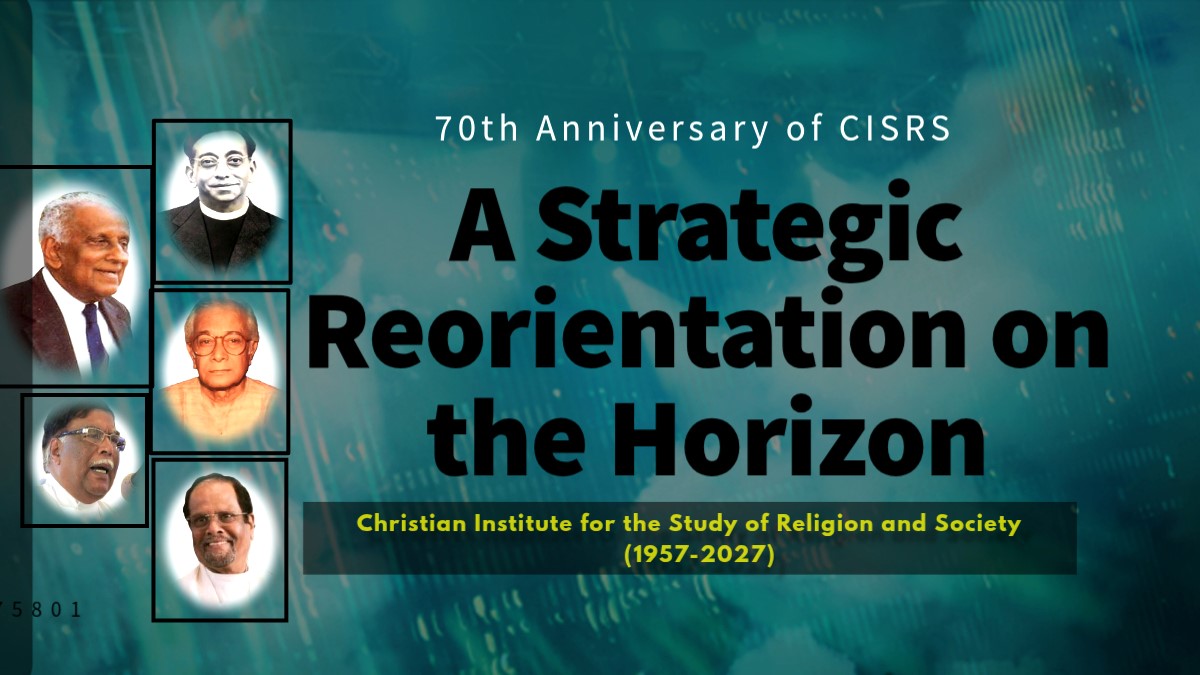
This short reflection is written in the context of the 70th anniversary of the Christian Institute for the Study of Religion (CISRS), which will be celebrated in 2027. Over these seven decades, the institute has aimed to provide Christian communities with a theological foundation for their social engagement.
The formation of CISRS in the 1950s was driven by the question of how faith intersects with ideology and how the church can embody social responsibility. One of the significant moments was M.M. Thomas’ presentation entitled “Social Manifesto for the Church” in 1943.[1] The ideas emerging from this reflection have influenced various discourses within Indian and Asian churches, as well as on global ecumenical platforms.[2]
From its inception, CISRS has maintained the vision that the church's social embodiment is not just a social concern, but a fundamental aspect of the Christian faith. M.M. Thomas, one of the founders of CISRS, articulated this idea in his work Salvation and Humanisation. [3] T. M. Philip articulates the content of this discourse as “the encounter between faith and ideology.”[4]
For Thomas, the Christian faith is centered on the life and witness of Jesus Christ, who lived responsibly. Christ urges the church to move beyond isolation and self-containment, encouraging it to engage with the world's questions. Ideologies are the worldviews that motivate groups to attend to the world's questions and work toward the transformation of society. The church exists at the intersection of the sacred and the secular, the Word and the world, faith and ideology. This intersection of faith and ideology allows the church to oppose the status quo while preventing social ideologies from stagnating and becoming authoritarian.
Thomas emphasized that a faith lacking an encounter with social ideology risks devolving into self-righteouness and fundamentalism. Conversely, he argued that an ideology that is entirely disconnected from any genuine encounter with religious faiths may lead to totalitarianism. Therefore, he advocated for their continuous interaction and envisioned a theological framework that resists any totalitarian scheme of salvation. Faith, as he imagines, is an energy within that nullifies the culture of stagnation and totalitarianism.
These ideas are further explored in CISRS publications such as Ideological Quest within Christian Commitment 1938-1958 (1980), Secular Ideologies of India and Secular Meaning of Christ (1976), and Faith and Ideology in the Struggle for Justice (1984).[5] The relationship between faith and ideology is clearly explained in these texts, and CISRS’s dedication to engaging in the human struggles for freedom and justice is effectively articulated.
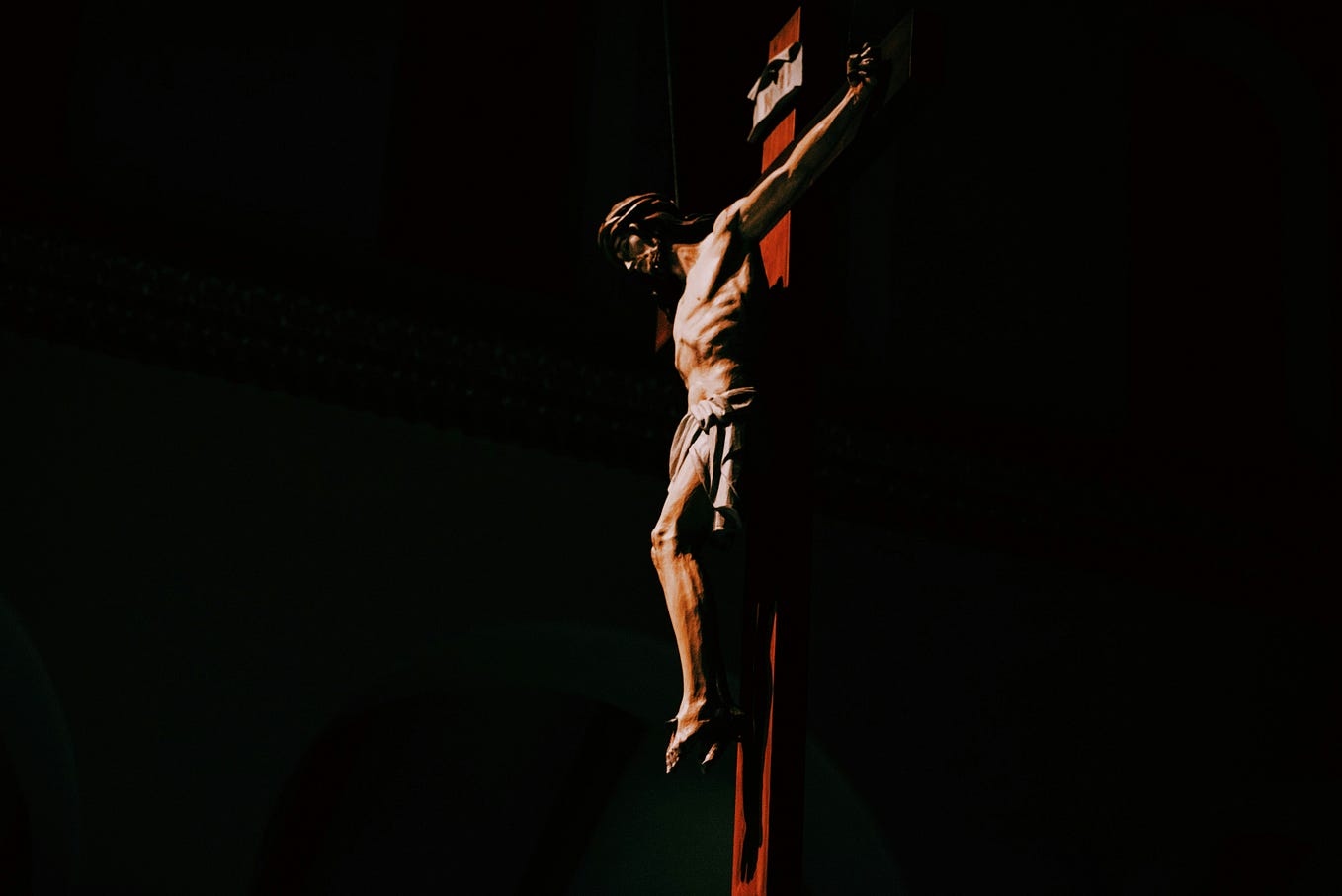
What does it mean to experience an interface between faith and ideology? For Thomas, this interface is represented by the cross of Jesus Christ. He situates the cross of Jesus Christ as an internal process of differentiation (Gilles Deleuze) or deconstruction (Jacques Derrida) or weakening (Gianni Vattimo)—specifically regarding identity, tradition, liturgy, hierarchy, patriarchy, and caste.[6] This process of weakening deconstructs both faith and ideology, allowing them to become open, fluid, and emerging.
In this context, salvation signifies a radical openness to the other, offering a new way of being and becoming. The process of becoming demands the de-othering of the other, reorienting of the self, and navigates toward a culture of new humanity. However, this eschatological process of forming a new human community—referred to by Thomas as Humanisation—is not simply an apocalyptic event or an abstract social project; rather, it is a messianic experience that is felt today through participation in the struggles of marginalized communities.
Thomas emphasizes that “the cross serves as the focal point of Christian faith, symbolizing the spiritual opening of our hearts to the cries of victims in response to the passion of God.” [7] Christian faith, as articulated by Thomas, embodies a weak thought that aligns with Giorgio Agamben’s concept of the inoperability of sovereign power.[8]
John D. Caputo characterizes the cross of Jesus as a manifestation of the weakening of God, envisioning Christianity as a community that embodies this weakness.[9] Jean-Luc Nancy further deconstructs Christianity and defines it as a dis-enclosed community.[10] Building on this, radical political theology brings attention to the lived experiences of the faithful, who use their faith to create ethical discourses that challenge the dynamics of power within and beyond their communities.
Thomas elaborates on this by stating, “Political theology translates this understanding into recognizing the situations of victims and pursuing ways to transform those situations. In this way, faith necessitates ideology in the struggle for justice.” [11] M.M. Thomas's political theology introduces a “parallax gap”—a site of differance[12]—between between faith and ideology, church and society.[13]
This radical political theology repositions faith as post-theological and ideology as both post-ideological and post-secular. In its most radical form, faith establishes a “parallax gap” between the church and society, promoting an enduring secular koinonia in the present world. CISRS seeks to function as a visionary research community, aimed at renewing the relationship between faith and ideology, which calls for more in-depth studies and critical social engagements.
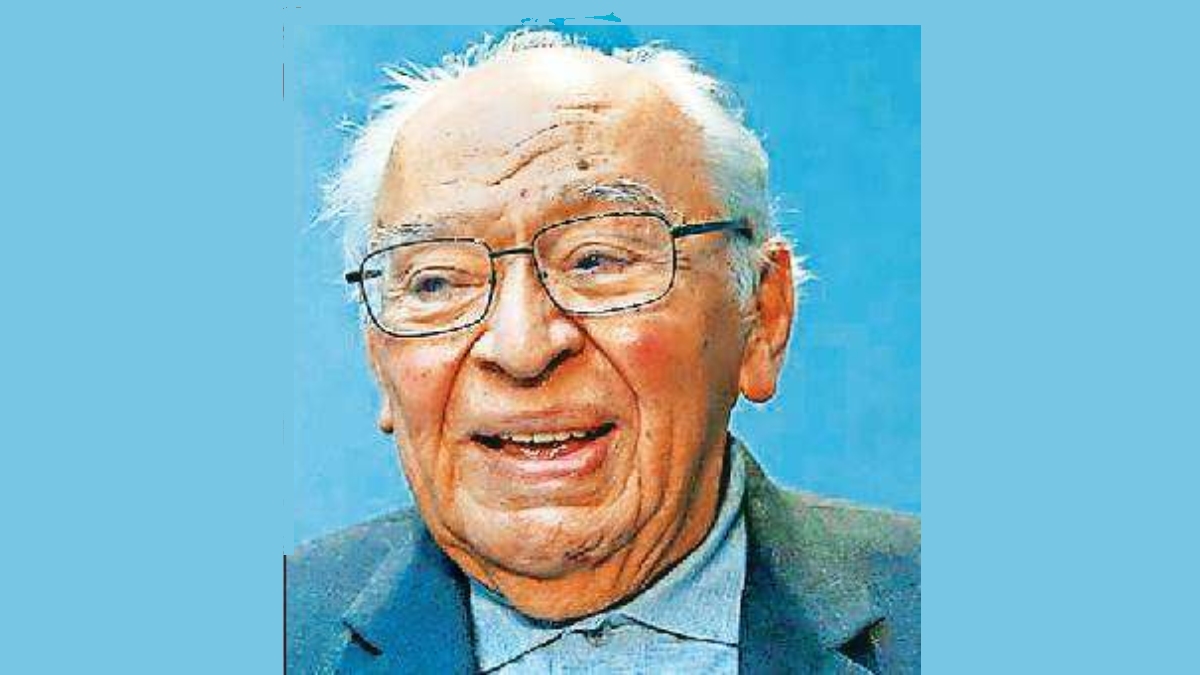
Y.T. Vinayaraj
Director, CISRS
20.05.2026/ Bangalore
[1] The complete statement can be found in M.M. Thomas, Ideological Quest within Christian Commitment, 1939-1954 (Madras: CLS, 1983), 71-72.
[2] A. Frank Thompson, The Christian Institute for the Study of Religion and Society: A Research Arm of Christian Churches in India (Lewiston: The Edwin Mellen Press, 1992).
[3] M.M. Thomas, Salvation and Humanisation (Madras: CLS, 1971; reprint, 2022).
[4] T. M. Philip, The Encounter between Theology and Ideology: An Exploration into the Communicative Theology of M.M. Thomas (Bangalore: The New Day Publications of India, 1986).
[5] M.M. Thomas, Ideological Quest within Christian Commitment 1939-1954 (Madras: CLS, 1983); M.M. Thomas, Secular Ideologies of India and Secular Meaning of Christ (Madras: CLS, 1976); M.M. Thomas, Faith and Ideology in the Struggle for Justice (Bombay: Build, 1984).
[6] M.M. Thomas, Risking Christ for Christ’s Sake: Towards an Ecumenical Theology of Pluralism (Geneva: WCC Publications, 1987), 119.
[7] T. M. Philip, The Encounter Between Theology and Ideology, 114.
[8] Giorgio Agamben, Potentialities: Collected Essays in Philosophy (Stanford: Stanford University Press, 1999).
[9] John D. Caputo, The Weakness of God: A Theology of the Event (Bloomington: Indiana University Press, 2006).
[10] Jean-Luc Nancy, Dis-Enclosure: The Deconstruction of Christianity (New York: Fordham University Press, 2008).
[11] T. M. Philip, The Encounter Between Theology and Ideology, 114.
[12]Jacques Derrida’s concept of différance is a brilliant and fundamental concept in deconstruction. It describes how words and signs do not have inherent or fixed meanings. Instead, meaning is constantly produced through two dynamics: it relies on its difference from other words, and it is endlessly deferred (postponed) along a chain of other signifiers.
[13] The Slovenian thinker Slavoj Žižek’s concept of the “parallax gap” illuminates the nexus between faith and ideology. Žižek defines parallax as a “constantly shifting perspective between two points [between] which no synthesis or mediation is possible.” See Slavoj Zizek, The Parallax View (Cambridge: MIT Press, 2006).
Become a member
Get the latest news right in your inbox. We never spam!




Comments
No Comments