
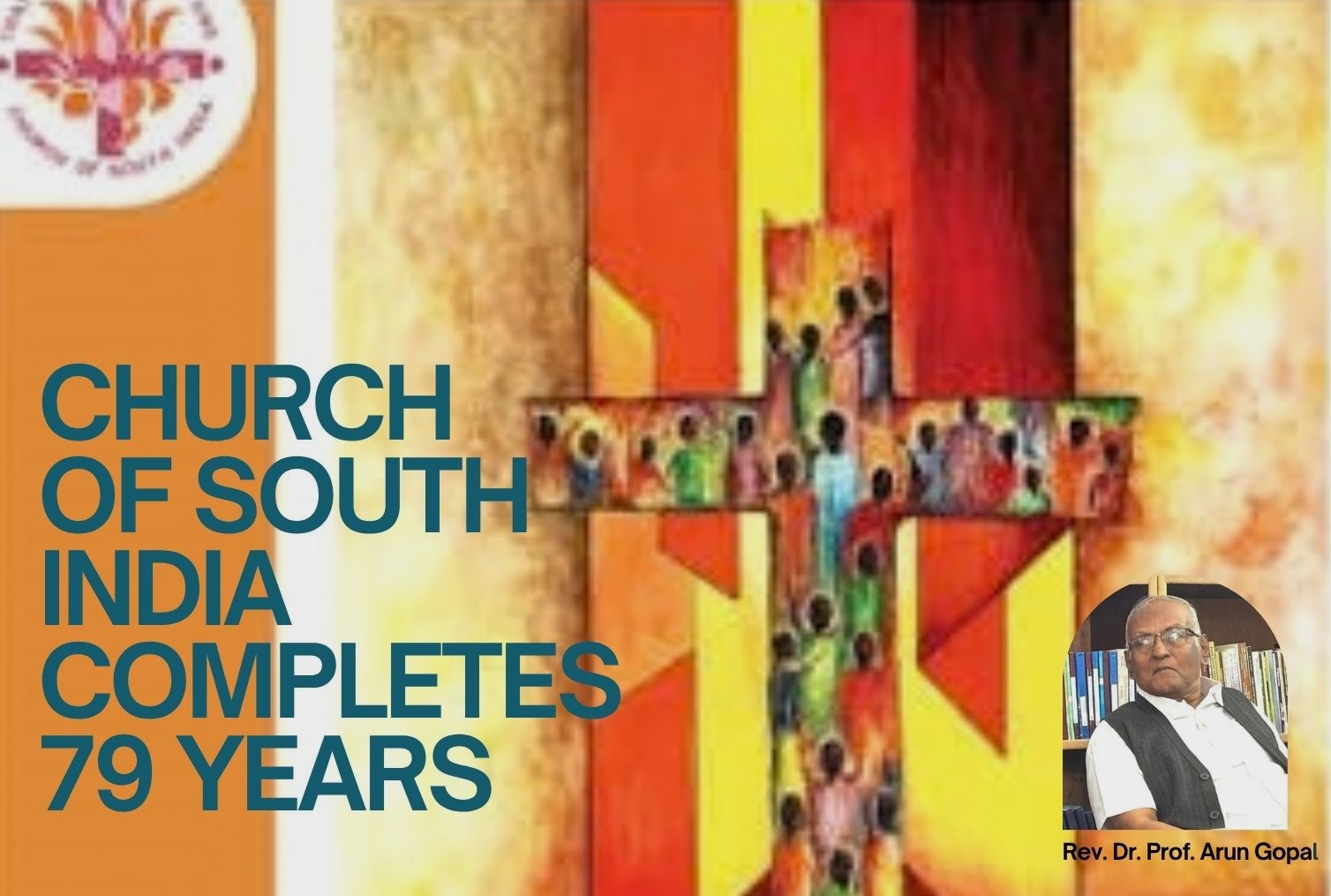
Church of South India completes 79 years
Rev. Dr. Prof. Arun Gopal
On September 27, 2026, the Church of South India (C.S.I.) observed its Formation Day with solemn Eucharistic celebrations, Thanksgiving Services featuring special liturgies, and community gatherings. This event was attended by nearly 4.7 million communicants worshipping in 14,500 congregations across 26 dioceses. It was a heartwarming experience to reflect on the prayerful, concerted, and dedicated efforts of the missionary statesmen and indigenous leaders who were the architects of the Church of South India. This occasion also served as a sacred moment to retrace, re-envision, and reaffirm our commitment to the ongoing “Faith Journey” of the C.S.I. as a Church for India and in India.
At the C.S.I. Synod Secretariat in Chennai, the “CSI Day” celebrations were presided over by the Moderator, the Most Rev. Dr. K. Ruben Mark, with assistance from the Deputy Moderator, the Rt. Rev. V.S. Francis. The program was planned and coordinated by the General Secretary, Adv. C. Fernandez Rathina Raja, and the Treasurer, Dr. B. Vimal Sukumar. Representatives from about 350 C.S.I. dioceses attended the event. Simultaneously, each diocese held Eucharistic Services led by both male and female presbyters in their parishes, with sermons and exhortations focusing on the mission, ministry, and witness of the Church of South India in contemporary Indian society.
The Church of South India was inaugurated on September 27, 1947, an event hailed as the “Second Pentecost.” On that day, four denominational traditions that had existed independently for centuries united to form one “United Church” through an organic union. A distinctive feature of this union is the amalgamation of both Episcopal and non-Episcopal traditions. The guidance of God, the Holy Spirit, has been evident since missionaries from different Protestant denominations began to meet regularly starting in 1850 to explore greater understanding, cooperation, and the comity of missions.
This foundational vision is articulated in THE BASIS OF UNION, which states: “The Uniting Churches believe that the unity of His Church, for which Christ prayed, is a unity in Him and in the Father, through the Holy Spirit, and is therefore fundamentally a reality of the spiritual realm.” This sentiment is further emphasized in the GOVERNING PRINCIPLES OF THE CHURCH, which asserts, “It believes that the Holy Spirit has guided those churches into this union so that evangelization may be fulfilled more effectively, in accordance with Christ's prayer that through the unity of His disciples, the world might know that He was sent to be its Savior.”
It is important to recognize that while acknowledging the decisive action of God, the Holy Spirit, in achieving visible and organic union in South India, the architects of the Church of South India envisioned the fulfillment of two broader purposes. First, the newly formed C.S.I., through the union of the South India United Church (SIUC)—which itself was a union of the Congregational (LMS) and Presbyterian churches, the South India Province of the Wesleyan Methodist Church, and the Church of India, Burma, and Ceylon (CIBC) from the Anglican tradition—was meant to be, as stated in THE BASIS OF UNION, a “true leaven of unity in the life of India,” facilitating a greater release of divine power for fulfilling God’s purpose in the world. In essence, the C.S.I. was inaugurated in 1947 with the expectation of nurturing the spirit of unity among all churches in India and around the world, ultimately fostering a sense of one family under heaven for all of humanity.
The second objective of this organic union, articulated by Rev. J.S.M. Hooper in his inaugural sermon, was to address the challenges faced by those of us in the world tasked with proclaiming the reconciling grace of God to all. He stated: “...we who are in the world to proclaim the reconciling grace of God to all men have been unable to agree among ourselves… The ‘bitter political and religious animosities,’ competitions, rivalries, and caricatures of one another’s missionary strategies have not only deterred us from fulfilling the ‘Great Commission’ but have also hindered people from knowing that God sent His Son into the world to be its Savior.”
As outlined by Rufus Anderson, Secretary of the American Board of the Reformed Churches, in 1854, there was a need for a paradigmatic shift from “Mission to Church” in India. The prospective Church in India was envisioned to be a “Self-Propagating, Self-Supporting, and Self-Governing Church.” Four major events contributed to the emergence of the Church of South India: (1). The South India Missionary Conference of 1900 held in Madras; (2) The 1919 Tranquebar Conference of the Indian and Overseas Representatives of the Lutheran, Methodist, Anglican churches, and the South India United Church; (3) The Lambeth Quadrilateral of 1920; (4) The appointment of the Joint Committee and its seven meetings from 1920 to 1942.
The faith affirmation of those gathered for the inaugural service on September 27, 1947, was that this great accomplishment was the result of nearly 50 years of prayer from 1900 to 1947 within all participating churches. While union negotiations were gaining momentum, ecumenical agencies such as the Christian Literature Society, Christian Endeavour Union, Young Men’s Christian Association, Student Christian Movement, Indian Missionary Society, and National Missionary Society, under the leadership of Sherwood Eddy, Bishop V.S. Azariah, K.T. Paul, C.J. Lukas, G.V. Job, A.J. Appasamy, and V. Santiago, contributed significantly to the growth and development of ecumenism. Additionally, institutions such as Madras Christian College, Tambaram, Women’s Christian College, Madras, United Theological College, Bangalore, and Jaffna College, North Ceylon, acted as unifying forces. It is noteworthy that several overseas and Indian leaders used these platforms for joint ventures and collaborative efforts.
Although this history is significant, I will not delve into the specific dates on which each of the Uniting Churches approved the Scheme of Union and how their cherished practices and doctrinal issues were respectfully examined to reach a consensus. Relevant resources are available in theological libraries, and the following books may be referenced: (1) Bengt Sundkler, Church of South India – Movement Towards Union 1900 – 1947 (1954); (2) Eugene P. Heideman, From Mission to Church – The Reformed Church in America Mission to India (ND); (3) C. B. Firth, Introduction to Indian Church History (1968); (4) J.W. Gladstone (Ed.), United to Unite – History of the Church of South India 1947 – 1997 (1997); (5) Rajaiah D. Paul, The Cross Over India (1952)
Interestingly, since its inception, the Church of South India (C.S.I.) has sought union negotiations with the Lutherans, the Methodist Church in Southern Asia (American Methodists), and the Mar Thoma Syrian Church. Significant historical documents include the C.S.I.–Lutheran theological conversations from 1948 to 1955, and the 1969 report of the Inter-Church Commission of the five South Indian Lutheran churches (A.E.L.C., S.A.L.C., T.E.L.C., A.L.C., and I.E.L.C.), which produced “The Constitution of the Church of Christ in South India.” However, these negotiations did not advance due to a lack of consensus on doctrinal issues, and the Methodist Church in Southern Asia has stated that it is not yet ready for union discussions. Nonetheless, the C.S.I., C.N.I., and Mar Thoma churches have achieved conciliar unity, joint programs, inter-communion, and mutual recognition of each other's ministries. From the beginning, the C.S.I. has been in ecumenical partnership with the Roman Catholic Church in India, engaging in various academic, theological, social, religious, and political initiatives.
The C.S.I. model of organic union contributed to the formation of the Church of North India in 1970. Notably, both the Baptists and the Disciples of Christ are part of this Union. The majority of Congregational and Presbyterian churches, along with all churches of the Methodist traditions, contributed to the formation of the Uniting Churches in Australia in 1977. The union negotiations between the C.S.I. and C.N.I. are progressing steadily, and it is hoped that, in God’s providence, there will one day be a Bharat Church of India.
(Rev. Dr. Prof. Arun Gopal is a retired presbyter of the C.S.I. Madras Diocese, former director of the C.S.I. Synod Department of Christian Education, and former professor of Christian Education at Pacific Theological College, Suva, Fiji Islands. Until recently, he was a visiting faculty member at the United Theological College, Bangalore, and Gurukul Lutheran Theological College, Chennai.)
Become a member
Get the latest news right in your inbox. We never spam!



Comments
No Comments