
INTERNATIONAL SEMINAR
On
Kerala Christianities
Reimagining Community & Identity
A REPORT
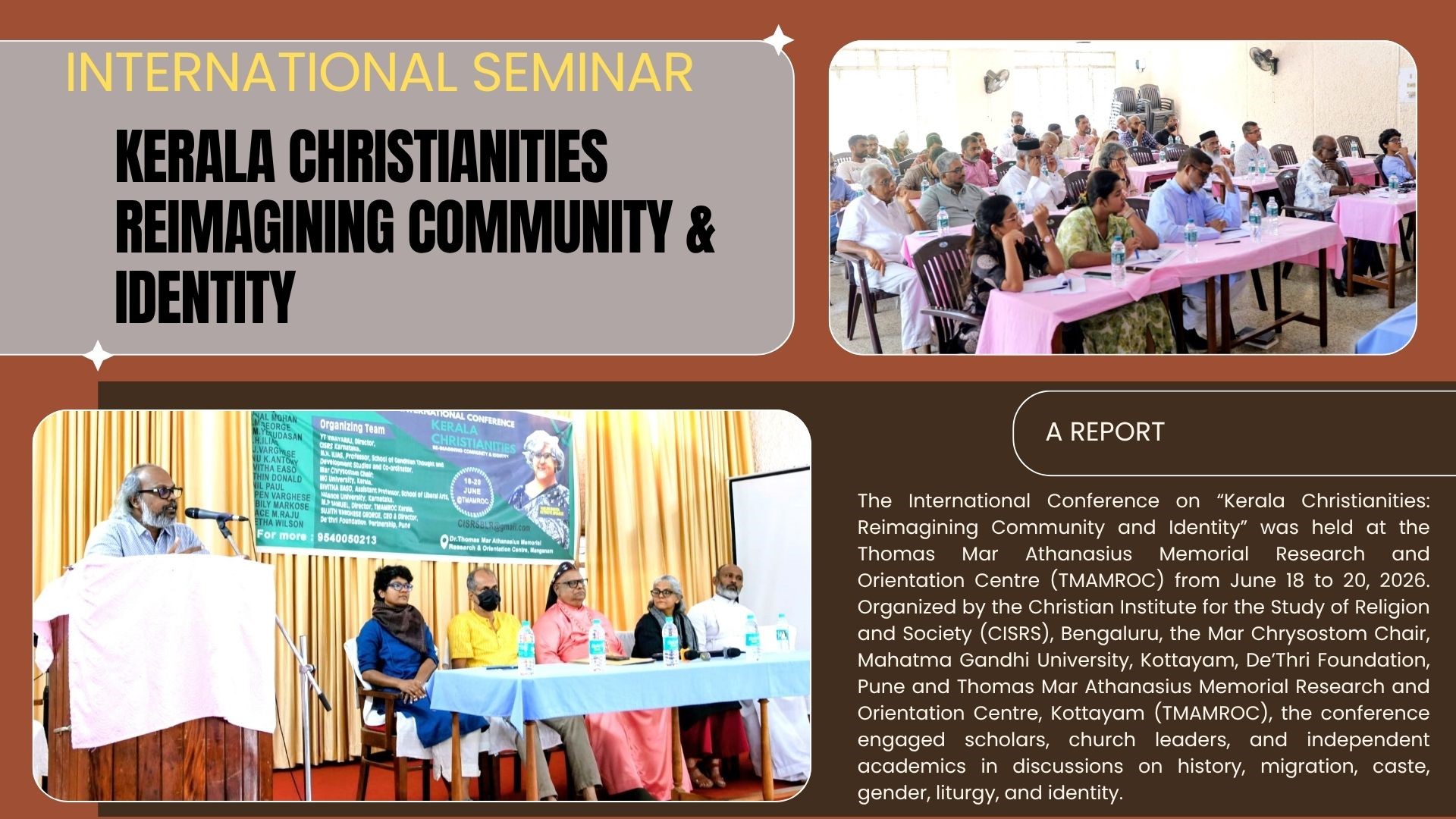
The International Conference on “Kerala Christianities: Reimagining Community and Identity” was held at the Thomas Mar Athanasius Memorial Research and Orientation Centre (TMAMROC) from June 18 to 20, 2026. Organized by the Christian Institute for the Study of Religion and Society (CISRS), Bengaluru, the Mar Chrysostom Chair, Mahatma Gandhi University, Kottayam, De’Thri Foundation, Pune and Thomas Mar Athanasius Memorial Research and Orientation Centre, Kottayam (TMAMROC), the conference engaged scholars, church leaders, and independent academics in discussions on history, migration, caste, gender, liturgy, and identity. It emphasized that Kerala Christianity is a diverse and evolving field rather than a single tradition. A total of 60 participants registered, representing universities, church organizations, and independent researchers.
Inaugural Session
Dr. M. H. Ilias, the coordinator of the Mar Chrysostom Chair at MG University in Kerala, spoke briefly about the establishment of the Chair in memory of the Most Rev. Dr. Philipose Mar Chrysostom, the Mar Thoma Valiya Metropolitan of the Malankara Mar Thoma Syrian Church. He explained that the conference aims to provide an important platform for exploring the analytical, theoretical, and methodological dimensions of the study of religion, while also creating space to engage with experiences and perspectives that have often been marginalized in academic discourse.
Dr. Y. T. Vinayaraj, Director of the Christian Institute for the Study of Religion and Society (CISRS), welcomed the gathering and recalled that the conference originated from a conversation he had with Dr. Ilias regarding the Christian Institute for the Study of Religion and Society’s current focus on publishing a handbook of Indian Christianity. In his address, he emphasized the complexity of studying Christianity as both a religious and social phenomenon, raising questions about how Christianity can be understood and defined. He noted that Christianity of India presents unique complexities shaped by historical and theological tensions.
The Most Rev. Dr. Theodosius Mar Thoma, Metropolitan of the Malankara Mar Thoma Syrian Church, inaugurated the three-day international conference by commending the efforts of the organizing team. The Metropolitan observed that Christianity in Kerala is a rich tapestry woven from diverse traditions, ranging from the heritage of St. Thomas Christians and European missionary influences to the experiences of indigenous communities, migrants, and other groups. He asserted that Christian identity cannot be reduced to a single narrative; instead, it is better understood through processes of encounter, adaptation, and transformation.
Dr. Bivitha Easo outlined the conference by posing critical questions about the study of Kerala Christianities. She encouraged participants to explore whether "Kerala Christianity" is a distinct field, along with its methodologies, challenges, and prospects. Emphasizing themes like migration, neo-capitalism, genealogies, and the relationship between Christianity and community, she called for interdisciplinary approaches. Easo stressed that Kerala Christianity encompasses diverse histories, identities, and experiences, and the conference aimed to address these complexities and emphasize the pluralities of Christianities in Kerala.
Keynote Address
In her keynote address titled "Rethinking the Study of Religion in India: Colonialism, the Nation, and Contemporary Publics," Varuni Bhatia reflected on the difference between practicing a religion and studying it as an academic discipline. She explained that when religion is examined within a secular university setting, it becomes a subject of critical inquiry, focusing on its history, texts, practices, and social significance rather than personal belief.
Bhatia traced the development of the academic study of religion back to the nineteenth century, discussing the contributions of scholars like Max Müller and the impact of colonial frameworks that classified religions into fixed categories. She also examined how Indian thinkers, such as Vivekananda and B. R. Ambedkar, responded differently to these frameworks.
Emphasizing the complexities and limitations of all academic disciplines, Bhatia argued that the study of religion must engage with its social realities, contradictions, and diverse expressions. In a pluralistic society like India, she highlighted the importance of cross-religious dialogue and advocated for a sociological approach that fosters greater understanding between communities, while also recognizing the challenges and complexities inherent in religious life.
Presentation
In her presentation, "Narrativization and Hybridisation as Techniques for Understanding Change," Susan Visvanathan explored how storytelling and cultural adaptation reveal social and religious transformations. She examined the interplay between inherited religious structures and modern forces such as secularization and migration. Focusing on St. Thomas Christian healthcare professionals, she highlighted how migration affects family life, gender roles, and the preservation of religious traditions, with women often taking on the responsibility for maintaining these practices. She addressed challenges faced by traditional churches, such as demographic decline and institutional rigidity, and called for alternative spaces for hospitality and community that adapt to a rapidly changing world.
In his presentation, "Writing History in the Context of Dalit Christianities," Sanal Mohan addressed the challenges of uncovering the histories of marginalized Dalit Christian communities. He argued that institutional histories often engage in a “silencing of the past” by overlooking caste oppression to present a more harmonious Christian narrative. By utilizing missionary archives and local biographies, he showed that Dalit Christians viewed conversion as a route to liberation rather than just adopting a new faith. His work emphasizes the importance of recognizing the lived experiences of caste slavery in understanding Dalit Christian identity and spirituality. Mohan advocates for a more inclusive historiography that acknowledges the resilience and agency of marginalized communities in Kerala’s Christian history.
In "The Impossible Fellowship," T. M. Yesudasan critically examines the ongoing caste-based exclusion within Christian communities. He argues that Dalit Christians face structural discrimination despite claims of spiritual equality from the Church. Employing various perspectives, he suggests that the Church often prioritizes metaphysical equality over real social justice, allowing entrenched inequalities to persist. The presentation highlights segregation in worship spaces, cemeteries, and endogamy, revealing the deep-rooted influence of caste. Engaging scholars like David Mosse, Ninan Koshy, and Susan Bayly, Yesudasan shows how caste remains embedded in ecclesial structures, denying Dalits recognition within the Church. He posits that their marginalized experiences challenge the Church to move beyond institutional barriers toward true justice, equality, and fellowship.
In his paper, "Making of the Purogamana Karshakan: Migration, Agrarian Expansion and the Re-creation of the Syrian Christian Community," V. J. Varghese examined the migration of Syrian Christians from Travancore to Malabar and its impact on community identity in modern Kerala. He argued that this movement resulted from changing socioeconomic conditions and colonial land policies, leading migrants to develop agricultural settlements and the ideal of the purogamana karshakan (progressive farmer). Varghese highlighted the Syro-Malabar Church's theological narratives that framed migration as a Biblical Exodus and explored how these themes contributed to anti-eviction struggles in the 1960s. His study emphasized that community identity is a dynamic process shaped by migration, labor, and social change.
The paper “In Transit”: Being Sojourners in a Syrian Catholic Transnational Mission, by Anu K. Antony, examines the identities and experiences of Syrian Catholic Malayali nuns involved in global missionary work. Based on fieldwork in England, Italy, and Peru, it highlights how these nuns view themselves as sojourners engaged in spiritual labor and awaiting fulfilment in the afterlife. The study contrasts the challenges faced in missions in England and Peru, including secularization, vocation shortages, cultural integration, and financial sustainability. It emphasizes that transnational networks rely on the flow of personnel and resources from the Global North to support ministries in the Global South. Despite different contexts, these congregations share a strong spiritual identity and mission that transcends borders.
Nidhin Donald's study, "Whose Kerala? Whose Christianity? Tracing Contradictions, Conflicts and Interests," investigates how social privilege and communal identity are maintained in Kerala's Christian communities. Focusing on a prominent Syrian Christian family, he analyses the roles of historical memory, family narratives, and church networks in preserving social status. The paper contrasts traditional elite identities, based on land and religious authority, with modern influences like education and global migration. While overt expressions of privilege have diminished, inherited social and cultural capital still affect access to opportunities and status, raising important questions about whose narratives dominate in Kerala Christianity.
In her paper, "Conscripts of a Caste Nation: Christians and the Making of ‘Permanent Minorities,’" Bivitha Easo explored how Syrian Christian identity in Kerala was shaped by colonial classifications, caste Hindu nationalism, and political modernity. She challenged the idea of a static Christian community, demonstrating how Portuguese, Dutch, and British colonial frameworks impacted the social standing of vernacular Christians, who claimed the title of “Old Christians” to maintain privileges. The study examined the community's shifting political alliances and their strategy of adopting minority rights language in democratic politics for representation, while at the same time excluding non-Syrian Christians from the same. While this approach provided some protection, it also led to a paradox where Christians co-scripted themselves as well as other minor communities as "permanent minorities," caught between integration and constraints imposed by the permanent majoritarian nation-state.
M. H. Ilias examined the evolution of the academic study of religion over the past thirty years, arguing that traditional views are inadequate for understanding contemporary realities. He noted that earlier approaches, which often relied on limited definitions, have been challenged by scholars like Clifford Geertz and Talal Asad, who emphasize the complex social, cultural, and political aspects of religion. Contrary to secularization theories, religion has not vanished but has become more visible in public life. Ilias advocates for more nuanced, interdisciplinary approaches to better engage with the role of religion in modern society.
Y. T. Vinayaraj, in his paper on Kerala Christianity, critically examined the philosophical and theological assumptions shaping its identity. Drawing on Jean-Luc Nancy’s thought, he argued for viewing Christianity as a dynamic reality composed of diverse histories and experiences, rather than a fixed-essentialist tradition. He called for deconstructing inherited theological frameworks that overlook social issues like caste discrimination and gender inequality. By engaging with Nancy’s concept of “dis-enclosure,” he suggested that Christian identity should emerge from openness and relationality. The paper also questioned the theological implications of multiple genealogies in Kerala Christianity and considered alternative Christian perspectives, like those of B. R. Ambedkar, for fostering inclusivity and justice.
In "In Between Memory and Memorials: Christianity and Popular Culture in Kerala," Ambili Anna Markose examined the interplay between collective memory, public commemoration, and Christian expressions in Kerala. The study distinguished between lived memories within communities and memorialized forms in monuments, festivals, and rituals. It highlighted how Christian histories and identities are continuously reconstructed through popular culture, demonstrating that multiple memories and traditions shape contemporary Christian self-understanding. Ultimately, the paper emphasized the vital role of popular culture in linking history, faith, and identity in Kerala.
In her paper, "Iberian Catholicism and Latinisation of Indian Christians," Grace Mariam Raju explored the relationship between colonial expansion and missionary activity in forming Latin Catholic communities on the Malabar and Coromandel coasts. She focused on St. Francis Xavier's missionary efforts, arguing that conversion was influenced by local communities' strategic choices, as seen with the Paravas, who adopted Christianity for Portuguese protection and social mobility. Raju highlighted Xavier's criticism of colonial corruption while demonstrating how local converts shaped their Catholic identity by blending maritime customs and indigenous traditions. The paper illustrates Latin Catholicism in India as a result of negotiation and adaptation among imperial, missionary, and local influences.
The paper, "Sacred and Secular Selves: Gospel, Modernity, and the Life Worlds of Christian Women in Kerala" by Eappen Varghese, explores how Christian women in Kerala used the Gospel to forge new identities and engage socially within a modern context. Analyzing the lives of Mariyamma Poulose, Elizabeth Devakiamma, and Kandamma Varghese, the study highlights how these women leveraged Christian values of dignity, freedom, and education to challenge social norms through preaching, literacy, and social reform. It argues that the Gospel was crucial in intersecting faith and modernity, allowing women to envision alternative existences and contribute to transformation in Kerala.
In another paper, "Surviving Nodes: Kerala Christianity and the Remains of a Wider Dispersed Network," Sujith Varghese George critiques the notion of Kerala Christianity as an isolated tradition. He places it within a network of Christian communities that spanned the Indian Ocean and western India. The study examines how these communities navigated maritime trade and inland connections, and discusses the decline of Christian populations in places like Goa and Maharashtra due to vulnerabilities in port cities. By adopting a network perspective, the paper offers a broader understanding of Kerala Christianity’s role in a larger historical context.
Public Event
In her presentation, Geetha Wilson explored the history and cultural significance of Chavittu Nadakam, a unique dance-drama tradition from Kerala’s Latin Catholic coastal communities. She traced its origins to local interactions with Portuguese missionaries and highlighted its dramatic storytelling, vigorous dance, rhythmic footwork, and martial elements. Focusing on Karalman Charitham, a celebrated text, she examined its portrayal of Charlemagne and his knights as defenders of Christianity, emphasizing how the narrative transforms historical accounts into symbols of faith and communal identity.
R. Sunil’s photographic exhibition visually captured the lives of Chavittu Nadakam performers. The striking images contrasted the elaborate costumes of actors with the modest realities of their everyday lives, illuminating the relationship between performance, identity, and social experience. The exhibition showcased how Chavittu Nadakam serves as both a cultural expression and a space for marginalized communities to envision dignity and collective memory, prompting viewers to reflect on the tensions between representation and lived experience within Kerala’s coastal Christian communities.
Panel Presentations
Donel Varghese's paper, "Between the East and the Indigenous: The Palliyogam in Varthamanappusthakam (1786)," explored the Palliyogam's role in the Syriac Christian tradition in Kerala, examining its structure and significance in community governance and ecclesiastical authority. The study highlighted the interaction between local traditions and East Syriac structures, discussing the Palliyogam's decline within the Syro-Malabar Church and its implications for authority and lay participation.
Jomina C. George's research, "Missionary Mediations: Religion, Science and the Evolution of Kerala’s Rationalities," analyzed the impact of the missionary periodicals Rajyasamacharam and Paschimodayam in shaping rationality and modernity in nineteenth-century Kerala. She argued that these publications used science to promote Protestant Christianity while critiquing local beliefs, contributing significantly to Kerala’s modern public sphere.
Sijin M. George, in "Memory, Identity, and the Politics of Christian Performance in Kerala," explored how Christian identities are shaped by performance and memory, focusing on the dynamics of Syrian Christian and Dalit Christian communities. He examined how cultural performances reinforce social status while highlighting how Protestant interventions created spaces for Dalit Christian women to challenge dominant narratives.
Aleena Maria Felix's paper, "Genealogy of Migrant Narratives: Where Lies the Malayali Migrant Christian Woman?" challenged stereotypes surrounding Malayali Christian women migrants and nuns in Germany from the 1960s onward. Through film analysis, she emphasized their significant roles in shaping transnational Christian networks and called for a rethinking of migration narratives to recognize women's contributions.
Ashlin Subhash's paper examined the liturgical debates within the Syro-Malabar Church regarding the ad orientem mode of Eucharistic celebration and the revision of the Taksa. She explored the significance of eastward-facing worship as a symbol of communal identity and continuity, highlighting tensions between the push for liturgical uniformity and the diverse practices across dioceses. The analysis of responses from clergy, laity, and ecclesiastical authorities showed that the dispute reflects deeper concerns about authority, tradition, participation, and identity as the Church navigates its heritage in a changing context.
Saran Joseph Alexander's study on coffinless burial practices in Kerala's Catholic communities explored their historical evolution and contemporary significance. He argued that these practices reflect religious identity, social status, and communal memory while emphasizing humility and equality before death. The paper revealed how funerary customs are influenced by socio-political factors and changing cultural values, showcasing the struggle between tradition and modernity within Kerala Christianity.
Bobby Mathew examined the symbolism of the Slain Lamb in the Book of Revelation through a postcolonial lens. He argued that this image serves as a counter-imperial symbol that challenges oppressive power structures, reimagining victory through sacrifice. The study highlighted themes of justice, liberation, and identity formation, illustrating how this symbolism resonates with marginalized communities and offers theological resources for empowerment and social transformation.
Joby Mathew's presentation on Dalit Pentecostal hymnody explored how early- to mid-twentieth-century songs served as a medium of resistance and identity formation for marginalized Christian communities. Drawing on various composers, he demonstrated how these hymns challenged stigma and inequality while affirming dignity and hope. The paper argued that these devotional songs not only expressed piety but also empowered oppressed communities to resist exclusion and construct alternative narratives of faith.
Valedictory Session
Rt. Rev. Thomas Mar Timotheos, Bishop of the Kottayam–Kochi Diocese, delivered the valedictory address at the conference. He emphasized that academic engagement should lead to meaningful transformation in the Church and society, urging participants to integrate the discussions into their respective contexts. He highlighted the importance of dialogue and collective responsibility, expressing gratitude to all involved. The conference concluded with the Bishop’s blessing and a group photograph, marking the successful completion of the International Conference on Kerala Christianities.
Conclusion
The conference opened new avenues for understanding the diverse experiences of Christian life in Kerala. Presented papers highlighted the complexities of Christian histories and traditions, challenging participants to rethink established narratives. By engaging with themes such as caste, migration, and social transformation, the conference reinforced that studying Christianity involves addressing contemporary issues of justice and community.
Prepared by:
Joseph K. Thomas & Shijil Mathews Oommen
Research Scholars, FFRRC, Kerala
20th June 2026
Become a member
Get the latest news right in your inbox. We never spam!


Comments
No Comments