
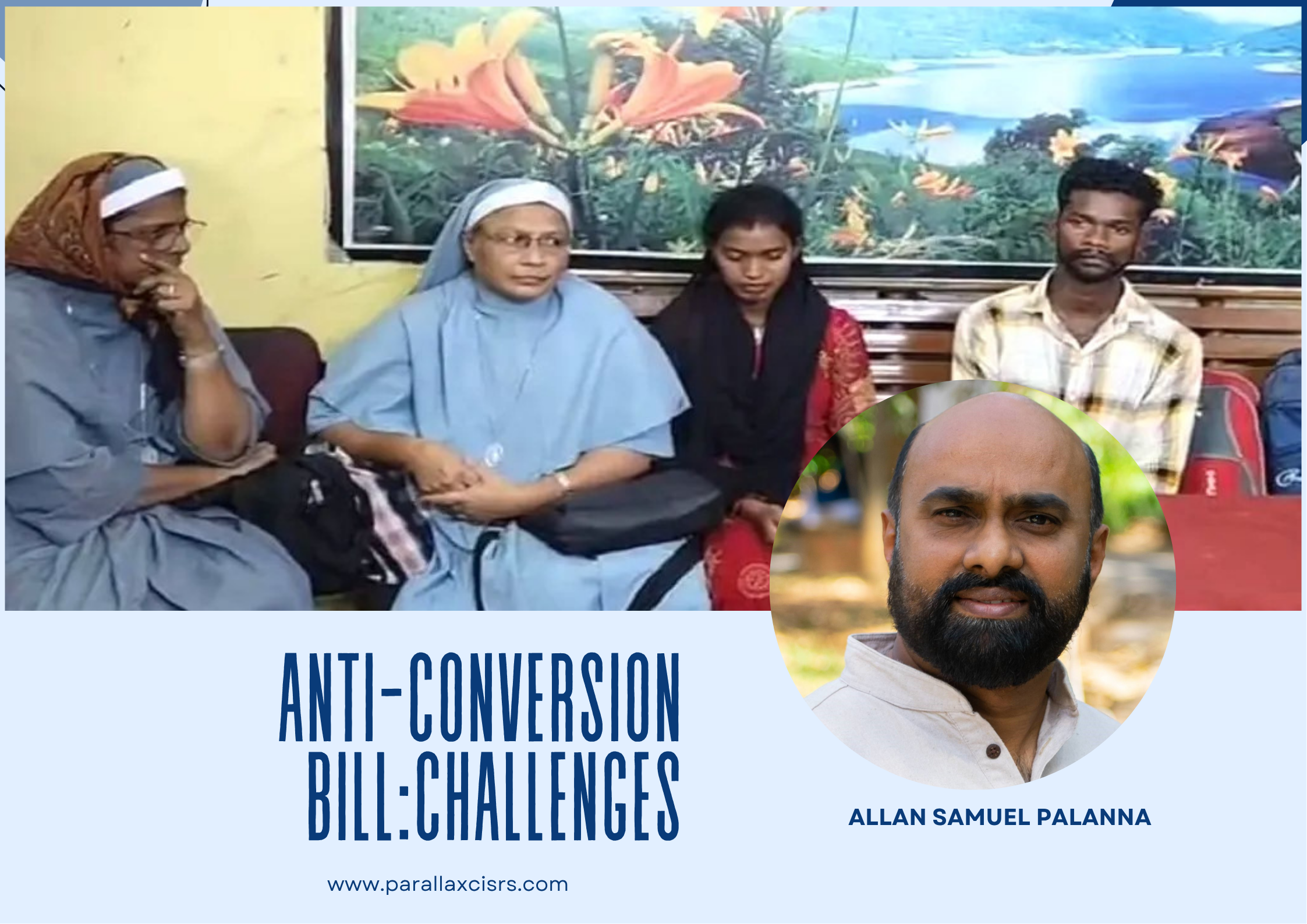
On July 25, 2025, two Kerala-based Catholic nuns were arrested in Chhattisgarh on charges of trafficking and forced conversion, highlighting ongoing misuse of anti-conversion laws. Allan Samuel Palanna’s earlier critique, written during Karnataka’s 2022 anti-conversion law, remains timely as cases persist despite the law’s 2023 repeal. From May 2022 to June 2024, 30 cases, mostly against Christians were filed under the repealed law. Though no new legislation has replaced it, authorities confirmed in 2025 that investigations into cases may continue. It was first published in Religion & Scoeity Vol. 67 No 3, September 2022.
Challenges for Churches in India in the Context of the
Anti-Conversion Bill (2022) in Karnataka
Allan Samuel Palanna
The Indian context has manifested itself as a rainbow of religious practices through the ages. It is, arguably, one of the few places in the world where widespread religious exchanges and religious experiences are inextricably linked to the fabric of society. Therefore, it is imperative that any pursuit of religious understanding needs to seriously consider the practices that emerge from the religious experiences of communities in India. There may be broad suspicions about the functioning of particular religions and of negation of religious practices. Notwithstanding the possibilities of such directions, religion, most particularly, Christianity in India has continued to offer identity and space to proclaim and practice alternative ways of life that have always been the mode of spirituality, especially of vulnerable communities.
Conversations on (Con)Versions
The question of (anti)conversion has echoed strongly in both pre-independent and post-independent India. Laws have always been promulgated even in pre-independent India such as the Raigarh State Conversion Act of 1936 or the Patna Freedom of Religion Act of 1942 which sought to ban forms of conversion even in British-ruled India.
If we were to agree with Carson’s view that “every culture and every age necessarily displays some tolerance and some intolerance”[i], we also need to assess the areas where certain sections of society through the State machinery involve in intolerance. The classic work by René Girard, Violence and the Sacred[ii] is perhaps one of the most significant contributions to the analysis of violence. Girard contends that human societies devise ways and means to victimize their fellow human beings due to an inherent desire for violence, both direct and indirect. Such direct and indirect violence against minorities, especially the Christian community in India may be perceived through, direct and indirect against lawful gathering for worship, FCRA (Foreign currency regulation act) withdrawal from various minority organizations, restriction on religious printed material, restriction on worship, building places of worship and organized congregations, systematic withdrawal of Christian material from educational books and narratives of national history and events, exaggerating Church and institutional shortcoming in social media and passing of various anti-conversion laws targeted towards the Christian community.
India has seen a slew of anti-conversion laws being passed through history. An erroneous suggestion that is generally put forth is that conversion was historically a colonial enterprise since the British government supposedly encouraged missionaries to destabilize Indian society. In continuity to this deeply held misreading of history, conversion is now perceived as a neo-colonial agenda seeking to disturb the peace and stability of the nation. Rajiv Malhotra and Aravintan Nilakantan’s Breaking India: Western Interventions in Dravidian and Dalit Faultlines or Arun Shourie’s Harvesting Our Souls: Missionaries, Their Design, Their Claims[iii] are instances of a growing literature of hatred and unfounded claims against Christians and their supposed ‘conversion’ agenda in India. The Postcolonial theoretical assumptions emerging from Bhabha or Spivakian thought which have largely influenced subaltern sociological and theological affirmations are now ironically being (mis)used to serve the dominant Hindutva agenda.
In her brilliant analysis, Sylvie Guichard exposes the current assimilation and co-option of the Postcolonial discourse into a Hindutva discourse.[iv] The emerging campaign “Hindu lives matter”[v] is a skewed interpretation of the BLM (Black lives matter) movement by co-opting the movement’s ideological principles into a rhetoric that minoritizes the majority and majoritizes the minority in India. Spivak had foreseen this danger, prompting her to warn that “many people want to claim subalternity. They are the least interesting and the most dangerous.”[vi] Christians are referred to as “rice bags” in common demeaning terms in the social media today. Churches and church-based institutions are perceived as vestiges of colonialism or continuing the colonial agenda of covert religious occupation through force, fraud or allurement. However, this was not the case as the missionaries often found it difficult to continue their mission due to the lack of support from the authorities.[vii] It has to be reiterated that the missionaries were often met with opposition and lack of support by the colonial British presence in India since the east India company and the later British governments did not want any disturbance to their business-oriented colonial enterprise in India.
Problematic Antecedents of the Anti-Conversion Acts in India
Anti-Conversion Acts have been ideologically encouraged to be brought by the governments ideologically shaped by the rightist nationalist organizations. There needs to be pointing out that the various States are bringing anti-conversion Bills and ordinances in order to circumvent the Parliament since numerous attempts to bring an Anti-Conversion Act in Parliament has not yet yielded results. These laws interestingly do not necessarily ban conversion per se. However, these laws seek to highlight the supposed illegality of the process of conversion through often broad ranging definitions of fraud and allurement. What is often emphasised in support of such laws is that there is a claim of universality i.e., that such laws are equally applicable to all religions. Robinson and Clarke point to the fact that somehow the term ‘conversion’ is directly attributed to only Christians and in some cases, Islam.[viii] Interestingly, conversion to Hinduism is indicated as mere Ghar Wapsi (homecoming) in the public narrative.
Article 25 which is often quoted/misquoted to uphold the right of ‘freedom of conscience and free profession, practice and propagation of religion’ also has adjoining clauses that are conditional. For instance, the freedom to profess, practice and propagate religion comes with clauses and further restrictions which include ‘public order’, ‘health’ and ‘morality’. Therefore Article 25 is not absolute and is open for interpretations. The case of particular concern is the 1977 Stanislaus Vs the State of Madhya Pradesh wherein the Supreme Court ruled that States are free to promulgate anti-conversion laws since it relates to public order and necessarily to religion. The judgement of this case, in fact, invalidated and diluted the essence and the spirit of Article 25 in its entirety by highlighting the conditional clauses. By doing so, the Supreme Court directly brought the entire argument to ‘sustenance of public order’. It deftly allowed local authorities to determine the concept and interpretation of public order and morality.
In 2015, the Union Law ministry had submitted that the Government does not have the provisions to table Anti-Conversion Act.[ix] It may be recalled that earlier attempts such as Indian Conversion (Regulation and Registration) Bill-1954, Backward Communities (Religious protection) Bill-1960, Freedom of Religion Bill-1979 have not be successful. Hence the various States have consistently brought forth Acts and Bills on anti-conversion such as the Orissa Freedom of Religion, 1967, Madhya Pradesh Dharma Swatantraya Adhiniyam 1968, Arunachal Pradesh Freedom of Religion Act 1978, Tamil Nadu Prohibition of Forcible Conversion of Religion Act 2002, Gujarat Freedom of Religion Act, 2003, Himachal Pradesh Freedom of Religion Act, 2006, Rajasthan Dharma Swatantraya Bill 2008, Uttarakhand Freedom of Religion Act 2018 and Uttar Pradesh Prohibition of Unlawful Conversion of Religion Ordinance/Act 2020. Another irony is that most of these Acts and Bills are erroneously named with the misnomer, “Freedom of Religion” These are certainly everything else other than the freedom to choose. Certain preliminary questions need to be posed regarding the context of anti-conversion laws:
- To what extent can/should a country regulate the personal choices of individuals as regards religion?
- What is the constitutional validity of these discriminatory laws?
- Are the provisions of the Constitution made redundant or irrelevant at the State level?
- What are the social, political and economic inequalities that ‘force’ people to convert to another religion?
- How do we understand terms such as secularism, freedom of religion and freedom of conscience? and finally,
- Are such anti-conversion laws a dominant caste agenda to further vigorously solidify the caste hierarchy and make it an inescapable entity?
The Karnataka Protection of Right to Freedom Bill (2022) and its Hidden Transcripts
The Karnataka Protection of Right to freedom Bill (2022), was first tabled in the Karnataka State Assembly on December, 2021 and passed in the State Assembly on December, 23rd, 2021. The fact that it was passed through a “voice vote” also ironically points to the fact that the majority voices often drown the unheard voices of the masses. The Karnataka Governor Thaawarchand Gehlot on 17th May, 2022 gave his assent to The Karnataka Protection of Right to freedom Bill (2022) ordinance. The Bill was finally passed by the Karnataka Legislative Council on 15th September, 2022. A preliminary reading of the Bill[x] suggests the following:
i. The phrase, “It shall come into force at once” (S.1.2) which introduces the Bill itself sounds undemocratic, without recourse or indication of the legislative process needed to pass the Bill.
ii. The definitions (S.2.1) that are articulated isolates the context as it claims, “unless the context otherwise requires” and lists categories through broad ranging, unspecific and vague terminologies such as Allurement [2(1)(a)], Coercion [2(1)(b)], Force ([2(1)(d)] Fraudulent [2(1)(e)], Marriage [S.6], Institutions [S.10] that offer enough room for persons with misguided interpretations and mala fide motives to act with the able support of the Bill.
iii. The draconian aspect of the Bill is that it seeks to give unhindered license and emboldens anyone or any group with malicious intentions to violently interfere in any religious gathering on the pretext of reporting conversions. It further incentivizes the reporting of the purported act of conversion [S.4 and 5(2)], criminalizes contexts and acts (S.3, 6 and 10) and makes the procedure of prosecution simple and easy (S. 4 and 12).
iv. Read further, the Bill authenticates and normalizes acts of vigilantism that have been witnessed in recent years across India.[xi] The modus operandi of the vigilantes is generally identifiable as they tend to act as mobs and subsequent arrests are evaded due to the supposed unidentifiability of these violent groups.
v. The Punishment for contravention of provisions (S.5) with punishments ranging from 3 years to 10 years are built upon assumptions that marginalized communities are incapable of deciding their faith. It, therefore, is an affront to the dignity, privacy and equality of the subaltern communities. Such laws further stifle the voices of the people in the margins.
vi. Such Bills have an implicit suggestion that subaltern communities are not entitled to have their own perspectives. It is also suggested that they cannot think for themselves. This adverse understanding is perhaps obvious that the highest quantum of punishment reflected in the Bill is seeking to convert ‘a minor or a person of unsound mind or a woman or a person belonging to the Scheduled Caste or Scheduled Tribe.’[S.5(1)] By bringing the said groups under a common matrix, the Bill clearly makes a value judgement that the said groups cannot think for themselves and therefore are in need of ‘protection’. Such a thought is both patriarchal, misogynist, ableist and Casteist in its orientation.
Challenges for the Churches Today
The Christian perspective on conversion has never been any of the descriptions that have articulated in the anti-conversion bills. Tertullian, an early teacher of the Christian Faith remarks that, “it is a human law and a natural right that one should worship whatever he (sic) intends; the religious practice of one person neither harms nor helps another. It is not coercion that we should be led to religion.”[xii] The Roman Catholic Canon Law clarifies in Canon Law 748 §2 that: “It is never lawful for anyone to force others to embrace the Catholic faith against their conscience.”[xiii] Therefore, it may be interpreted that if someone indulges in conversion without due consideration, it is a sin according to Canon Law.
The Constitution of the Church of South India, Chapter 3: Mission of the Church makes it clear that (i) “The Kingdom is realized through the Conversion of heart and life (metanoia)”; (ii) “Mission is not aggressive propaganda, but a way of life.” and (iii) “True mission is carried out in a spirit of openness…avoiding any attitude of triumphalism.”[xiv] Hence, the church laws clearly prohibit misrepresentation, allurement, force, fraud and inducement.
However, Sebastian Kappen warns that: “Indian Christianity has, largely, retained its imported character. The Christ of theology and popular devotion still bears the marks of his origin in the West (sic)…Small wonder that neither the Christ of the Church nor the Church of Christ has made any profound impact on the Indian People.”[xv] The exclusion status of the Dalits in India continues today even after the levels of consciousness achieved in over three decades of sociological and theological deliberations.
This is indeed a reality for most vulnerable communities including the tribals, adivasis and other indigenous communities. Churches and institutions in India continue to engage in such Casteist practices without the much-needed debate on the ethics of justice. Therefore, there needs to be a deep soul-searching within Christian communities for the shortcomings in the witnessing presence of the churches that, perhaps, have created unfounded fears and lack of confidence amongst a section of the populace.
Mediating the Theological Discourses on Conversion
1.Ethical Audit of ‘Strategies’ of Mission: Not being ready to admit past failures in ‘strategies’ of mission is the first impediment to just conversations on the subject of conversion. The modes, means and engagements of mission are to be constantly revisited in the light of the suspicions that are raised as regards perception of mission in the public imagination. Churches and organisations may have walked the paths of defeat and ethical failures whilst involving in mission.
2. Public Truth-Telling: Paul says, ‘pray that I may declare it boldly, as I must speak.’ (Ephesians 18:20). Just witness involves an unequivocal commitment to truth-telling, or ‘truthing in love’ (Ep. 4:15). Boldly speaking truth to power also involves a constant introspection and self-evaluation of oneself and being aware of the traps of self-righteousness. Thomas Aquinas, the great doctor of the church, seems to have once replied, “Churches now have silver and gold…nor can she now say to the lame, ‘Rise up and walk.”[xvi] Also, whilst Christians vehemently argue against “Ghar Wapsi” campaign, they fail to acknowledge that the other religious traditions are similarly opposing proselytization!
3. Necessity for Arguing for Conversion through a Universal (Human) Rights Discourse: As observed earlier, the discourse on conversion is unfortunately located within the public order ambit which gravitates towards questions on the stability and wellbeing of society at large. Therefore, the current argument for (anti) conversion laws are supposedly justified given the utilitarian principle of societal cohesion and fair representation of all religions.
A related argument for (anti) conversion laws is the supposed preservation of all religious traditions without the unnecessary possibility of a large sale takeover of one religion by the other, especially by a ‘foreign’ religion to the extent that the historical trajectories of particular religious traditions (in this case, Hinduism) are either diluted or annihilated. Given these arguments in place, the courts may favour a larger consensus on the stability and order of society rather than privilege certain religious (Christian) convictions that posit conversion as a fundamental belief principle. This has been clearly evident in the way the Supreme Court of India viewed conversion whilst pronouncing the judgement in the Graham Stains Case. The Court, in its judgement remarked that: “It is undisputed that there is no justification for interfering in someone's belief by way of ‘use of force’, provocation, conversion, incitement or upon a flawed premise that one religion is better than the other”.[xvii]
It is apparent that the present argument for (anti)conversion augurs well within the available processes for governments to promulgate such ordinances or Bills, which is arguably established by the present government of Karnataka by initiating The Karnataka Protection of Right to Freedom Bill (2022). It is, hence, imperative that there needs to be an urgent theological and philosophical shift in arguing against (anti) conversion laws. One shift may be to argue for conversion as a human rights issue rather than a public order issue. It is certainly treading the blurred lines between individual rights and societal stability which has always been a contentious issue in legal circles. Yet, a human rights discourse is still possible since the affirmation and assurance of human rights will certainly lead to stability and wellbeing of society as a whole. What are the ways in which a justification for conversion as a human rights discourse be possible?
A subsequent argument that needs further examination is the fear of one religion trumping another to the point of extinction of the other religious traditions. Such fears are not entirely uncommon as any rightist agendas across the globe have played upon these unfounded fears in order to sanction violence against minorities. White supremacy, Zionism, holocaust denial, Uighur and Rohingya persecutions and Brahminic hegemony are all facets of the same logic of persecution and supposed extinction. Conspiracy theories supported by purported data and religious population projections are generally used to convince the local populace that common experiences of conversion, rioting, slaughtering, terrorism, intrusion, polygamy, no birth control, insistent religious dressing are all roads to the extinction of the (Hindu) religious tradition.
Reimagining Counter-Narratives on Conversion
Given this highly-charged rhetoric, the response to (anti) conversions laws may be two-fold:
Firstly, due caution must be exercised in essentializing proselytization/conversion as the fundamental tenet of Christianity since the nuanced theological differences between proselytization and conversion (however productive) are often lost in the larger rhetoric of religious politics and ideological war that is being waged in the public space and social media today. Christian perspectives must wrestle with the question as to whether there needs to be an assertion of conversion as the central belief system of Christianity or that Christianity essentially centres on love and certainly respects other faiths? When conversion is articulated in theological terms, does conversion mean social and individual transformation or is it merely a change in the status of religion?
Secondly, there needs to be a protracted engagement in allying fears of the supposed annihilation of particular religious traditions and large-scale demographic shifts in the local populace which is thought to affect vote bank politics. The second proposition is far more challenging given the current vitriolic narrative and fear mongering for political gains.
Thirdly, what is also glaring is the identifiable absence of a counter narrative in the public space provided by those who have undergone the conversion experience. Though testimonies and witness sharing are largely part of the worship life of the Christian communities, a legitimate, augmented and articulated public narrative of conversion is not readily available from those who have had a personal conversion experience. This may be due to the tentative nature of the initial conversion itself and individuals or communities may not be better equipped to face the rigour and scrutiny that a public narrative entails. There may also be fears of repercussions from the original communities.
Fourthly, it is often left to the official representatives of the ecumenical churches to contend or oppose (anti)conversion Bills in the public space which further unnecessarily raises suspicion of the motives for opposing such Bills. Hence, naturally so, the objections that were raised against the Bill particularly by Christian leaders were not adhered to, given the suspicions that are raised when leaders of religious communities do make their objections apparent.[xviii] It is pertinent that a suitable theological articulation of the conversion experience must be envisioned by the communities if it needs to stand the test of public scrutiny and debate. This will also solidify the grounds of opposing such discriminatory laws that question the basic foundation of the rights discourse.
It is imperative that to reimagine Christian witness today as declaring the Christian ethical alternative of God’s reign, churches and theological institutions must be willing to take sides and help nourish the articulations of those who have voluntarily undergone the conversion experience since the conversion experience of any person is the hallmark and the test of religious liberties in any given country. Christians must endeavour to be part of a people’s movements and consciously participate in movements against any disparaging statements and Acts/ Bills brought out against other religious communities. This is a costly and a risky choice in the contemporary India. However, such involvements have to be taken as the Christian ethical alternative of God’s reign in the participation in the liberative practices.
Archbishop Oscar Romero, through his bold life and witness in fighting injustice in the Latin American context transfigured the traditional symbol of the Eucharist into a compelling God’s “No” to the dehumanization of the world. Carvalhaes records this event, thus:
Archbishop Romero’s death (assassination) at the Eucharistic altar served as a witness to the death of Christ, as the death of the poor announces/have announced/will always announce the many injustices that shape and try to define our world. However, the death of Archbishop Romero at the altar of Christ also announces/has announced/will always announce that the gospel of Jesus Christ carries this kernel of unsettlement, of uneasiness, of critique, and unrest, this always annoying and revolutionary challenge of love, egalitarianism, peace, and hospitality for the time we call now, and for any power that is. The breaking of the bread and the pouring of the wine promise a new time, now and always, a new earth and new promises of God that our tears will be wiped away and we all will be freely welcomed at the altar/table/feast of Christ.[xix]
Such are the places of theophanies, epiphanies and transfigurations. What is remarkable is the courage with which vulnerable communities continue faith practices that defy set explanations. It is the painful making and remaking of trust in a deeply unsafe and complex environment. Only relatively rarely in such settings have communities responded with counter-aggression or by absolute withdrawal. They continue to ask how they and those of other communities can be worshippers and practitioners together. It is in this sort of context, we would say, that we most clearly see what it means to carry the cost of faithfulness, to inhabit the place of Jesus and so to bear the stresses and the horrors of rejection and still to speak of sharing, hospitality and transformation. The new vision of the messianic age proclaimed through the Cross is found in the love for the other, irrespective of unequal power relations that exist in community, including ours.
The life, death and resurrection of the one who was God’s love in action shows that the manipulation of our language and life is not final. Love can be found in the one who was and will be God’s love poured out into our world. The articulation of this love is also to be found in the resources of communities who live on the margins of religion and may be, with deep reverence, we may be able to hear the songs of love that question the very credibility of violence and death, and in the face of brokenness, still affirming and celebrating life in all its fullness.
(Rev. Dr. Allan Samuel Palanna is an Ordained Presbyter of the Church of South India, Karnataka Southern Diocese. He is Professor in the Department of Theology and Ethics at the United Theological College, Bangalore.)
Notes
[i] D. A. Carson, The Intolerance of Tolerance (Grand Rapids: Wm. B. Eerdmans Publishing, 2012), 47. (emphasis original)
[ii] René Girard, Violence and the Sacred (New York: Bloomsbury, 1977).
[iii] See, Rajiv Malhotra, Aravintan Nilakantan, Breaking India: Western Interventions in Dravidian and Dalit Faultlines (Princeton, N.J: Infinity Foundation, 2011); Arun Shourie, Harvesting Our Souls: Missionaries, Their Design, Their Claims (Michigan: University of Michigan, 2000)
[iv] Sylvie Guichard, ‘Assimilation in a Postcolonial Context: the Hindu Nationalist Discourse on Westernization,’ in Zwischen Anpassung und Subversion, pp. 371–389. DOI: https://doi.org/10.30965/9783846759516_021. Accessed 13th June, 2022.
[v] ‘Hindu Lives Matter’ Emerges as Dangerous Slogan After Horrific Killing in India,’ https://time.com/6193304/hindu-lives-matter-india-killing/. Accessed 14th June, 2022.
[vi] Cited in Leo N. De Kock, ‘Interview with Gayatri Chakravorty Spivak: New Nation Writers Conference in South Africa,’ A Review of International English Literature, 23:3 (1992), p. 46.
[vii] cf., Timothy J. Gorringe, Furthering Humanity: A Theology of Culture (Aldershot: Ashgate Publishing Ltd, 2004), pp.185-186.
[viii] Rowena Robinson and Sathianathan Clarke (eds.) Religious Conversion in Indian: Modes, Motivations and Meanings (New Delhi: Oxford University Press, 2003), p.11.
[ix] Anoop Ramakrishnan, ‘Anti-Conversion Legislation: Comparison of the UP Ordinances with other state laws,’ https://prsindia.org/theprsblog/anti-conversion-legislation-comparison-of-the-up-ordinances-with-other-state-laws. Accessed 20th August, 2022.
[x] Government of Karnataka, ‘ಕರ್ನಾಟಕ ಧಾರ್ಮಿಕ ಸ್ವಾತಂತ್ರ್ಯ ಸಂರಕ್ಷಣಾ ಅಧಿವೇಶ, 2022. https://erajyapatra.karnataka.gov.in/WriteReadData/2022/4131.pdf. Accessed 17th September, 2022.
[xi] ‘Hindu vigilantes work with police to enforce “love jihad” law in North India,’ https://theintercept.com/2021/07/03/love-jihad-law-india/. Accessed 4th July, 2022.
[xii] To Scapula 2.1-2, cited in Carson, The Intolerance of Tolerance, p.53
[xiii] Code of Canon Law, https://www.vatican.va/archive/cod-iuris-canonici/eng/documents/cic_lib3-cann747-755_en.html#BOOK_III. Accessed on 10th July, 2022.
[xiv] Church of South India, Priorities for the Mission of the Church (Chennai: CSI Synod, 2010), pp.110-112.
[xv]cited in, K.P Kuruvila, The Word Became Flesh: A Christological Paradigm for Doing Theology in India (Delhi: ISPCK, 2002), p. 4.
[xvi] cited in John Ross Macduff, The Footsteps of St. Peter: Being the Life and Times of the Apostle (Oxford: Oxford University, 1877, digitized 2006), p. 308.
[xvii] “Rabindra Kr. Pal: Dara Singh vs Republic of India on 21 January, 2011”. https://indiankanoon.org/doc/1481882/?type=print. Accessed on 14th June, 2022.
[xviii] ‘Anti-Conversion Bill In Karnataka: Governor Let Down Christians, Says Archbishop Peter Machado,’ https://news.abplive.com/karnataka/anti-conversion-bill-karnataka-governor-let-down-christians-says-archbishop-peter-machado-1532334. Accessed 2nd June, 2022.
[xix] Claudio Carvalhaes, Eucharist and Globalization: Redrawing the Borders of Eucharistic Hospitality (Eugene, Oregon: Pickwick publications, 2013), p.2. Emphasis original.
Become a member
Get the latest news right in your inbox. We never spam!




Comments
No Comments