
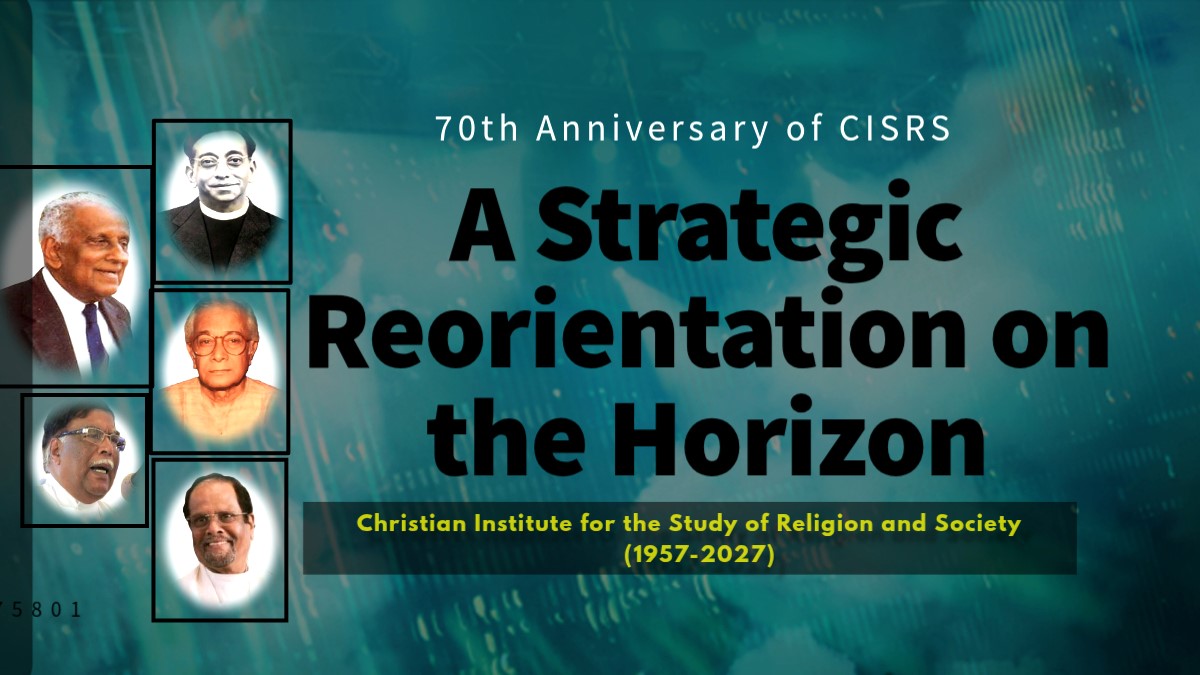
70th Anniversary of CISRS: A Strategic Reorientation on the Horizon
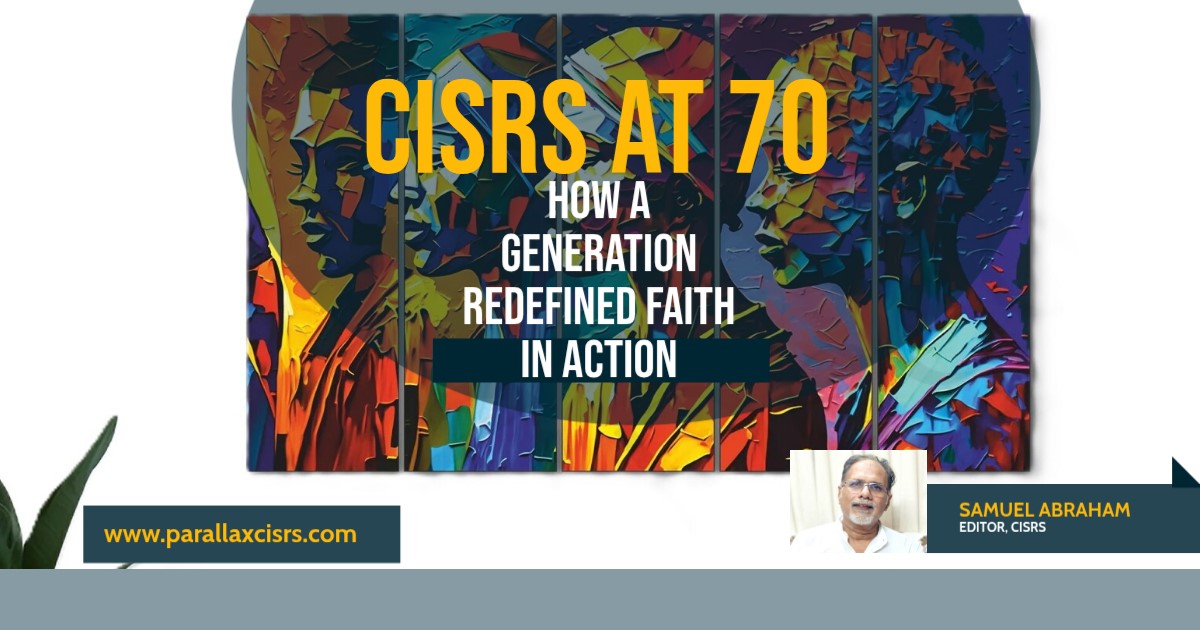
As the Christian Institute for the Study of Religion and Society (CISRS) marks its 70th anniversary, it is an occasion not only to celebrate its history but also to reflect on its transformative journey of Christian public witness. Established in 1957 as a research and study wing of Indian churches, CISRS has been a beacon of faith and social engagement in South Asia over the past seven decades. This significant milestone invites us to honor the visionary founders who laid the groundwork, the various leaders who have guided its mission through the years, and the dedicated individuals who continue to uphold the institute's life and witness in an increasingly complex and challenging world. Celebrating this 70th year is also a deep moment of reflection, renewal, and reorientation in our commitment to faith-based social engagement.
The origins of the Christian Institute for the Study of Religion and Society (CISRS) began during key moments in Indian Christianity, particularly at the Tambaram Missionary conference in 1938. This conference led to important discussions around theology in various parts of India. One significant discussion took place in Kerala in 1943, where M.M. Thomas presented a paper titled “Social Manifesto of the Church.” This paper greatly influenced conversations about the church's role in promoting social justice, both in India and on international platforms like the World Council of Churches (WCC) and the Christian Conference of Asia (CCA).The notion of a church’s active engagement in societal issues, as envisioned by Thomas, paved the way for collaborative efforts among Christian leaders in India. Alongside his contemporaries—Russell Chandran, E.V. Mathew, and P.D. Devanandan—he recognized the necessity of nurturing Christian social thought and took the significant step of establishing the Christian Institute for the Study of Society (CISS) in 1953. In 1957, this initiative evolved into CISRS, incorporating an essential focus on the study of religion. P.D. Devanandan served as the inaugural director of the institution.
With a clear vision of identifying “Christian participation in nation-building,” CISRS embarked on a mission to empower Indian faith communities in navigating the challenges of a post-Independence and post-missionary landscape. Its understanding of nationalism extended beyond mere opposition to colonialism; it embraced the idea of nurturing a just, inclusive, and wider community that actively resists fragmentation and social injustice from within. Inspired by the philosophical legacies of Indian thinkers such as Rabindranath Tagore, Mahatma Gandhi, Jawaharlal Nehru, Rammanohar Lohiya, and B.R. Ambedkar, as well as radical anti-Brahminic movements in Tamil Nadu and Maharashtra, CISRS championed an inclusive form of nationalism that emphasized multiplicity rather than homogeneity in terms of culture, religion, and social existence.
Recognizing the importance of interfaith dialogue, particularly in engaging with Renaissance Hinduism, CISRS initiated discussions and programs aimed at fostering mutual understanding among various religious communities in India and thereby contributing to the building of a community based on justice and love. In fact, this marked the beginning of Indian Christian Theology that envisaged volumes such as Unknown Christ of Hinduism (Raimon Panikkar, 1964), Acknowledged Christ of the Indian Renaissance (M.M. Thomas, 1970), and Preparation for Dialogue (P.D. Devanandan, 1964), reflecting on Christ from Indian cultural traditions.[1] This interfaith theological approach soon expanded beyond the institute and became a significant program within the broader framework of the WCC.
Under the stewardship of visionary leaders such as M.M. Thomas and P.D. Devanandan, CISRS played a crucial role in shaping the global discourse around ecumenical social thought, which envisaged churches’ collective involvement in building a responsible society in response to the study of WCC commission on church and society and the Vatican Council II (1962-65). The landmark WCC conference held in New Delhi in 1961 underscored the need for churches to contribute to the development of a responsible society.[2] This focus inspired churches across India and Asia to engage actively in socio-political movements that champion justice for marginalized and vulnerable communities.
In the face of socio-political challenges, such as the political Emergency declared by Indira Gandhi from 1975 to 1977 in India, CISRS became a prominent voice by mobilizing support for vulnerable communities who happened to be the victims of the government’s social, political, and economic policies. CISRS courageously critiqued the economic and political policies in place that failed to protect or empower the weaker sections of society.[3] The powerful slogan “from evangelization to social action,” introduced by CISRS, galvanized the formation of Christian action groups, leading to heightened participation in socio-political struggles aimed at defending the rights of marginalized communities. As we reflect on the 70 years of the life and witness of CISRS, we affirm its unwavering commitment to transformative faith and action, inspiring various faith communities and secular groups in favor of the marginalized and disenfranchised.
Since the 1990s, CISRS has facilitated engaging discussions and thoughtful deliberations aimed at challenging the monolithic and often authoritarian developmental policies dictated by the state. This initiative has positioned CISRS as a steadfast ally of marginalized communities in the country. Under the leadership of Saral K. Chatterji, who succeeded M.M. Thomas in 1976, the organization advocated distinctly Christian social action and Indian contextual theologies. These included Dalit theology, Tribal theology, and Womanist theology, which were inspired by the principles of liberation theology in Latin America and Black theology in North America. This effort reflected a deep commitment to addressing the lived experiences and theological reflections of diverse and often overlooked communities in India.
Since the beginning, CISRS placed strong emphasis on organizing seminars and workshops, collecting reports, and publishing them for the benefit of churches and the theological academia. However, the emphasis on social action in the 1980s signified a pivotal transformation in its publishing ministry, evolving from a narrow approach centered on interfaith dialogue to a broader engagement with inter-ideological discourse. This marked a turning point in Indian Christian Theology—one that moved away from elitist perspectives and listened to the voices from the margins. CISRS’ journal Religion & Society and its newsletter, The New Guardian, manifest those engagements. Under the leadership of Godwin Shiri and Vincent Rajkumar, successors to Chatterji, the organization endeavored to put the vision of justice into action, embedding the commitment to marginalized communities in its programmatic activities.
However, the rise of neoliberal capitalist economy, politics, and culture that necessitated newer ideological and theological engagements and frameworks demands a further reorientation of the Christian ethical social thought today. It demands a significant reorientation—from a focus on human empowerment to a deeper examination of the socio-political agency of the marginalized. It is an ideological/theoretical realization to acknowledge and accept the desire of the marginalized to re-present themselves rather than be represented. In addition to this, the growing ecological crisis and its impact on ecological systems and the communities that depend on them necessitate another paradigm shift: one that transitions from merely implementing solidarity programs to developing thought patterns and practices fostering planetary communities that admit the agency of the earth and earth communities. There is a pressing demand to translate Thomas' theology of humanisation to planetarity, a theological movement from liberation theology toward a more encompassing political theology of common belonging.[4]
In today's context, marked by neoliberalism, neofascism, and neo-Zionism, there is an urgent need to develop a radical postsecular political thought and theology. This approach should explore different religions as ethical frameworks that shape individual and communitarian identities, contributing to the creation of a respectful society. The current perception of secularism, which promotes religious neutrality and treats religion as a private matter—often viewing it as a potential source of communalism and terrorism—challenges faith-based organizations like CISRS to affirm the ethical potential of various religions, especially in the emerging context of Islamophobia, Zionism, and Hindutva. Furthermore, the transformation of the welfare state into a totalitarian state, which exercises sovereign power over its citizens, calls for innovative post-nationist and postsecular democratic-political practices that challenge majoritarianism and political exclusivism.
Although the path forward is fraught with challenges and obstacles, there is a collective determination to advance toward realizing the vision established by the pioneers of CISRS. This vision emphasizes the renewal of Christian commitment, aimed at fostering a transformative community grounded in justice, respect, and love—qualities that energize and activate its faithful members. CISRS remains dedicated to this journey, bolstered by the collaboration of sister ecumenical organizations in India and abroad, various faith communities including the churches, and theological academia. CISRS also gratefully acknowledges the support of public friends and institutions from outside church circles. These partnerships are vital in promoting a public witness, contributing to a more open, dialogical, and communitarian approach in its mission. Through these collaborative efforts, CISRS aims to enrich its life and witness in a manner that is inclusive and transformative for all involved.
Rev. Dr. Y.T. Vinayaraj
Director, CISRS
16/05/2026/Bangalore
[1] M.M. Thomas defines Indian Christian Theology as the response of Indian Christian faith communities to Christ and his saving action throughout history and culture. See, M.M. Thomas and P.T. Thomas, The Pioneers of Indian Christian Theology (Thiruvalla: CLS, 1990).
[2] The section of the Assembly report on “Christian Responsibility in Political Action,” prepared by M.M. Thomas, remains one of the enduring statements on the Christian approach to “nation building.” See Paul Abrecht, “Some Reflections on Ecumenical Social Thought—Then and Now,” in Christian Witness in Society, ed. K.C. Abraham (Bangalore: BTE-SSC, 1998), 32-49.
[3] In 1979, the responses of M.M. Thomas to the Emergency were published by his disciples and supporters. These were later reprinted by CISRS in 2022; M.M. Thomas, Response to Tyranny: Writings Between July 1975 and February 1977 (Delhi: ISPCK, 2022).
[4] For more details, see Religion & Society, Vol. 72, No. 2 (April 2026).
Become a member
Get the latest news right in your inbox. We never spam!






Comments
No Comments