
The 50th Anniversary of the Internal Emergency: Reflections from CISRS Archives. This reflection was first published in Religion & Society, Vol. 67, No. 3, pp. 25-36
Scattered Thoughts on the Constitution for the Present
Mary E. John
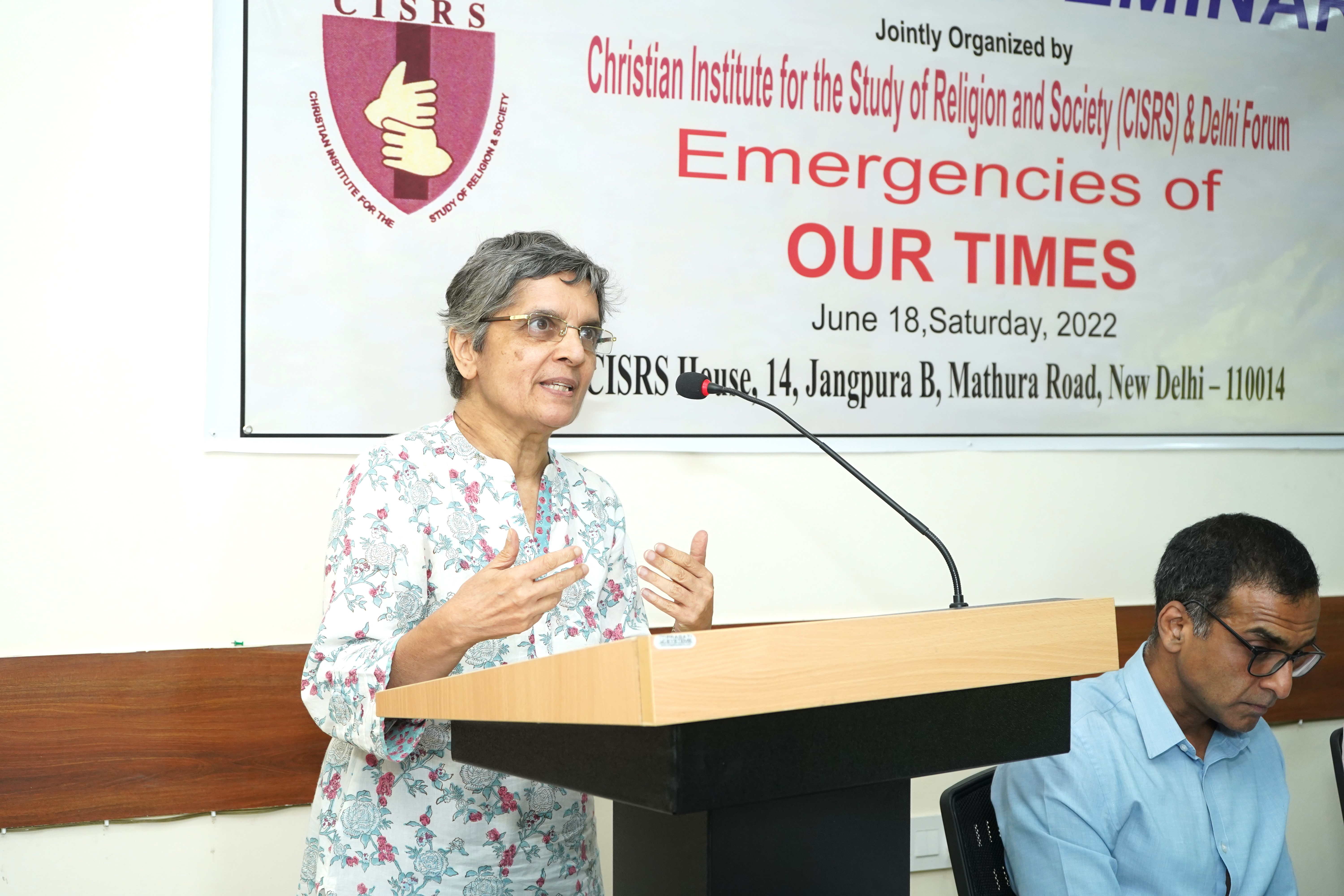
Let me begin by thanking CISRS for this important event and for inviting me to participate. The Emergencies of our Times, as we know only too well, are not just that we are not living in an official Emergency, but are in a time when those who rule have been brought back by the will of the people. The National Emergency of 1975-77 saw oppositional forces gather and find the means to bring the Emergency to an end within two years.
In these non-Emergency emergency times, we have found ourselves relying increasingly on the Constitution. I do not recall – prior to 2014 – the Constitution being treated as such a foundational text. It is not accidental that several pioneering studies on the Constitution have been produced–foremost among them being Gautam Bhatia’s The Transformative Constitution: A Radical Biography in Nine Acts (Bhatia 2019). Bhatia’s case studies offer testimony that liberty, equality, and fraternity are a trinity constituting the “heart and soul” of the Constitution (drawing from the thinking and framing achieved by B.R. Ambedkar). At the same time, I have experienced some unease at the way in which references to the Constitution and its principles are taking on a certain Biblical air in some quarters, as though upholding these principles would be a guarantee against all that is perceived as being wrong today. As Bhatia himself argues, what is transformative about the Constitution is not about constraining State power, guaranteeing socio-economic rights, or securing distributive justice, but about making democratic politics possible. It is surely, then, one of the deepest ironies of our times that the rulers of today have been democratically elected.
In this paper, I wish to reflect on some of the contradictions within the Constitution, contradictions that have had particularly potent effects in the fields of minority rights and women’s equality in the present time. It is necessary to become more aware of some of these contradictions and the historical reasons for their presence, in order to be better prepared for the challenges before us.
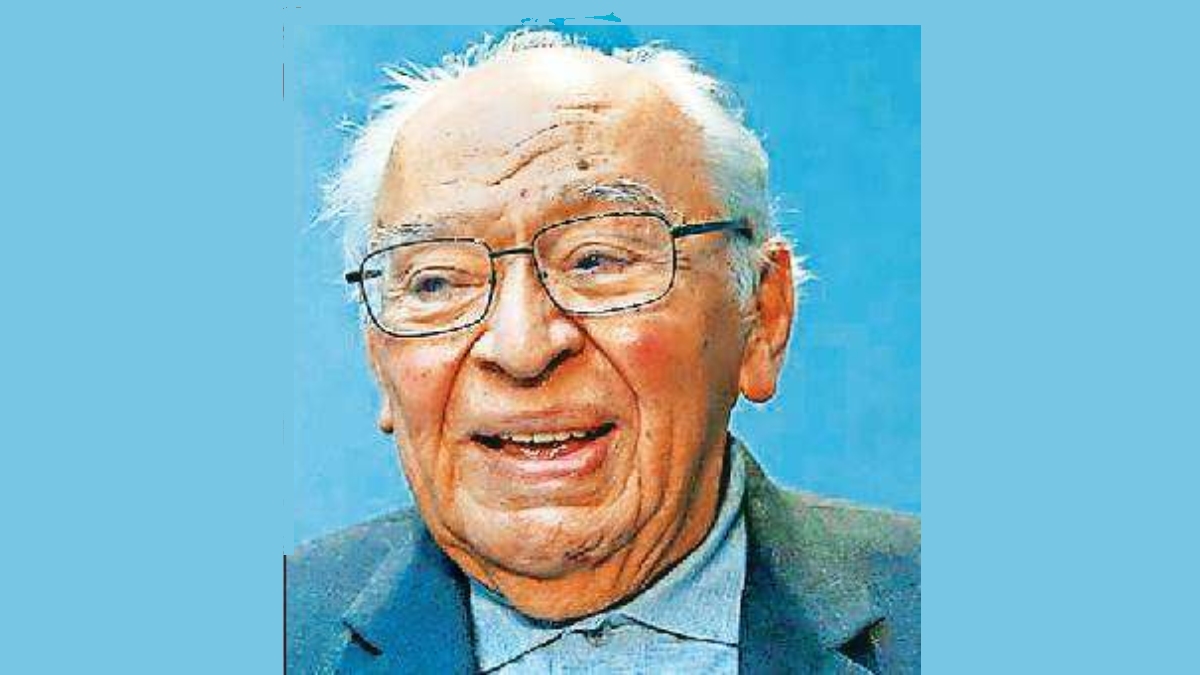
Along with Bhatia, let me cite another scholar of the law, namely Upendra Baxi. In an op-ed piece written for the Indian Express three years ago (Baxi 2019), Baxi described his time as “the tolerance of the intolerable — disrespect for dissent, encouragement for practices of ethnic violence, caste or community-based lynching, and production of social indifference towards states of injustice and human rightlessness”. In his view, the Constitution is not so much a liberal as a post-liberal document because of how it had to straddle various contradictions. It contains basic rights that avail not against the state but against civil society: The rights against untouchability (Article 17) and against “exploitation” (Articles 23 and 24) are collective rights of discriminated peoples. Second, Article 19’s civil and political rights are declared subject to “reasonable restrictions” imposed by the legislature. More surprising perhaps to those not very familiar with the Constitution is his third point that Article 21, guaranteeing rights of life and liberty is immediately followed by Article 22, authorizing preventive detention. While Article 21 is quoted extensively, Article 22 is rarely remembered.
All that Article 22 allows for are certain qualifying clauses such as the following:
Protection against arrest and detention in certain cases. (1) No person who is arrested shall be detained in custody without being informed, as soon as may be, of the grounds for such arrest nor shall he be denied the right to consult, and to be defended by, a legal practitioner of his choice. (Nor does this clause apply to any person who is arrested or detained under any law providing for preventive detention.)
Fourthly, according to Baxi, “ours is the only Constitution that needs protection against itself”. Fifth, the power to impose President’s Rule on states may be exercised by the Union but is subject to the process of judicial review. Sixth, a large number of draconian security legislations have been upheld by the Supreme Court, including some colonial laws violating fundamental human rights. Seventh, respect for international law required by Article 51 does not result in enacting even enabling legislation on custodial torture, let alone a fully-fledged adherence to the nearly universal convention against torture and inhuman, cruel, or degrading punishment or treatment. Eighth, the judicially developed law against sexual harassment in the workplace continues to be stymied at almost all sites.
In Baxi’s view, the Constitution was the product of the poignant realities of the Indian Partition, in order to reconcile four contradictory ideas: Governance, development, rights, and justice. It should not require the realisation that these tasks are still with us. At the same time, it is based on a “shared political responsibility model”. The key idea is that we accept “a responsibility for what we have not done”, simply because many “cases of harms, wrongs or injustice have no isolable perpetrator, but rather result from the participation of millions of people in institutions and practices that result in harms”.
Baxi concludes his article by saying that the Constitution contains a kindred concept of justice. Read as a whole, it says that only that development is just which disproportionately benefits the worst-off or the constitutional have-nots. To be a good citizen is neither to be a liberal, Marxist, or a Hindutva person, but to be and to remain responsive to the sufferings of co-citizens and persons.
I would like to suggest here that we need to be prepared for further facets to this contradictory Constitution from which we now attempt to find resources to take on present-day injustice. While it is true that untouchability was banned and those listed in the Schedule of India’s Castes and Tribes were granted a modicum of substantive rights in the form of an exception to the rule of formal equality, the same cannot be said for other groups considered to be in positions of relative vulnerability. Religious minorities suffered severe setbacks because of the Partition – their rights were reduced to so-called cultural rights, with further negative consequences for women.
Personal Law Reform
Let me explain myself briefly in light of the trajectory of Muslim personal law reform during the highly communalized decades of the 1920s and 30s. As many scholars have attested, the irony at this historical moment was that Muslim women were initially perceived as having more rights than their “backward” Hindu sisters. Two major bills were passed without too much fuss – the Muslim Personal Law (Shariat) Application Act of 1937 and the Dissolution of Muslim Marriages Act of 1939. These Acts were able to achieve in one stroke more uniformity among Muslims under the Shariah and greater justice for women. The 1937 Act ensured that Muslim women who had hitherto been governed by customary practices based on a joint family property (similar to Hindu laws) would now be able to inherit family property under the provisions of Shariat Law. While there is no question that the political creation of Islamic unity through women was uppermost in the minds of Muslim leaders, it was very successful in conveying a potent combination of a common community identity centered on advancing women’s rights in a climate of growing rivalry. It is important to bear in mind, therefore, that right up till the time of independence – when the Hindu Code Bill had yet to be seen through – Muslim personal law reform offered an instance of a religiously administered yet dynamic mechanism that was able to claim rights for women that Hindu women did not have. Many have commented on the decisive changes that occurred in the aftermath of the Partition and the creation of Pakistan. On our side of the hastily drawn border, the newly created secular Hindu majoritarian state – unlike its colonial predecessor – could not inspire confidence in the community that had suddenly turned into a ‘minority’. This insecurity of Muslims had the effect of closing down the dynamism of personal law reform, by defining their freedom in predominantly religious and cultural (rather than citizenship) terms within the new Constitution. (Bajpai 2000, Ansari 1999, Agnes 2001, Newbigin 2013). We might say that, with the birth of a new nation peopled by majorities and minorities, the tenacity of culture had found a new target, and its signs are visible in the Constitution itself.
For their part, at the time of finalising the Constitution, women’s rights remained almost entirely within the frames of non-discrimination. Gautam Bhatia has demonstrated the significance of Article 15 (1) with its sparse enunciation
The State shall not discriminate against any citizen on grounds only of religion, race, caste, sex, place of birth or any of them.
Article 15 is the major source for anti-discrimination legislation when it comes to sex, that is, for gender equality. According to Bhatia, a transformative reading today would reject the notion of ‘natural differences’ between men and women in favour of discrimination understood “as a product of social, economic, and cultural structures and institutions” (Bhatia 2019: 4).
However, it should not be forgotten that when women’s rights were being debated in the Constituent Assembly, the dominant form of equality that found acceptance was that of formal equality. It was stalwarts of the national women’s movement who strongly attested in the Constituent Assembly debates that they required none of the special treatment granted to the Scheduled Castes. Bear in mind here that this was said in 1948 when barely a couple of decades ago women’s organisations had to fight tooth and nail for the passing of the Child Marriage Restraint Act of 1929 which raised the minimum age of marriage for girls from 12 to 14 years in the face of massive opposition from nationalists. At the end of the day, it was not so much their tireless campaigning as the confounding effects of Katherine Mayo’s diatribe Mother India that turned the tables in their favour. And yet, these very leaders of the women’s movement were so buoyed by their hopes of equal rights in the new nation to be, that they shunned suggestions such as a reservations policy for women. Article 15 (3) allowed for “special provisions for women and children”, thus clubbing women and children together as a socially vulnerable group.
There is no doubt that much has changed today from the time when the Constitution was made, and that this would be reflected in later court judgements. Indeed, as I shall be explaining further on in this paper, we are even less prepared when ideas of gender equality are invoked in such a way as to actually perpetuate harm.
On a different note, we may also wonder why almost all economic rights – including the critical idea of a living wage – remain within the Directive Principles of State Policy, and hence outside the scope of justiciability available under the Fundamental Rights. According to Bhatia, this was deliberate on the part of the Constitution makers. B R Ambedkar came to the view that the Directive Principles were there to “facilitate and enable” the State to carry out programmes for economic and social justice, but it could “not impose an economic philosophy or a system”. It could encourage socialism but not be a socialist Constitution (Bhatia xxxiii, emphasis original). But surely it is all the more telling then that it is the ban on cow slaughter that has so determinedly been brought out of the Directive Principles and straight into the realm of punitive law in the last few years.
These remarks should not be misunderstood. I am not trying to dilute our faith in the Constitution – all that I am doing is to ask us to recognise that it was as much a product of its times as we are the product of ours. We must draw upon this foundation not as the last word but as a living Constitution that bore all the marks of its making and therefore as a document that needed to be and has been amended and remade. This is especially necessary given the peculiar times that we find ourselves in today.
The Paradox of Gender Equality and the Age of Marriage
In the remaining part of this paper, let me share some scattered thoughts as someone who has learned the most from the kaleidoscope of women’s struggles in the last so many decades. These lessons have come from the most unexpected of places. So, on the one hand, those whose sufferings ought to have cowed them into silence, have been amongst the most longstanding and firm in their demand for the rights of citizenship. On the other hand, many of us with years of experience in the women’s movement have yet to get the measure of the nature of current rule -- authoritarian populism -- when it comes to questions of gender.
No better illustration of what it means to be a member of a religious minority and to see one’s rights being stripped away in the name of religion can be found in the Shahbano case of 1985. As many would be fully aware, this was a case that began innocuously with the demand of an elderly divorced woman for maintenance from her husband. But before long it turned into a major national crisis pitting India’s unity against religious identity such that a Muslim woman’s rights were wiped out at the intersections. Notice that this was in the 1980s under Rajiv Gandhi.
It has therefore been one of the few rays of hope in the twenty-first century to have witnessed a veritable turnaround as Muslim women’s voices have by no means been silenced in the darkest of times. They could be heard in the triple talaq judgement, in the attacks on Jamia Millia Islamia, and of course in the amazing courage of women across the city of Delhi – in Shaheen Bagh but also in the resettlement colonies across the Jamuna river. It needed nothing less than police brutality and an open-season approach to making riots happen that quelled these voices. One is left wondering, then, about the role the Constitution can play in the kinds of arrests and detentions that have followed, while the actual culprits walk free.
My second example comes from one of the more recent claims on the part of those in power today to speak and advance their cause in the name of gender equality and women’s empowerment. We couldn’t be further from the truth if we thought that the current dispensation was of the same variety as other forms of right-wing rule across the globe. Some of the latter have been notorious for giving women’s rights the go-by – recall Donald Trump’s infamous statements, and the more recent overturning of access to abortion in the US; or the revival of traditional gender norms in several nations of South America and Eastern Europe. To underline my point – ours is a government that has learned a different set of lessons and it is the women’s movement that, more often than not, is caught on the wrong foot with the state’s discourses on welfare schemes, safety measures for women, and so on. No better example of the current stakes can be found than in the government’s move to raise the minimum age of marriage for women from 18 to 21 years.
In late December 2021, the Government of India decided to amend the Prohibition against Child Marriages Act (PCMA) of 2006 in order to raise the minimum age of marriage for women from 18 to 21 years, making it the same as the age for men. The formal proposal for an amendment came almost two years after a surprise announcement − in the Finance Minister’s February 2020 union budget speech in Parliament − that the government was contemplating such a move. In July 2020, a Task Force was set up via the Niti Aayog to examine the issue, which invited interested parties to share their views. Although the Task Force’s report is yet to be made public, the government has already framed the amendment Bill and referred it to a Parliamentary Subcommittee for further consideration; responses from the public have once again been solicited.
To understand what is at stake here we must begin by noting that the new law intends to redefine any person who has not yet reached the age of 21 as a ‘child’. This is necessary in order to ensure that marriages below the age of 21 are prohibited with legal force, in other words, treated as criminalisable. The government’s rationale for doing this is listed in the unusually lengthy “objects and reasons” section of the new Bill (PCMA 2021). The Bill claims that Equality, one of the foundational values of our Constitution, will be “holistically” realised through equality in the marriageable age.
No Bill in recent times has claimed to address such a wide range of conditions. The list of ills that the Bill intends to remedy includes everything from a woman’s physical, mental and reproductive health, to her disadvantages in higher education, in employment opportunities, skill training, and entry into the workforce. These disadvantages, it is rightly said, perpetuate women’s dependency on men. The Bill will also take on the challenges of improving maternal mortality, the sex ratio at birth, and the nutritional status of mother and child. The language is that of empowerment, ending discrimination, greater self-reliance, achieving the Sustainable Development Goals, and abiding by the UN Convention on the Elimination of All Forms of Discrimination Against Women, or CEDAW, which India signed in 1980.
Given that many women’s and children’s rights organisations and activists (including myself) have come together to oppose the new law, a strange face-off is being staged. According to the “objects and reasons” of the PCMA Bill 2021, the government is acting to empower women and protect children, and yet, those who profess to work for the rights of women and children are opposing this action, appearing to go against the foundations of the Constitution itself!
This then is the strange position that some of us find ourselves in – these are the emergencies of our times that are so hard to put into perspective. In considerable contrast to the prior history of social reform around child marriage during the colonial period, when reformers and feminists were pitted against the conservatism of revivalist nationalists who stoutly defended even infant marriage as a wonderful Indian custom, the shoe seems to be on the other foot today. Over a century ago 10 years was considered appropriate – what is going on when the government of today believes it ought to be 21?
In order to argue against this particular move, I have tried, as a good social scientist who believes in the persuasive effects of empirical facts, to look at existing data. As several commentators have noted, Census data shows that the mean age at marriage for both women and men has been increasing slowly but steadily, with the mean age at marriage in 2011 being around 21 years. According to National Family Health Survey data, rates of marriage below 18 have been declining quite significantly -- within the 26.8% who have married before they were 18, only 6.6% had married at an age below 15 years. The current picture would therefore be better described as declining trends of adolescent or early marriage rather than child marriage.
I have pushed the claims of social science, and not my feminist ideals, by confronting the extravagant claims being made as to how raising the age of marriage to 21 years will lead to women’s empowerment and equality on so many counts. When examined closely, age seems to matter comparatively much less as a possible causal factor of harm once we cross the age of marriage of about 15 years. There is certainly a positive correlation between age at marriage more generally and other indicators such as health and educational levels. But this is because better-off families with better access to nutrition, health, and education marry their daughters at correspondingly higher ages today (compared to the situation a century ago). In other words, the higher age of marriage does not cause better health or education – all three are “caused” by the economic status of the family.
The crucial point here is that higher ages at marriage do not lead to better outcomes in a cause-effect fashion. A woman who is poor and has no access to proper nutrition or health facilities does not become healthier or less poor merely because she delays her marriage by a few years. For example, anaemia is our biggest cause of maternal mortality, and India has some of the worst figures in the world. But data show that women’s anaemia levels get no better when the age of marriage rises above the age of 21. On the other hand, NFHS-4 shows that they improve considerably when we move up the economic status scale – even when “up” means just above the poorest 20%.
The biggest paradoxes are in employment, or more accurately, paid work. India happens to be among the countries with the lowest rates of employment for women. However, even these already low rates have been declining in recent decades. The alarming state of women’s employment is rarely connected with issues like age at marriage. When we do, we find that not only has employment for women fallen in the very years when ages at marriage have been increasing, but the proportion of employed women declines as we move to higher ages at marriage. In other words, poorer women are both more likely to have paid employment and to have married earlier, while better-off women marry later but are less likely to be employed (John 2021: 165). Thus, it is meager employment opportunities rather than early marriage that is preventing women from becoming more economically self-reliant and empowered. Of course, housewives perform critically useful labour of many kinds, but they remain economically and socially dependent on men.
What will a legal fix achieve?
There is a final argument that can sidestep the overwhelming evidence showing that raising the age of marriage will not lead to the empowerment of women. This is the negative one that says: even if there is no major benefit, what is the harm in raising the marriage age? Is it not a good thing that it would (potentially) break the age-old patriarchal belief that the bride should always be younger than the groom? So why are opponents being so contrary in advancing this form of gender equality?
My answer has been this – the government is attempting to fix something that is not broken, and it will do immense harm (John 2022). As the data show, the age at marriage has been rising steadily, and though the average age is now above 20 years, a very large proportion – 56% as per National Family Health Survey 4 (2015-16) data, 70% of the poorest 20% -- of women in the age group 20-24 years married before the age of 21. The new law will bring large numbers of young people into the zone of being criminalisable, robbing women of the legal protection that marriage provides. One can well imagine – in our current communal atmosphere -- how a selective application of this new law would work itself out, on which occasions the law may look the other way and where it would not.
What is even more strange is that a state that claims to be so eager to empower women shows no signs of creating the actual enabling conditions that would make women lead more autonomous lives. Education has become increasingly expensive, and decent work is vanishing. Budgets for health care are a fraction of what they should be. The international agendas that have been pushing for the elimination of child marriage globally have always been motivated by population control – empowerment is only a recent feel-good addition that is mostly cosmetic.
So where does this leave us? Women’s and child rights activists, as I have said, have been in the strange position of opposing a move in favour of gender equality. We have used the tools of the social sciences to uncover the fallacies in the claims being made. But to what ends?
In lieu of a Conclusion
In this paper, I have raised the question of the status of the Constitution as a foundational text for democratic politics in the present time. Drawing on diverse legal thinkers like Gautam Bhatia and Upendra Baxi, we can see that the Constitution is a historically constituted document, embodying the contradictions of its time, yet open to transformative interpretations in the present. The sparseness of its principles of non-discrimination based on sex has allowed a certain leeway from earlier stereotypical views of women’s roles and vulnerabilities to the potential of a better appraisal of the forces of discrimination and inequality at work in contemporary society. But we need to strengthen our resources in a time when an authoritarian regime is able to use ideas of women’s equality as enshrined in the Constitution to create policies that will actually do more harm than good. This is not the kind of challenge that we are well prepared for, and it will take further democratic moves and skills of interpretation to strengthen our claims in the years to come.
(Mary E. John is professor emeritus at the Centre for Women’s Development Studies, New Delhi, India. She was the director of the centre from 2006-2012 and before that the deputy director of the Women’s Studies Programme at the Jawaharlal Nehru University, New Delhi. Recent publications include Discrepant Dislocations: Feminism, Theory and Postcolonial Histories (New Edition, 2021).
References
Agnes, Flavia. 2001. Law and Gender Inequality: The Politics of Women’s Rights in India. Delhi: Oxford University Press.
Ansari, Iqbal A. 1999. “Minorities and the Politics of Constitution Making in India” in Gurpreet Mahajan and D. L. Sheth eds Minority Identities and the Nation. Delhi: Oxford University Press.
Bajpai, Rochona. 2000. “Constituent Assembly Debates and Minority Rights”. Economic and Political Weekly, May 27.
Baxi, Upendra. 2019. Constitution contains a kindred concept of justice, asks a citizen to be responsive to sufferings of co-citizens. Indian Express June 6.
Bhatia. Gautam. 2019. The Transformative Constitution: A Radical Biography in Nine Acts. Harper Collins India.
John, Mary E. 2021. Child Marriage in an International Frame: A Feminist Review from India. London and New York: Routledge. South Asia Edition 2022.
John, Mary E. 2022. A Suitable Girl? Marriage, Age and Equality. The India Forum, February 2022.
Newbigin, Eleanor. 2013. The Hindu Family and the Emergence of Modern India: Law, Citizenship and Community. Cambridge: Cambridge University Press.
Become a member
Get the latest news right in your inbox. We never spam!







Comments
No Comments