
The 50th anniversary of the internal Emergency in India
Reflections from CISRS archives (No.3)
Originally published in Religion & Society, Vol. 67, No.3, Sepetember 2022
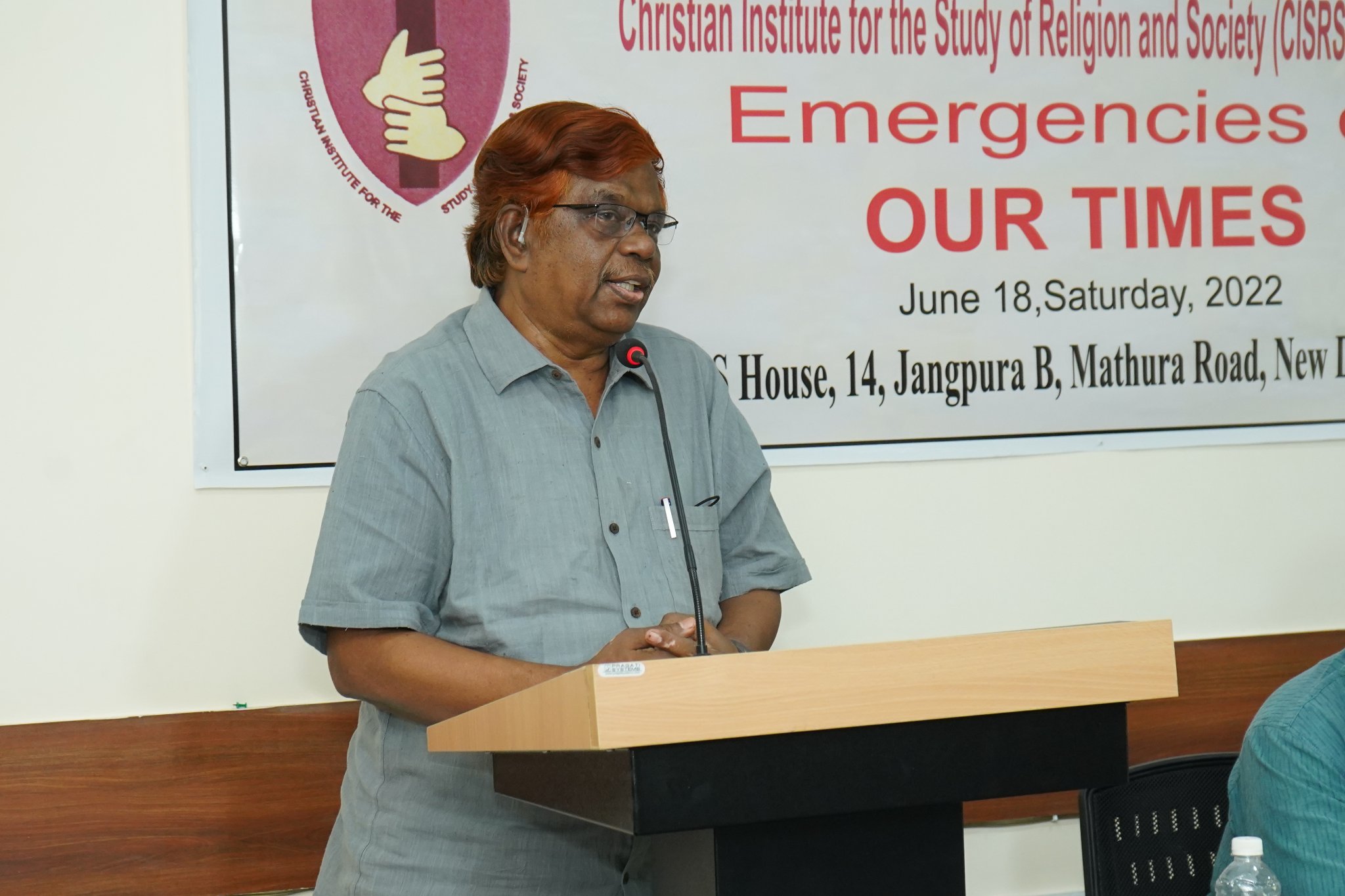
Emergencies of Our Times
Justice K. Chandru
As I am standing here and speaking once more after several years, I remember Saral Chatterjee and several citizens here having several discussions in this forum regarding the emergency. Now after 47 years, that too in the month of June, we are recalling the effects of the emergency once more. It throws back our days of emergency. And as rightly said, while we are reminding the effects of the emergency and its lessons, the government is busy deleting the portions for the school children to learn about the emergency. This is something that gives me an idea, during the emergency as you know when the government pre-censored the newspapers, some other newspapers started putting blank columns. Even that was refused to be allowed by the Press information offices. So, some other newspapers started quoting speeches of Jawaharlal Nehru against British Imperialism. Even that was scored off because to remind of dictatorship Modi has to think that whatever he said and spoke during that time he was one of the victims of the emergency and was in jail for a few months. In fact, Mrs. Gandhi said in Parliament, in Rajya Sabha that in the emergency there had two phases, the first phase was on the twenty-fifth of June, till so far as Tamil Nadu was concerned, till January 1976. That was the first phase before the DMK party led by Karunanidhi did not allow many of the emergency measures to be implemented in Tamil Nadu. Therefore, just ten days before she dismissed the Government.
She said in the Parliament that there are two states that are actively involved in working against the emergency, vis-à-vis the development work done by the Government and acting against the interests of the nation, and they are also getting foreign funds for doing this. That is what she said. And the two governments she mentioned obviously refer to Tamil Nadu and Gujarat. Tamil Nadu had become a headquarters for many of the anti-emergency activities. In fact, every known political party shifted its headquarters to Tamil Nadu. For the first phase of the emergency, they all had their party set up and every meeting was held in Tamil Nadu. And therefore Mrs. Gandhi said that there are two islands of indiscipline and one island was Tamil Nadu. Fortunately, during that time we were in Law College and we then had a predicament, that on the one hand that before the emergency the discussions which took place from 1967 to 1975 in the Parliament by leading political parties was that this constitution was a bourgeoise landmark, a reactionary constitution. P Ramamurthy of the CPM went on record to say that we have to throw this constitution to the Bay of Bengal to have a new constitution. And at this time the emergency was declared, and the importance reworking the constitution became important.
There were only talks about land reforms; tax concessions and the court stood in striking off many of these progressive steps taken by the Government. Therefore, there was a clear stand that the government can cut the judicial laws and try to push the country backward. The political Government is saying that they look forward to initiating progressive reforms. And when actually the emergency came, I was a second-year law college student we then taught about the constitution and that the people are the ones who laid the foundation of the constitution and it is the people who talk about their rights. Now you theoretically learn article 19 (1) and then when you come outside nothing is available there. When you start realizing this question it becomes a little uneasy between the teacher and the student in the classroom. In the classroom, we learn about the structure of democracy and the effect of courts and law. And then we grew along with this experience, on the other hand, we were also helping many of these movements which are semi-legal. I used the word semi-legal because they were not fully legal at the round. The Naxalite party and the RSS which was banned at that time other than the political party who were having a semi-legal working set-up, distributing the materials during time of emergency. Everything was printed in Tamil Nadu. So, our job was to take it all over India. We enjoyed the risk of being arrested and the same time trying to bring adventure in spreading this message. And in this process, two things came very clear as you all know after the immediate of this emergency was declared very curious orders were passed under 359 (1) suspending articles 19 and 21 till the emergency is in operation. Now, this is a crucial thing whether the parliament or the delegated central government can suspend fundamental rights. Now as a student of law we don’t think that when we do the violation of a right, we talk about the fundamental right that the high court has the power to entertain a writ petition. There are thousands of people who are detained in India including Advani, Bajpai, Modi, every left leader, and every right leader at that time. Therefore, the question of moving to the court against detention became crucial.
Thanks to some of the judges who were very bold and had trained in the school of civil liberty like justice Chinnappa Reddy and Rajindar Sachar, they all had the courage to issue a writ petition; because article 226 itself says that the write can be issued for any other purpose need not be only for one-month rent. So, the question was whether the District Magistrate can pass the order for detention and can it be scrutinized by the court. There were eight high courts that had the courage to issue writ petitions against Government. Then came the step taken by the government to transfer all these cases to Supreme Court and the Supreme Court gave the infamous judgment in the ADM Jabalpur Vs Shukla case. That was a very shocking statement because before the government was facing several litigations that the summary and constitution amendments had all been set off, the position taken by the Supreme Court in ADM Jabalpur Case was very not only shocking but for the backset statement of the Supreme Court. The Supreme Court said you cannot approach any court for that fundamental right under suspension. Now one of the issues that were raised during that argument was that suppose the government wrongly shoots somebody, the district magistrate shoots somebody wrongly, and those wrong actions cannot be brought to the course of action of the court. Only Attorney General can come to the court. That is the most infamous statement made, recorded and agreed upon by the court. Then the petitions were dismissed.
Now the question arises here all about the students who learn the constitution and there is a huge interpellation given to the constitution that you cannot come to the court, that too this situation brought two important developments on the one hand parties felt that democratically functioning in this so-called democracy is not possible therefore you have to think of the alternative method of operations. That means there is a setup of semi-illegality. Countering this Mrs. Gandhi in order to give a new color for the emergency declared 20-point program. Some of the parties even the communist party of India, CPI welcomed this 20-point program thereby she was able to make a clear division among the political parties. Showing that there are not just negative features but there are positive things in the project of emergency. Secondly the question of the press. If the press is controlled how the right to information should be maintained? Therefore, people started thinking of alternative methods of dissemination of ideas and information.
There emerged people, writers, artists, and organizations opposing the emergency which was long absent after the Second World War. After the anti-imperialism period, these associations completely disappeared. There emerged the urge to have a civil liberty forum to fight for the common man other than the political party set up and thus emerged forums like PUCL. There was a conviction about the need for a civil right movement to fight for civil justice and these are the lessons that we have learned while in law college. Actually, before I join the law college, I was not intended to practice law but the emergency made us think that we have to fight for justice at the core. We were given opportunities to take issues to the court and then were all like professional carriers of law at one point in time.
The most important part of the emergency was that the normal political party can take a different approach they can suspend their concerns for the larger interest of the nation. This is the argument that was trying that is about the larger national interest. When the Tamil Nadu DMK government was dismissed, dismissed without any constitutional basis, but then the courts were not interested in going behind this. But after the dismissal of the DMK government, some of the progressive groups functioning in Tamil Nadu shifted back to their original place because they were no longer in haven or the islands of indisciplinary political activities.
When the basic constitutional provisions are defeated then for the first time people started looking into issues, and listening the to constitution. If it is not constitutional the court does something about it. The court decision on the ADM Jabalpur case which all know that it was not a correct decision and not only a correct decision but also more of a piece of the government, and after a long time in 2010 some judges have the guts to say that the decision was wrong. And finally, after all, other cases in the Aadhar Card case one of the judges wrote the ADM Jabalpur case was a wrong decision. Even before they could write. In the post emergency, the Janata experiment brought an amendment that you can’t suspend one month’s rent during emergency. So, there was a constitutional advancement of law, so the most important thing of today was during the emergency the most draconian Law that was used for the maintenance of internal security MISA. Lalu Prasad Yadav was in jail when his daughter was born, he named that lady as MISA. Her name today also is MISA only. And many people in Tamil Nadu have a prefix of Misa, Misa Balakrishnan, Misa Gayathri, etc. Misa has become a landmark because in 1971 when Misa was introduced in the parliament if you see the discussion that there are people who said that this is likely could be used against a political opponent. But then the government, the home minister gave a reply to this is laid against anti-social elements only, therefore no need to worry. Even DMK voted for MISA. They did not oppose it. Therefore, the discussion of civil liberty also brought a discussion should we have the detention law without the scrutiny of the court. Do we have a law to scrutinize detention? In fact, when we are in law college there were warrants issued even without naming the person, there were blank warrants. If you see the Shah commission inquiry, it is mentioned that the district magistrates misuse the power of issuing blank warrants where the police get the chance to write the names. Our hostels were raided, our rooms were checked, and we were all not allowed to enter the college; because of these nameless warrants. The question is should we have a detention law when there is the security of the court?
After the emergency the first demand was to repeal MISA, yes it was repealed and only followed NSA, National Security Act which is still there. They didn’t stop with National Security Act, they also brought TADA and POTA, but all these were withdrawn. In 1967 they brought UAPA. UAPA was very innocent because there is a bail and trial and nobody was willing to criticize it. After POTA was withdrawn the UPA was amended and it has become worse than any other previous laws. And today you will find, how UAPA is creating such havoc in this country. We may not have an emergency, not any fundamental rights are suspended, and the ADM Jabalpur case is no longer there. But today we will find there are 13 intellectuals who are kept in jail without any reason. No bail no trial. When bail is the rule, jail is the exception. Now, what is happening is that you do get the bail, don’t get the Sakshi, and you don’t get a reason why they are being denied. Some of the people were worst affected like father Stan Swamy. He is no more with us. In fact, he is one of the landmarks between pre-emergency and post-emergency. He has died without trial, without bail, and without medical attention.
Today when we talk about the emergencies of this time that may not be a possibility of emergency as such we declare, number one. Number two we may not have the old method of presenting charge sheets or detaining people on a large scale. In the first emergency, there were at least two thousand people were detained at a time. Today people there may be two hundred, but what is important is, in the present day the activity by such a government carried by the BJP party is much more dangerous and aggressive than what was faced in the emergency. I know there was no court to support the civil rights movement. But still, we have enough courage and groups to fight against this kind of denial of democratic rights in this country. But what is happening today is that after several years nearly after 47 years we are facing a situation and it is called an undeclared emergency. I am not using the word undeclared emergency because the word emergency means several things to several people. But I only say today we are facing a situation where one of the largest losses in this country. The law allows them to do whatever they want. Without any charge sheet, you are booked for months and not granted bail forever. Why bail? Father Stan Swamy only asked for a straw, a sipper because he had Parkinson’s disease because could not hold a tumbler of water, he has to have a sipper. Whenever I go to any meeting, I take this straw with me. I ask people what is this. This sipper was denied to him. He asked the magistrate why you don’t give me a sipper. The magistrate asked the jail officials to give him a sipper. They look into the rules and said that there are no rules to give him a sipper. No straw. And then he moved to the court which we think that the court is the last resort. Any judge with some humanitarian consideration should have wanted or paid out for the packet, even the government revenue gazette allows that expenditure. But the judge, after all, worth sense, the high court judge of the mobile court, said he will order this through notification, so what will father Swamy does for these three weeks that he has to wait for the government reply and to then get a straw. This is what I will now start saying, this is the last straw of Mode’s bag. The straw will become a symbolic object by which we should throw Modi out the only thing we should start fighting. This is the starting point if you move the court, the court will look the other way around. Now, this is the most dangerous situation. We never had a lack of faith in court during the emergency though there were restrictions on going to court. Today there are no restrictions. Today there is no law that prevents the court from taking any matter for that matter. And then they start looking the other way around that we find, that is the qualitative difference that we have brought about.
Do we have an independent judiciary or they are subordinate to the executive? Or they say yes to every executive action. Now somebody ask me all the judges and all the judgments have been sold today. when Ranjan Gogoi, the former chief justice, he retired from service, he accepted a nominated Rajya Sabha membership. When people questioned, he said there is a precedence in this country. There was Ranganatha Misra. So, there is precedence in this country. But most important thing was that he published a book, a very funny title called “Justice for the Judge”. I don’t know what it means. The topic, and title of the book is “Justice for the Judge”. Now, when he releases that book, he wanted some good people to be allowed, so he called me in Chennai. Sir, please come for the book release, I want to give you the first copy. I told him, sir, if you release it I will buy it from any local book shop, I am not coming. Then he said if you want to criticize me, then come and criticize me. I will not stop you. I told him I didn’t come and all. But most important was after the function, a tv program asked him. Sir, can you deny there is no corruption in the judiciary? He said I cannot. So, you have a confession from the top most person in the judiciary, that the judiciary is corrupt. There was a film released recently in Tamil Nadu, the topic of the film was the judgment has been sold. So, I was talking about all that elongates that film, I told them that it is not caught for orders, catch for orders you unfollow corrupt. Suppose you don’t decide at all, just admit the matter and sit over it. And today how many sensitive matters Supreme Court sitting over? Not making a decision. Whether it is Krishna Jayanthi or a review of the Sabarimala Ayyappan temple issue or any matter for this pattern. Any sensitive matter including my case matter. They are not having any time for reading all this matter. This procrastination, this indifference, this lack of faith, this disobedience of undertaking they took because at the time we enter the office, the judge takes an oath that I will uphold the constitution without any fear or favor, without ill will, all that we say but ultimately sitting over the cases without any responsibility. Now what we do, we don’t decide anything. Recently, when the issue of summer vacation for judges came to the Supreme Court, somebody said two years we had no vacation due to COVID and we had skipped summer vacation. Judges said, “we can’t give up our full-fledged vacations.” So, the lordships are happily sitting on summer vacation. And some other lordships are going to international conferences in foreign countries what about deciding matters pending in the courts which is the most important thing for the common people? Judges are not interested in cases. This will be all on notice whatever demolition, whatever destruction goes on. The lordships have no time to hear these petitions. That’s what is most important. So, when you talk about undeclared emergency, we understand what Modi, and Shah can do, we can understand what BJP can do, and we can understand what the RSS can feed into it. But what is important is that a forum or the branch of government that is intended to supervise or at least to browse lightness to such orders is turning the other way or not. That is the greatest danger that we are facing today. We have a judiciary, which is supposed to be independent, or to establish the flow is not interested because, I will also tell you one important, when the NJSE amendment was stuck down by the court or any narrow chapels when the selection committee majority or executive now when the matter came back to BJP, the only two points were projected, first point that we not alter the selection committee and then overruled are explained by the parliament at any time.
Today they have not brought back the constitutional amendment which was struck down. They don’t want to bring back any NJSE, because they do much more better things than the NJSE can do. And the net result was, we have a whole lot of judiciaries which become planned in the sense that does not resolve the matters. As I told you there are different forms of corruption, one corruption form is not designed for anything, just procrastinating, and sitting over it. They don’t say anything but these speeches all over the country. Make revolutionary speeches impossible. Thereby misleading the very viewpoint of the people’s perception of such speeches. And therefore, when we talk about the emergency of the time, when we also look back on the 75, 77 what happened 47 years before, see some comparative things. on the other hand, we have to think differently. there need not be any emergency in this country, there need not be any constitutional amendment, there need not be any government notifications to suspend fundamental rights, there need not be any ADM Jabalpur case, but still, we face the same heat, the same situation. And that is what we are worried about. If we have to start something new, we will have to start a campaign, where the basic structure and the basic fundamental rights of the people have to be redeemed. And for that, we need much more forums and much more follow-ups. And in fact, some other saying about the other experiments on religion areas. These all will make longer this discussion upon taking you to those issues, but the major area today is on a rise in the approach of judiciary to make every constitution safe. There are, there is a talk now, two types of talk one, that we should have no constitution, that’s another dangerous area. Secondly, the other one is the constitution cannot decide everything. It’s something else, that will have to think of something new. The answer came in the Ramajanma Bhoomi case where the faith of the majority faith was answered, positively by the court. This is another crime where; the fascist idea is slowly disseminated into the societal thinking process. That the majority of the faith will decide many of these issues today. This is another area where, not an emergency, but post-emergency the people who want to execute all this also will become sufferers of dehumanization. Modi was there for 21 months in jail. Advani, Bajpai everybody was in jail. It is not as if, they don’t go to jail, and they don’t know the jail condition. But today when they order, these paragraphs, these references to the emergency should not be learned by the students, what now they are trying to do. They clean some. Like the ethnic cleansing, the ideas were to be cleaned, the students should not go to those memories again. Before we need more forums to talk about these issues, talk about this denial, even children not going on this, that we should have these issues, that memories are of short. And then we should organize a program while comparing today’s existence with the 47-year-old emergency. We should also think of, giving a new nomenclature to this approach. Of course, there can be some good reason for the emergency, but this is something where the democracy is perverted by one political ideology, the democracy can be subverted, the democracy can be killed and that process through one-party rule, one nation arguments, one language, one food, everything they can put in a logical line. So, these are the issue we have to discuss and not confined to academic forums but take to the larger masses. And that process we should work and I wish this seminar a good turn out from here which will we must be able to translate into action in a larger framework from Kashmir to Kanyakumari. And that is what is the main success of the very same exercise, that we are doing today. Thank You.
(Justice K. Chandru is an Indian advocate and former judge of Madras High Court. Justice Chandru is known for a case which took place in 1993 when he was practising as a lawyer, to which the film Jai Bhim is dedicated.)
Become a member
Get the latest news right in your inbox. We never spam!



Comments
No Comments