
The 50th Anniversary of the Internal Emergency: Reflections from CISRS Archives. This reflection was first published in Religion & Society, Vol. 67, No. 3, pp. 20-24
Survival, Resistance, and Resilience in the Time of Emergencies
Safoora Zargar
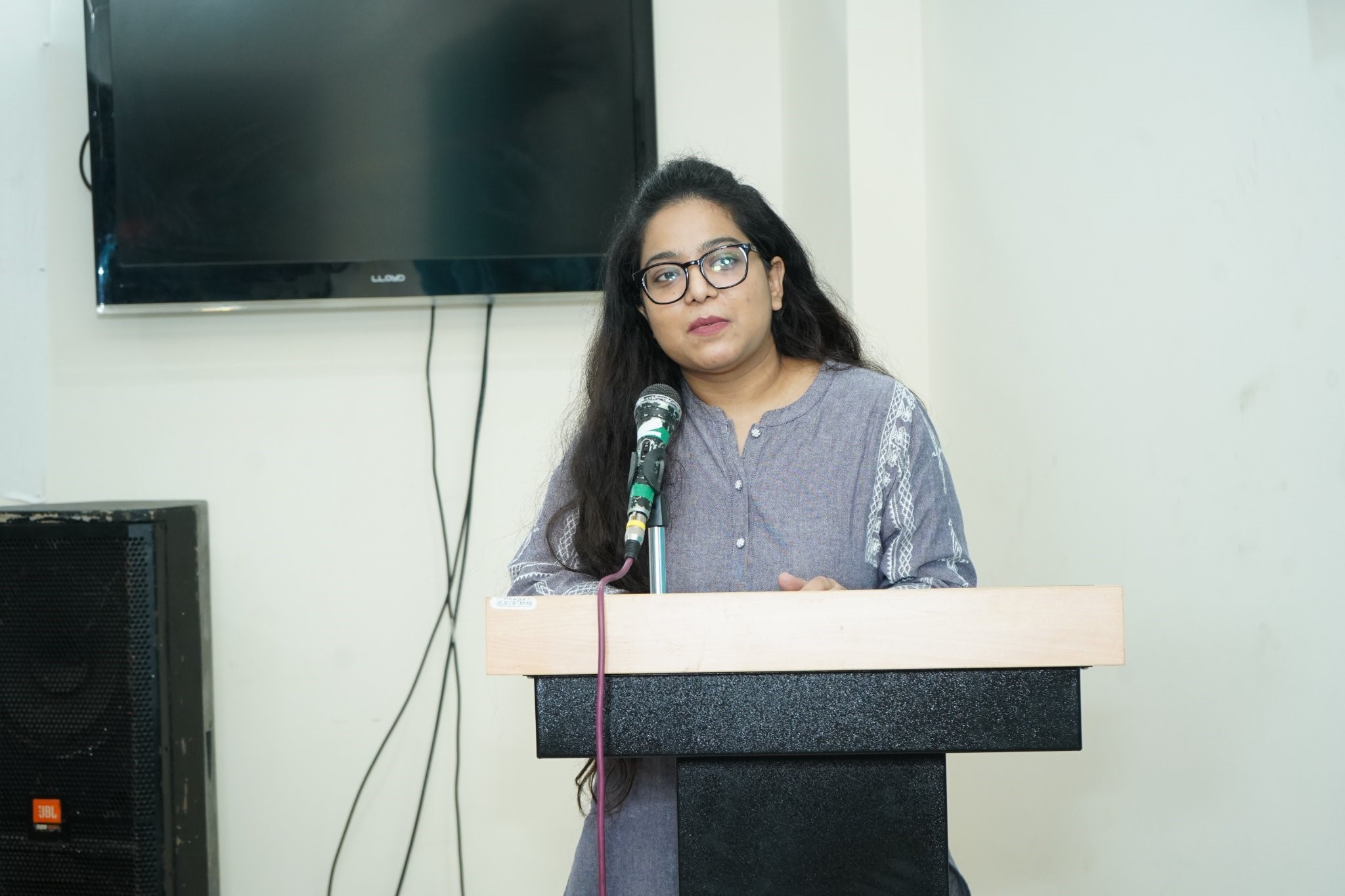
Let me extend my thanks and gratitude to the Christian Institute for the Study of Religion and Society (CISRS) for having me here and thank you for the solidarity that has been extended to me through this forum. These expressions of solidarity, of course, might be just a few words but it really does make a difference to somebody like me who is undergoing so much hardship on the ground and find it difficult to do an everyday task. See, when you come to such places like this and you know people talk to you with respect, they respect your struggle, they understand your struggle and they give solidarity, it really means a lot. It makes it easier to make yourself and the counter effects. It counts a lot and thank you for all of that. I am also really glad that I could come to this CISRS house and share some of my life experiences as a Muslim woman living in this time of undeclared emergencies.
I would like to share something very personal which is definitely political also. I was just a normal college student who is going about her work and is a viscous walker about things in her life. I am a practicing Muslim in so many ways and that is one thing that really kept me going through the present time. I did my graduation from Jesus St. Marys college and then I worked for a few years in the corporate world. Then I realized that I wanted to learn more. I decided to do my Masters and so I went to Jamia and I completed my Masters. I would say that I come from an upper-middle-class family located in the Ishk war region in Jammu and Kashmir which is different from the Kashmir valley. It is also different from the Jammu region in terms of geography and demography. In my childhood, I experienced a lot of curfews and military engagements in our place. I was very young at the time when the insurgency happened in our state. That was the time I started gaining consciousness as a child. It was a kind of experience that taught me a lot about our own life in our place. I started asking my questions about these things to my parents and but they never talked about the militants and the struggles of Kashmiris at that time. It was only when I came to Delhi, and I was taunted or hated for my identity as a Kashmiri Muslim girl I started thinking about it seriously.
My mind drastically changed when I came to Jamia when I got opportunities to interact with mainline Indian Muslims coming from varied backgrounds and I got to know about so many politics like left politics and secular politics. I started raising issues and concerns about the politics of identity and formulating my own politics as a citizen of this country. During curfews in connection with the anti-CAA struggles, I started organizing students and other people and organizations concerned about democracy, justice, and equal rights for all. The authorities were trying to crush the movement and stop the voice and at that time I had only one intention that is to keep the movement alive. At this time, we had two motivations, one, not to be silent in a time of injustice, and secondly to bring people to a common minimum program. Thus, we started the Jamia coordination committee which has been criminalized by the Delhi police in so many ways.
Since the lockdown period to today, the anti-CAA activists or the equal citizenship activists continue to be hunted in the country. Despite the processes of crushing the movement on the part of authorities, it was a moment when we saw so many faces, so many voices, and so many leaders who could put our voice forward, who could basically put our concerns and points forward for a just democratic society. I got arrested on the 10th of April when the whole country was going through a severe pandemic situation. I was in my house which was surrounded by policemen all around it. They took me away and they didn’t tell me why they were arresting me. When they arrested me, I found I have no lawyer who will be coming to jail at that time. It was really a very bad situation for me. I felt like I am going to be hanged. And I realized later that it was just the beginning of long-standing trials. Facing interrogations every day for about 4 and 5 hours, for 60 charges and for one UAPA, was very challenging for me. Living life as a UAPA accused and being trolled and trivialized insistently by the national media as an anti-nationalist were really new things in my life. The media influenced by the Hindutva movements tried to portray me as a symbol of over-sexualized, characterless, and criminalized Muslim women. Life has changed a lot. I had forgotten my earlier life totally.
All of us are well aware of the political process that we are undergoing now and of course, we have our own encounters with the state. At the same time, we are well aware of the potential of the civil society movement in this country. On one side we know that there is clear political propaganda that influences our executive system, legislature, judiciary, and media, and on the other side, we have civil society engagements for justice. And we need to be conscious that there is a progressive section in our country, which continues to blame religion or faith for the deterioration of the politics in this country at large.
It is so difficult to continue these battles simultaneously. Imagine, the police opening fire on a group of protesters in Ranchi and what’s trending on social media is everybody saying that there should not be any violence. There, the police should not deal with stone petals like this and it’s so stocky visible that one day later there was an Adivasi protest all over the country, how the language just drastically changes, it’s like angry youth pending stones at the police who were just sitting with their tails and legs. It was the same in the case of the Ram Navami protest, the entire discussion was about Muslims should abandon their sentimental approach and stop getting instigated and instigative. ‘Don’t instigate’ is nowhere. Last three years we have been asked to endure and not protest. It is so simple to say ‘don’t rape,’ rather than saying ‘not to be raped.’ I am sorry to say that even some of the feminists and the progressive people in our society who led so many movements and saw so many social movements, failed to understand this very, very simple problem. I look at this issue from the vantage point of islamophobia. It is Islamophobia. We have to name it. Even the progressive people are not recognizing the crucial ramifications of islamophobia that intrude into our notions, knowledges, and convictions. Recently I had a conversation with a group of progressive groups in our college and they started critiquing identity politics as a binary politics that is destroying the country and then spoke about the fecundity of the left-secular politics that considers all religions the same. It is unfortunate that we connect the politics of survival of Muslim people in India with the Islamic politics in Pakistan or any other terrorist activities in other parts of the world by ignoring the power- inequality that the minority communities are facing in this country.
Here, we need to constantly question our ideas of stringent nationalism and ask how it weaponizes Islamophobia and manufactures it. Islamophobia is about having some misconception about Muslims, of course, there is a global background for it. But then how it is weaponized and manufactured hate at the ground level is to be debated thoroughly. Now, whether it is the media, the police, the judiciary, the executive, anybody, any person in this country, I can see this phobia that is getting alarmingly growing and being legitimized.
One thing I need to clarify here. It is not easy to escape a particular identity in a homogenized world. People form institutions on the basis of their identities and they want to legitimize them. No political party in this country is an exception. I don’t personally feel that people will lose their night shells of identity one day and become an integrated part of a homogenized society. But there is a stalemate in the current situation that we don’t have a common minimum program that respects and differentiate various identities for the common good. We are not in a position to hope that our political system will rise above identity politics which has been used for electoral gains over these years and at the same time, we have terribly failed to eradicate hate from the hearts of the people. The rampant atrocities against minorities and the demolitions of their living spaces never enrich our hope to say that we are moving toward a radical democratic situation. What we are watching in the daily news and listening to the everyday stories makes us think that we are in a much worse situation than the Emergency. Today it has worsened from human right violation to genocide situation which alarms us to rally together to ensure a just democracy rather than doing the ritualistic acts of remembering and documenting the emergencies.
(Safoora Zargar is an Indian student activist leader from Kishtwar, Jammu and Kashmir, best known for her role in the Citizenship Amendment Act protests. Zargar was a M. Phil student of Jamia Millia Islamia and media coordinator of the Jamia Coordination Committee.)
Become a member
Get the latest news right in your inbox. We never spam!


Comments
No Comments