
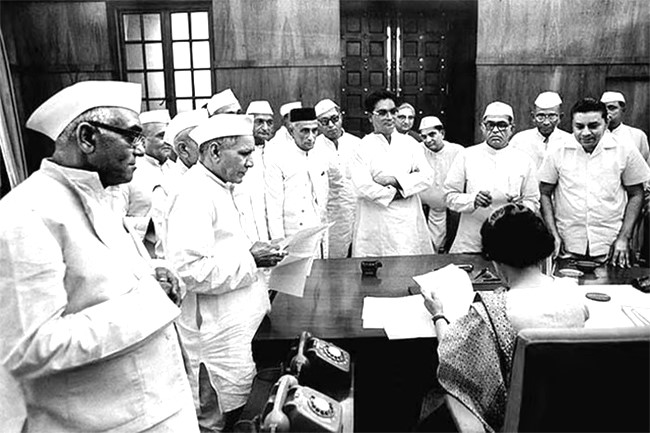
50th Anniversary of the Internal Emergency in India: Reflections from the CISRS Archives. This is an excerpt from the editorial published in Religion & Society, Vol. 67, No. 3, 2022.
Emergencies of Our Times
The Emergency which was proclaimed by Mrs. Indira Gandhi’s government on 25 June 1975, and which lasted for about 19 months, was a crucial period of time that hampered the democratic fabric of our country extremely. Mrs. Gandhi was given authority to rule by decree, allowing elections to be cancelled and civil liberties to be suspended under article 352 of our Constitution. In turn the law of the state was suspended, the judiciary, legislator, and administrative systems were controlled, and the voices of dissent were restricted. Most of Indira Gandhi’s political opponents were imprisoned and the press was censored. This was well-expressed in the ‘obituary’ published by the daily newspaper Times of India a few days after the Emergency: “Democracy, beloved husband of Truth, Loving father of Liberty, brother of faith, Hope and Justice expired on June 26.”
As we all know, the Emergency was not just a political plot of authoritarianism; in fact, it was incurred with social and economic impacts that warranted power to the elites and the industrialists. Apart from the human rights violations involved in the mass forced sterilization campaign spearheaded by Sanjay Gandhi, there was an urge for an authoritarian transformation of the socio-economic system in the interest of monopoly Capitalism. As it was well-narrated by Ajit Roy, the Marxist ideologue, the Emergency was the pre-taste of globalization and the entry of the neo-liberal economic culture in India. It was the Emergency that certified the fact that India can be an appropriate launching pad for the neo-liberal economy and culture in the future. This is the crucial fact that demands us to look at the Emergency critically.
Apart from the critical responses to the Emergency aroused from various corners of political organizations and people’s movements within the country, Christian response to the state of Emergency was diverse and assorted. Most of the Christian churches and faith communities supported the Emergency in order to show their allegiance to Congress and Indira Gandhi. They were ready to accept the need for Emergency as a disciplinary process for economic growth and prosperity. Christian Institute for the Study of Religion and Society (CISRS) was one of the progressive Christian organizations that opposed the Emergency on the basis of the conviction that freedom is a gift from God and the denial of freedom is the denial of the people’s right to participate in the process of their own development.
In response to the Emergency, CISRS exhorted Indian Christian communities to challenge all forms of authoritarianism and offer a genuine public witness that stands in solidarity with the progressive forces in this country. M.M. Thomas, the director of CISRS termed the Emergency as the end of democracy in India and said: “The Emergency is nothing but the onslaught on democracy and a betrayal of the nation.” Rejecting Indira Gandhi’s claims for the declaration of the Emergency, Thomas argued that unless we supported the revolts resulting from people’s effort to throw off age-old socio-cultural and economic structures, the issues of poverty, economic backwardness, and political instability would remain with us forever. For Thomas, the economic progress of the nation was integrally connected to the issues of caste, patriarchy, and slavery. He contended that the effort to quell people’s revolts for the sake of internal peace, economic progress, and self-reliance through a state of emergency was nothing but the repudiation of all human rights envisaged by a welfare state and its democracy.
As Arvind Narrain reminds us in his recent book entitled India’s Undeclared Emergency: Constitutionalism and the Politics of Resistance (2022), today we are in a crucial historical moment of ‘undeclared emergency’ where the rights of the citizens are ‘being snatched away under the guise of patriotism and cultural nationality’. The voices of dissent which constitute the heart of our democracy have been rendered acts of terrorism and urban Naxalism. The intellectuals who raise their voices against the tendencies of political authoritarianism and totalitarianism are tarred as anti-nationals and terrorists. By consciously constructing a centralized power system, the current political system has weakened and undermined our public systems of accountability such as the parliament, legislature, election commission, judiciary, and media. Neo-capitalism intrudes into our daily life in the disguise of neo-fascism. As Ramachandra Guha rightly puts it, the common link that connects both eras of emergencies is that ‘one party’, ‘one ideology’, ‘one law’, and ‘one leader.’ The state of emergency is returned when people are rendered objects of rule and denied their constitutional authority to decide their political participation.
At this juncture, the question that comes to our collective cognizance is how do we defend a normative state, a culture of inclusive nationalism, and cultivate secular and constitutional values that determine our common fate as citizens of this country? How do we recapture the counter-cultural forms of dissent rooted in our religion and culture and envisage pluriform existence that respects our differences? How do we envisage a culture of equality and justice today when the neo-capitalist forces manipulate our common life-world with the support of neo-fascist forces? Envisioning a common political platform of dissension is not the only task today; rather, to refurbish our religious, cultural, and moral thinking in favour of a social democratic system in our country.
(Rev. Dr. Y. T. Vinayaraj is director of the Christian Institute for the Study of Religion and Society (CISRS), Bangalore
Become a member
Get the latest news right in your inbox. We never spam!




Comments
No Comments