
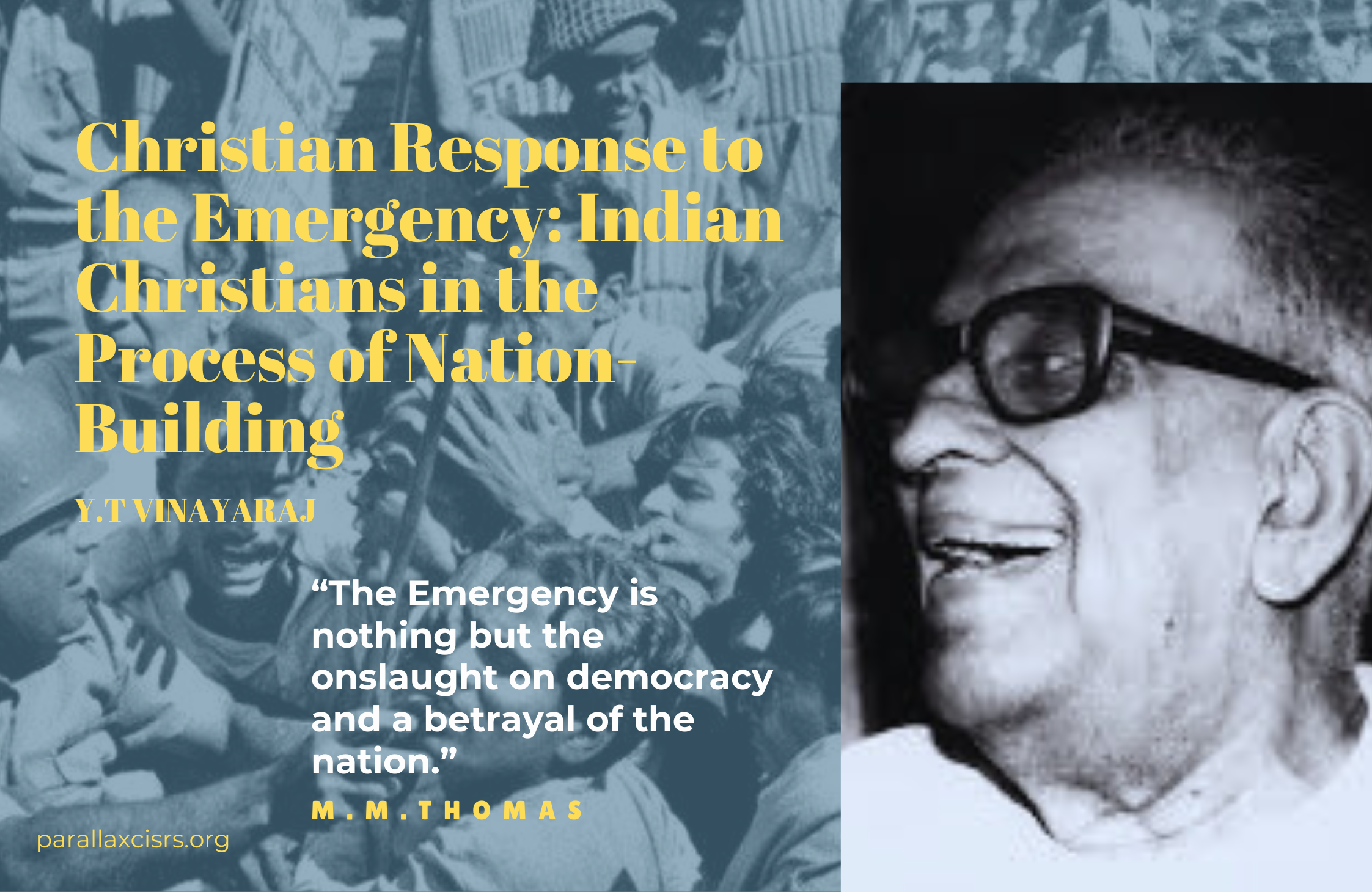
Christian Response to the Emergency: Indian Christians in the Process of Nation-Building
Y.T. Vinayaraj
Introduction
As a moment of national shame, a blot on India’s democratic record, the Emergency has been built mere as a moment for forgetting than as one for remembering. --Emma Tarlo[1]
Reflections on the Emergency must now, more than ever before, be pushed into “our” political terrain, so familiar and yet still so unknown. --Mary E. John[2]
Political democracy in which people participate in political process is the starting point for extending it to people’s participation in economic processes; on the other hand, a destruction of people’s right of participation in the political process will only destroy their chance of organizing themselves to make their influence felt in economic processes and to build themselves as self-reliant peoples. --M.M. Thomas[3]
Christianity in India has a vivid history of supporting nation-building in India. However, it has never been monolithic in content. There were Christians who remained within and still desired to be in the legacy of British governance in India. However, being a progressive faith community in India, we want to reiterate and reclaim the legacy of the progressive minority within the minority in the post-independent period that upheld the uncompromising commitment to the anti-colonial/nationalist movement in India and explored the liberative theological moorings to envisage a responsible Christian public witness in this country. The nationalist Christian missionaries like C.F. Andrews and the native Christian leaders such as H.C. Mukherjee, Bishop Azariah, K. T Paul, P.D. Devanandan, M.M. Thomas, S.K George, and J Russell Chandran invoked Christian faith communities in India to seek indigenous religious resources to develop an anti-colonial social existence in India.[4] The Madras Rethinking Group consisting of P. Chenchiah, A.J. Appasamy, and V. Chakkariai had already started this move from the Tambaram Mission Conference in 1938 itself. Christian organizations like YMCA (Young Men’s Christian Association), SCM (Student Christian Movement), AICIC (All India Conference of Indian Christians), YCCA (Youth Christian Council of Action), and CISRS (Christian Institute for the Study of Religion and Society) which were following the nationalist idea of Gandhi and his Nationalist Movement all over India enriched this progressive-nationalist Christian public witness in India. One of the major historical moments of that progressive Christian public witness in post-independent India was the Christian response to the Emergency declared in India in 1975.
The Emergency in India
Emergency in India was a 21-month period from 1975-1977 when Prime Minister Indira Gandhi had a state of emergency declared across the country at midnight on 25-26 June 1975. It was officially issued by President Fakhruddin Ali Ahmed under Article 352 0f the constitution because of the prevailing “internal disturbances.”[5] The emergency was in effect from 25 June 1975 until its withdrawal on 21 March 1977. The order bestowed upon the Prime Minister to rule by decree, allowing elections to be cancelled, and civil liberties to be suspended. In this period, the law of the state was suspended, the judiciary, legislator, and administrative systems were controlled, and the voices of dissents were restricted. Most of Indira Gandhi’s political opponents were imprisoned and the press was censored. It was a crucial violation of the power of the state and the rights of the people. Several other human rights violations were reported from the time, including a mass forced sterilization campaign spearheaded by Sanjay Gandhi, Prime Minister’s son. The Emergency was a fatal blow to the democratic setup of our country. This was well-expressed in the ‘obituary’ published by the daily newspaper Times of India a few days after the Emergency: “Democracy, beloved husband of Truth, loving father of Liberty, brother of Faith, Hope, and Justice, expired on June 26.”[6]
However, Indira Gandhi had her own clarifications for implementing the Emergency. According to Mrs. Gandhi, it was part of the social and economic disciplining; secondly, it was to abate the political demands of the opposition, especially Jayaprakash Narayan’s socialist movement; finally, it was to combat the emergence of the fundamentalist groups such as Rashtriya Swayamsevak Sangh (RSS) and the Sangh Parivar. Ajit Roy the Marxist ideologue, in his analysis of the factors that led to the declaration of emergency poses two things: (1) the urge for an authoritarian transformation of the socio-economic system in the interest of monopoly capital, and (2) the drive for ensuring the security of Indira Gandhi’s personal political power.[7] It is true that Indira Gandhi was facing a political inconsistency immediately after the Allahabad High Court’s verdict on Raj Narain’s case. On 12 June 1975, the Allahabad High Court found Indira Gandhi guilty on the charge of misuse of government machinery for her election campaign, and the court declared her election null and void and unseated her from her seat in the Lok Sabha. The court also banned her from contesting any election for an additional six years. This political unrest might have forced her to declare the Emergency. However, the people like Ajit Roy focus more on the socio-economic reason forced by the monopoly capitalist which in turn invoked severe criticisms from the trade unions and the socialist movements in India.[8]
The Christian response to this state of emergency was not uniform. According to Saral Chatterji, the Christian responses to the Emergency were mainly of three kinds: first, approval of the Emergency so as to show the Christian allegiance to Congress and Indira Gandhi and to express their dissatisfaction with the freedom offered by the state which becomes a hindrance to the sociopolitical and the economic freedom of the country; second, accepting the need of Emergency as a disciplinary process for economic growth and at the same time restless at the severity of the measures of press censorship and detention without trial; third, opposing the Emergency on the basis of the conviction that the freedom is a gift from God and the denial of freedom is the denial of the people’s right to participate in the process of their own development.[9] The progressive Christian response to the Emergency is reflected in the third approach which is clearly stated by the journal of CISRS, Religion and Society:
We take our stand with those who believe that bread and freedom go together, especially in a poor country like India. For, poverty here is not purely an economic phenomenon, it is intertwined with traditions of social authoritarianism and cultural fatalism which can be resisted and overcome only through the political awakening and awareness of dignity and power of the poor and the oppressed. We also believe that the mission of the churches is not merely or primarily to safeguard Christians’ ‘communal’ interests but to work for the human dignity and rights of all citizens of this country.[10]
Christian Response to the Emergency
When most of the established churches in India were endorsing Mrs. Gandhi’s declaration of Emergency in 1975, the progressive Indian Christian thinkers expounded it as the end of democracy in India. WCC General Secretary Dr. Philip Potter’s letter to Indira Gandhi immediately after the declaration of Emergency explains clearly the responsibility of the global ecumenical movement:
We understand that a very large number of political prisoners have been held under Emergency laws. There is widespread distress over the detention without trial of people arrested on political grounds and the total denial to them of any judicial remedies. We feel strongly that the powers now assumed by the executive, under the amended Maintenance of Internal Security Act which provides that no grounds be given for the detention of any person and that no person detained shall have any rights to personal liberty by virtue of natural law, constitutes a very serious abridgment of human rights. More than three months have elapsed since the declaration of the Emergency and the continuance of these measures against those who have dissenting political views is very disquieting.
...We, therefore appeal to you to take steps to release those who have been detained on account of political dissent and to restore the democratic right of the people for political expression, discussion, and dissent. We equally appeal to you for the release of Mr. Jayaprakash Narayan and others of proven moral and political integrity. We are confident that such steps will contribute to maximizing the participation of the people and will strengthen your attempts for the revitalization of the economy and for ensuring justice, especially for the weaker sections of society.[11]
Taking a strong stand against the Emergency in India the General Secretary of the Christian Conference of Asia (CCA), Yap Kim Hao wrote to the National Council of Churches in India (NCCI) to make a representation to the Government of India to appeal to release all the prisoners who had been detained on political agenda:
The question of political prisoners in several countries in Asia came up for discussion at the meeting. Special concern was expressed about a large number of political prisoners in India. While no accurate figures are available, there is evidence that the number of detainees is very high. The working group particularly noted that all these are detained without any trial, most of them for more than one year now. Again, the laws regarding detention in India appear to be the most rigorous in Asia. The working group has asked me to urge the NCC of India to make representations to the Government of India appealing to the Government to release all prisoners who have been detained on political agenda.[12]
Christian Institute for the Study of Religion and Society (CISRS) took a strong stand against the Emergency for weakening the democratic values of the country and denying the rights of the common people to express their views and perspectives on their own future.[13] M.M. Thomas, the director of CISRS termed it the end of democracy in India and said: “The Emergency is nothing but the onslaught on democracy and a betrayal of the nation.”[14] Rejecting Indira Gandhi’s claims for the declaration of the Emergency, Thomas argued that unless we supported the revolts resulting from people’s effort to throw off age-old socio-cultural and economic structures, the issues of poverty, economic backwardness, and political instability would remain with us forever. For Thomas, the economic progress of the nation was integrally connected to the issues of caste, patriarchy, and slavery. He contended that the effort to quell people’s revolts for the sake of internal peace, economic progress, and self-reliance through a state of emergency was nothing but the repudiation of all human rights envisaged by a welfare state and its democracy.[15] Thomas upheld that the essence of democracy is to affirm people’s right to enter into the political, economic, and social process of building the nation. Political freedom is the basis of all other freedoms. Affirming people as the subjects of history determines the democratic status of a country. He explains this:
The essence of democracy is that people are subjects of history and not objects of exploitation, or even of welfare, that their right to participation in the policy-making processes where power is exercised, is sacrosanct, and that if one form of democracy narrows the expression of this right to the political sphere, the answer lies, not in denying it in that sphere but in extending it increasingly also to the economic and social spheres which influence politics.[16]
Critiquing the conformist stand of the majority of Indian Christians, M.M. Thomas wrote in the journal of CISRS, Religions and Society which offered a staunch critique of the state-authoritarianism: “The Church in India is called upon to witness to the power of the human future in Christ to overcome them. Instead, the churches are pursuing a policy of conformism.”[17] Thomas contended that the church is more than a minority community concerned with its own communal interests. “In Jesus Christ, the church represents the humanity of all the people of India.”[18] Under the leadership of M.M. Thomas CISRS launched a sharp critique of the Emergency and circulated a statement entitled “Why the Ruling Congress Should be Voted Out” during the time of campaigning for the general elections.[19] Saral K. Chatterji who was a strong proponent of the anti-emergency programmes of CISRS commented on the political solidarity of Indian Christian thinkers with the secular progressive politicians as “the formation of new community beyond the traditional so-called Christian community.”[20]
Apart from CISRS, Christian movements in India like the Student Christian Movement of India (SCM), Christian Union of India, Christian Association of India for Peace with Justice, and the Fellowship of the Clergy Concerned with Human Rights formed in Kerala recorded their dissent to the state totalitarianism and at the same time offered their solidarity to the efforts to retain peace and justice in the land. The Synod of the Church of South India (CSI), despite their support to the 20–point programme of Mrs. Gandhi, demanded the immediate withdrawal of the restriction on the freedom of the press and the fundamental rights of the people due to the state of Emergency.[21] The metropolitan of the Mar Thoma Church, Dr. Yuhanon Mar Thoma wrote a letter to Mrs. Gandhi and expressed his voice of dissent: “A vast number of people, and that a growing number, feel the price we have to pay is costly, with people like Morarji and others in jail, and a Press which has its freedom to write news and views we feel a kind of depression. On behalf of thousands, I request withdrawal of emergency by gradual stages.”[22] Critiquing the churches’ endorsement of the state of Emergency, Anand Chandu Lal, a pastor of the Church of North India (Later he became the moderator of CNI) interrogated the nationalist attitude of the church for being alienated from the struggles of the common people in the country who were deeply affected by the Emergency.[23]
Political Theology in the Post-Emergency Context
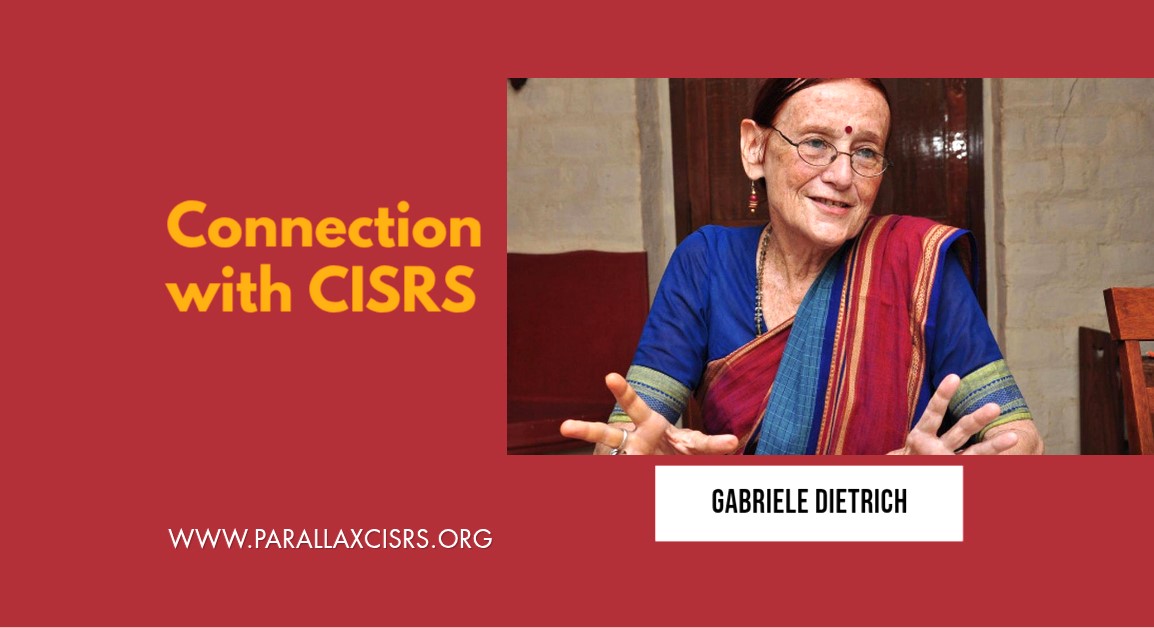
Mary E John, as she takes a radical turn from the other social researchers, who deal with the state of Emergency in India as a critical moment in the history of its democracy and state, argues that it was a potential time of the emergence of new social movements including women movements that envisaged politics differently other than that of the repressive politics of the state.[24] According to John, the Emergency has to be seen as a potential political sight where new social movements have emerged and the common people started critiquing the totalitarianism of the state in and through their daily activities of resistance. In the same vein of thought, Gabriele Dietrich contends: “Jayaprakash Narayan’s Total Revolution Struggle against the Emergency galvanized enthusiastic participation…there seemed to be a space opening up for independent voices of transformation.”[25] It was true even in the case of Christian communities in India also. The resistance to the Emergency initiated at least two things in Christian communities in India: the emergence of Christian social action groups to interrogate the dominant pattern of development and to stand in solidarity with the marginalized and the oppressed; secondly, the emergence of a radical political theology of state and democracy.
There was a deep quest among the Christian faith communities in India in the post-Emergency context to initiate welfare programmes for the marginalized and the oppressed and thereby formulate a radical theology of development and democracy. It was not in terms of social charity and mission; rather it was in the form of critical social action and social engagement. In response to the economic paradigm that led to the declaration of the Emergency in India, the progressive Christian communities identified it as a “Taj Mahal philosophy of development”[26] –economic growth minus economic justice. S.L. Parmar who was a pioneering Christian leader at this period who initiated those creative discussions within the Christian circles stated it clearly:
Economic growth is essential for overcoming poverty and human misery. But an obsession with quantitative growth (higher GNP) without integrating it with social justice, self-reliance, and mobilization of people’s power, has generated serious contradictions in many countries of Asia, Africa, and Latin America.[27]
Parmar exhorted for an ideology of ‘growth that brings development for all.’ Taking this cue, CISRS started thinking in terms of its role in building up people’s movements for justice and offered a radical theology of development for preparing people against the dominant ideology of development. Gabriele Dietrich explains the rationale of this paradigm shift: “development cannot be achieved by money, foreign aid, copying Western models or eastern models, drafting five-year plans, but it will be brought about by the people themselves.”[28] Thus, CISRS invoked Christian churches to formulate and support people’s movement for justice. It is well-expressed in the words of Prof. Saral K. Chatterji: “the Church’s voice in its relations with the State or government must be strengthened by a constant effort to listen to the people in their concrete situations, and its ideas on social, political and economic matters must be forged on the anvil of its concrete involvement in the people’s struggles.”[29] In the 1980s in India, there was an uprising of various Christian social movements demanding justice for the Dalits, Tribals/ Adivasis, women, and traditional workers who had lost their land, labor, and livelihood due to the new development policies of the state. Delhi Forum, Programme for Social Action (PSA), Fellowship for Justice Concerns (FJC), Urban Industrial Rural Mission (UIRM), and the Bombay Urban Industrial League for Development (BUILD) are some of them.[30] CISRS initiated peoples’ movements like JWP (Joint Women’s Programme), AICPF (All India Christian People’s Forum), AIDWF (All India Dalit Women’s Forum, and LEAS (Legal Education and Aid Society) for the cause of economic and social justice.
From the Catholic Church circles, Fr. Sebastian Kappen initiated a radical theology of development and human rights in the post-Emergency period. He criticized the Emergency for declining the fundamental freedom of people in the name of economic growth. For him, it was a political move to support the industrial bourgeoisie to dominate the depressed classes in India. He held the view that the emergency accentuated the already existing economic disparity in the country. For him, the emergency legitimized further the concentration of political power and social resources among the elites and the high castes. Fr. Kappen contended that the Church as the Disciples of Christ must stand for wholistic freedom and thereby stand in solidarity with the struggling masses in order to envisage Jesus’ kingdom in this land.
Christians who join the struggle of the masses for the progressive structural transformation of the class society of today into the classless society of the future will be but translating the original concern of Jesus into the contemporary historical initiative. What marked him out from the prophets of old and from the apocalyptic visionaries was his teaching that the future hoped for, the kingdom of God, was already emerging in the present where man’s response met God’s challenge. …. The disciples of Jesus have to help the oppressed masses in India bring the present they live closer and closer to the socialist future they hope for.[31]
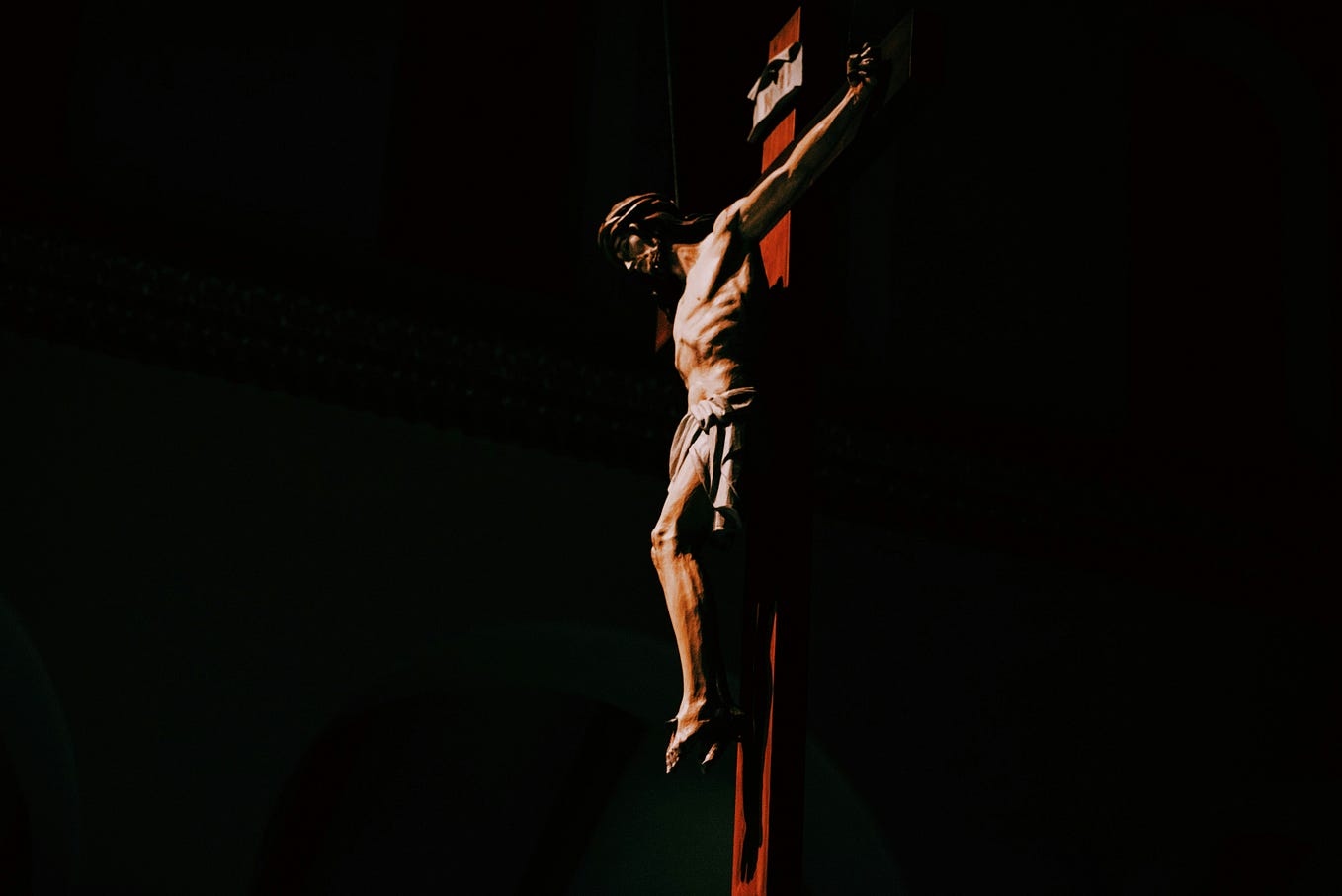
M.M. Thomas, on the other hand, tried to offer a radical political theology of state and democracy. According to Thomas, the cross as it is the self-manifestation of the self-forgetting and self-sacrificing God signifies the negation of the totalitarian exercise of power over humans. Differentiating ‘kingship’ from ‘servanthood’ Thomas defined the role of the state to serve the people, but not to rule over the people. Thomas cites St. Mathew to clarify his theology of state: “You know that the rulers of the Gentiles lord it over them, and their great men exercise authority over them. It shall not be so among you, but however, would be first among you must be your slave; even as the Son of man come not to be served but to serve; and to give his life as a ransom for many” (Mt. 20: 25-28). Thomas comments that the throne of David has been replaced by the kingdom community through the crucified and risen Jesus Christ.[32] He interrogated the totalitarianism and the authoritarianism of the sovereign state and demanded a social democracy based on freedom and justice.
Thomas argued that on the cross, Jesus Christ disarmed the rulers and the authorities of the world. The empire is defeated and nullified. Cross signifies the end of the totalitarian power and the beginning of a New Humanity—a secular Koinonia where there is no dichotomies. Alluding to Paul, Thomas argues that in New Humanity “there is no longer any distinction between gentles and Jews, circumcised and uncircumcised, barbarians, savages, slaves, and free men” (Col.3:11). The New Humanity is constituted as a single body—the political ontology of the tortured. The crucified body of God is not a new thing; rather it is the body of the slain lamb from the creation of the world and it continues to be slain till the end of the world fighting against the totalitarian forces of powers. The political ontology of the tortured signifies the church which bears the mark of crucifixion. Connecting his political theology with the diaconal duty of the church, Thomas writes:
The church in India is called to proclaim the gospel of the crucified and risen Christ as the source of redemption of all spiritualities underlying religion as well as ideologies, and to demonstrate the Koinonia in Christ around the Eucharist as the nucleus of a movement of the larger Koinonia in Christ uniting peoples of diverse religions, ideologies, and cultures—as well as the cosmos with its bio-diversity.”[33]
Political theology in the post-Emergency period envisaged a secular Koinonia where the church stands in solidarity with the poor and the oppressed in their struggle for justice and thereby gives up its communal self-interest and self-identity for the sake of building a larger community of justice.[34]
Conclusion
In the history of the Christian communities in India, the quest for the building up of a secular nation-state in India has always been there and it got new momentum during the state of Emergency in 1975. During this period, Churches tried to think about their critical responsibility in civil society as it is well-founded on the life and the witness of Jesus Christ in the context of Roman imperialism. The post-Emergency context reveals the church’s quest for formulating a theology of development in favor of the weak and the excluded. Connecting the economic and the social issues of civil society with the political desires of the common people in the margins of society Christian faith communities in India were able to envision a secular ideology of Christian public witness in India. If we consider the state of Emergency as a ‘Kairos-moment’ moment for the faith communities in India to reclaim their call and commission to be a servant of the public society in India, then the contemporary context of the “undeclared emergency” is to be yet another historical moment to give birth to radical theological imaginations of justice. As Emma Tarlo said; “the Emergency should be a moment of remembering; not of forgetting”.
Rev. Dr. Y.T. Vinayaraj is the Director of Christian Institute for the Study of Religion and Society (CISRS), Bengaluru. This article was initially published in Indian Christianity and Its Transformative Potentials, edited by James Ponniah, Delhi: ISPCK, 2025, pages 106 to 118.
Notes
[1] Emma Tarlo, Unsettling Memories: Narrations of India’s Emergency (Delhi: Oxford University Press, 2003), 19.
[2] Mary E. John, ‘The Emergency in India: Some Reflections on the Legibility of the Political,’ Inter-Asia Cultural Studies 15.4 (2014) 625-637 at 636.
[3] M.M. Thomas, Response to Tyranny (New Delhi: Forum for Christian Concern for People’s Struggle, 1979), 62.
[4]C.F. Andrews once said during the emergence of the National Missionary Society (NMS): “She [the Church in India] assimilates as largely as possible the ancient traditions of India, and makes them a vital part of her own constructive growth.” C.F. Andrews, The Renaissance in India: In Missionary Aspect (London: Church Missionary Society, 1912), 167. M.C. Mukherjee advised Christians in India: “We have to demonstrate by every word we utter and by every act we perform that the professing of a different religious faith has not tended in the least to make us less Indian in our outlook than our non-Christian brethren, that we are prepared to play our part and to shoulder our share of the responsibility in every kind of work undertaken for the benefit of our country as a whole.” Happy Gestures, hindubooks.org.
[5] The final decision to impose an emergency was proposed by Indira Gandhi, agreed upon by the President of India and thereafter ratified by the cabinet and the parliament (from July to August 1975), based on the rationale that there were imminent internal and external threats to the Indian state.
[6] Timesofindia.indiatimes.com
[7] Ajit Roy, ‘The Indian Events from the Indian Perspective,’ in The Meaning of the Indian Experience: The Emergency, edited by Saral K. Chatterji (Madras: CLS, 1978), 5-17 at 10.
[8] Ibid., 12-14.
[9] Editorial, Religion and Society, Vol. XXIV, Nos. 2 & 3, June & September 1977:2
[10] Ibid.
[11] Letter from Dr. Philip Potter, General Secretary of the World Council of Churches, to the Prime Minister Mrs. Indira Gandhi dated 9th October 1975 (released to the Press on 24th October 1975 in Geneva), Religion and Society, Vol. XXIV, Nos. 2 & 3, June & September 1977: 3-4.
[12] Christians and The Emergency: Some Documents, Religion and Society, Vol. XXIV No. 2&3, 1977: 8.
[13] Ibid., 9
[14] M.M. Thomas, Response to Tyranny, 66
[15] Ibid., 67.
[16] M.M. Thomas, Response to Tyranny, 16.
[17] M.M. Thomas, Editorial, Religion and Society, Vol. 24 No.2-3, 1977, p. 256
[18] M.M. Thomas, Response to Tyranny, 39.
[19] A Consultation held in Bangalore, Feb. 19, 1977; published in R & S Vol. 24, Nos. 2-3, 1977, p. 129-133.
[20] R.W Taylor, “Churches in India,” in Christianity and Crisis, R & S, Vol. 38, No.19, June 26, 1978, p. 166.
[21] The Church of South India—Resolution of the Fifteenth Synod—January 13-17, 1976 published in Religion and Society, Vol. XXIV No. 2&3, 1977: 44-45.
[22] Letter to Prime Minister Mrs. Indira Gandhi written by Juhanon Mar Thoma, Metropolitan of the Mar Thoma Church on 25th August 1976. Religion and Society, Vol. XXIV No. 2&3, 1977: 65.
[23] Anand Chandu Lal, ‘Some Observations and Reflections on the Church in India Before, During and After the Emergency,’ in The Meaning of the Indian Experience: The Emergency, 83.
[24] Mary E John, ‘The Emergency in India: Some Reflections on the Legibility of the Political,’ in Inter-Asia Cultural Studies, Volume 15, 2014 issue 4.
[25] Gabriele Dietrich, ‘Upholding Each Other,’ in Ritu Menon (ed.) Making Differences: Memoirs from the Women’s Movement in India (New Delhi: Women Untold, 2001), 10’
[26] M.M. Thomas, Religion and Society, Newsletter No. 5, June 10, 1976.
[27] S.L. Parmar, “Education for development,’ in Religion and Society, Vol. 20, No. 2, 1973: 21.
[28] Gabriele Dietrich, Religion and People’s Organization, Introduction, Religion and Society, p. xi.
[29]SK Chatterji, “Church-State Relation in the Context of the Indian Emergency,” in The Meaning of the Indian Experience: The Emergency, 76.
[30]Vincent Rajkumar, R.C. Thomas & Arun Kumar Wesley (eds.), Journeying in Faith and Action: A Story of CISRS (Bangalore: CISRS, 2017), 43.
[31] S. Kappen, ‘Christians and the Socialist Challenge in Post-emergency India,’ in The Meaning of the Indian Experience: The Emergency, 97
[32] M.M. Thomas, The Throne of David (Tiruvalla: CSS, 2006), 41.
[33]M.M. Thomas, A Diaconal Approach to Indian Ecclesiology (Rome & Tiruvalla: CIIS & CSS, 1995), 82.
[34]M.M. Thomas, “The Church in India—Witness to the Meaning of the Cross Today,” in Future of the Church in India, ed., Aruna Gnanadason (Nagpur: NCCI, 1990), 11.
Become a member
Get the latest news right in your inbox. We never spam!


Comments
No Comments