
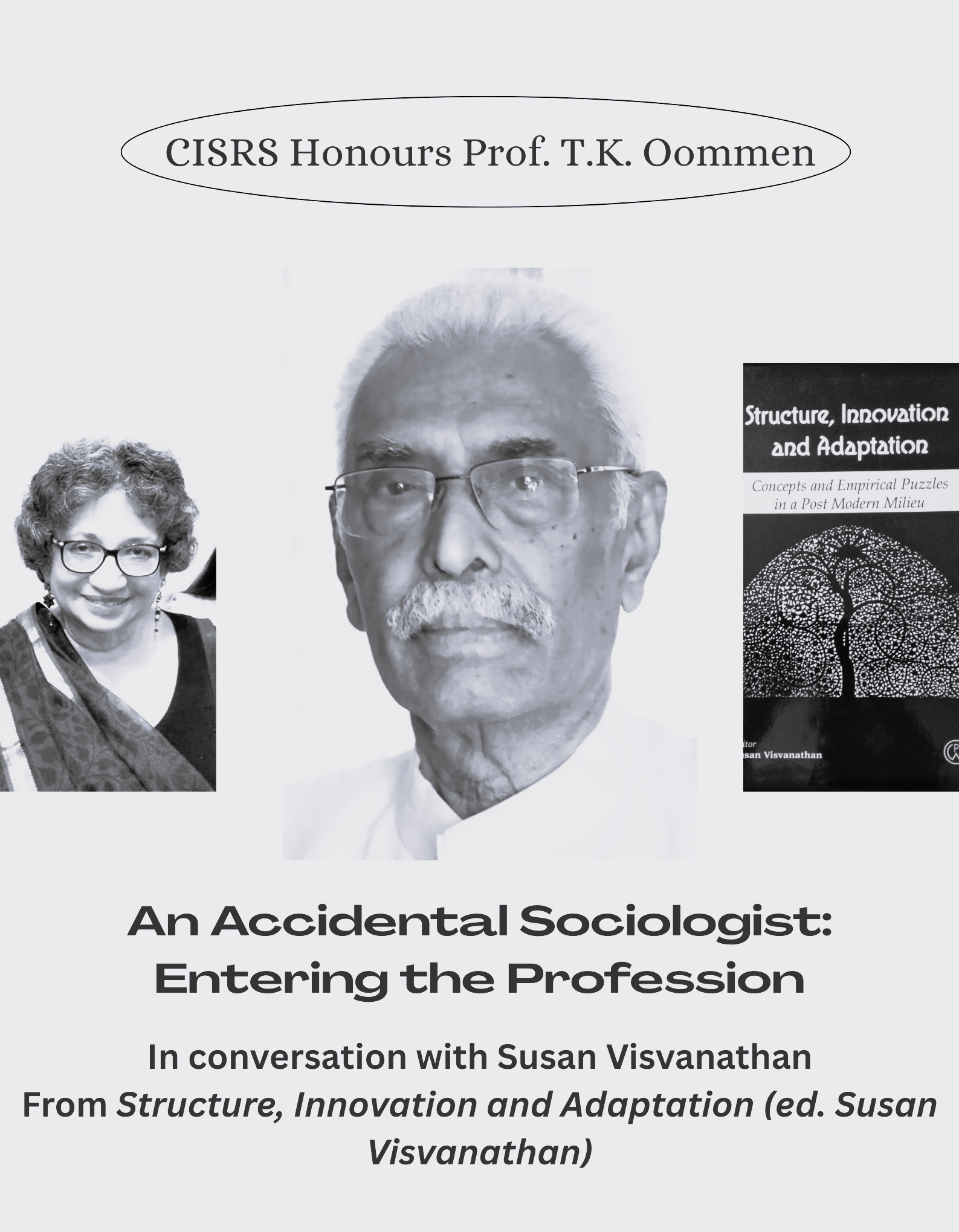
Remembering T. K. Oommen: 'The Accidental Sociologist'
Tharailath Koshy Oommen (1937-2026), a distinguished Indian sociologist, author, educationalist, and Professor Emeritus at the Centre for the Study of Social Systems at Jawaharlal Nehru University in New Delhi, passed away on February 26, 2026. In recognition of his contributions to education and literature, he was honored with the Padma Bhushan award in 2008 by the President of India. Throughout his career, he held several prominent positions, including President of the International Sociological Association from 1990 to 1994, a member of the Sachar Committee, and Vice-Chair of the Commission on Church and Society for the World Council of Churches in Geneva. He had numerous publications, including articles and book chapters in both national and international journals. Professor T.K. Oommen was also a close associate of CISRS since its inception.
Prof. T. K. Oommen often described his entry into sociology as “accidental”. His path was shaped by missed opportunities and chance decisions. He had intended to pursue social work but found himself drawn into a lifelong engagement with sociology. As a student, he encountered scholars such as Irawati Karve, S. C. Dube and M. N. Srinivas, who exposed him to different approaches to studying Indian society. Oommen formed his own perspective through discussion, fieldwork and historical inquiry. He later played a significant role at Jawaharlal Nehru University, where he was among the early faculty who helped shape the Centre for the Study of Social Systems.
In a conversation with Susan Visvanathan, a sociologist, Oommen recalls his journey from childhood in rural Kerala—marked by modest circumstances, long walks to school, and life in the closing years of the Travancore princely state—to his emergence as a sociologist in India.
These reflections (reproduced from Structure, Innovation and Adaptation) are more than personal memories. They offer a glimpse into the early years of sociology in India and the effort to develop ideas and methods rooted in the country’s own social realities.
CISRS presents this piece as a tribute in Oommen’s own voice—an introduction to the life and thought of one of India’s foremost social thinkers.
An Accidental Sociologist: Entering the Profession
T.K. Oommen in conversation with Susan Visvanathan
I come from Venmoni, a village in Allapuzha district. Mavellikara, Panthalam and Chenganoor are the closest towns all of which are 10 to 12 kms away from my village.
My father was working in Travancore, Kerala. He was in the Electricity Department. Since there was a lot of communal discrimination at that time, in Travancore, his promotion was not given in time, and so he shifted to Cochin. Both Travancore and Cochin were principalities which became parts of Kerala.
I was born in 1937, in my mother’s village, as the convention among Syrian Christians is that the first couple of births are handled by the wife’s family. Karipuzha, my mother’s village lies between Mavellikara and Haripad.
I went to the nursery school in Karipuzha. It was called Olapallikudam. We were taught the first letters on sand which were inscribed on palmleaves. In 1941, because of World War situation in Cochin my mother insisted that Mathew, (you know him, as the founder of Deepalaya, which educates street children in Delhi), a younger sister and I had to shift to my mother’s home for a year.
After one year in Karipuzha, I went to Venmoni and lived with my mother and siblings as a tenant in a house adjoining our Tharavad, the joint family home, till my father constructed a house for us. We could not stay in the family home, as my father’s eldest brother lived there, with his wife, six children and our paternal grandmother. There, in Venmoni, I studied in the Government Primary School till the Fourth Form. I went to Middle School run by the Mar Thoma Church. Ours was one of the biggest Edavagas, or parishes, of the Mar Thoma Church. Venmoni School stopped at Class Ten. So I had to plan to attend some college for Intermediate, the first two years of College.
There was no bus service through the village. One had to walk for 3 or 4 kms and then catch a bus. The college in Pandalam, the nearest town, was a college run by NSS (Nair Service Society). However, I studied in Changanaserry, since my parents thought I was too frail a child to travel to Pandalam. I went to live with my mother’s sister, who lived a close distance, a fifteen minute walk, from Saint Berchman’s (SB) college in Changanaserry. I did my intermediate from 1953–1955 from SB. I went for my B.A to Trivandrum University College and did my B.A in Economics (main), with Indian History and Politics (subsidiaries), English and Malayalam. I got my first degree in 1957.
I was not very happy with Economics, so I started talking to people, about future studies. The suggestions which came were that I study with D.N. Majumdar (Anthropology) in Lucknow, or with Ghurye (Sociology) in Mumbai. Job opportunities were however in Social Work. So I applied to Delhi School of Social Work. Though I went through the interview, which was held in Kerala, and was selected, I did not get the letter of admission. Consequently I went to take my seat for a Diploma in Social Service Administration from Tata Institute of Social Science (TISS) Bombay. While on the train, we were forced to disembark in Poona, since there was a flash flood. We were told we could re-use our ticket up to three days, if the track was cleared.
There was one Mr Panikkar on the train who was a railway employee, but he was also a Pune University student, and he told me that since I would miss the admission in Bombay, why not try for admission at Pune University? When I went to Pune University, the admission registration was over. Panikkar had told me, “If you have a problem, go and meet Swamy.” Swamy was the Assistant Registrar, Academic, of the University, by name Mr Venkatakrishnan, a Pallakad Brahman. The guard at his door would not let me in, so I sent a chit with my name. Swamy called me in, and asked: “Whatdo you want?” I described the situation to him. “Give me in writing what you have said just in one page.”
I borrowed paper from him and wrote out my story, and my ambition to study, and after reading it, he scribbled something in Marathi, and sent me to Mr. W.H Golay, the Registrar. I did not know Hindi, or Marathi, and only a little English. The Registrar, after reading the page I had written asked: “Who wrote this?”
“I did.”
Then he wrote on the margin, “May be Admitted.”
After three days, I did catch the train to Mumbai, but admissions were closed there, and I returned to Poona as an M.A student of Sociology. I was a University topper, who had been trained by Professors Irawati Karve, and Y.B Damle. I could have become a Ph.d candidate, but Prof Karve had got an assignment as Consultant to Program Evaluation Committee of Planning Commission. She used to commute between Delhi and Poona, and take two hours of classes on one day a week, certainly a brilliant orator and teacher. She was not taking any Ph.d students that year. Damle got a fellowship to MIT (Massachussetts Institute of Technology) that year. There was no other Ph.d supervisor. I was rendered an academic orphan, looking for something.
S.C Dube, was visiting Damle at Poona University. I was asked to dinner by Damle to meet S.C, being the topper that year. Dube invited me to Saagar: “Young man, what is your plan?” he enquired. Those days S.C Dube was at Saagar, and he said “I can take care of you for one year, as a research analyst.” He offered me three hundred rupees per month as salary, which was a large sum of money.
The Delhi School of Economics had advertised a Fellowship in Sociology. The Selected Fellow would work with M.N Srinivas as the advertisement specified. I was invited to Delhi for the interview at the Delhi Department of Sociology and I went there. Imtiaz Ahmed got the Fellowship, and I didn’t. I was very upset. I had done a good interview by chance. I felt I had deserved the fellowship. Imtiaz had however many things in his favour, though in the end, he did not receive a degree under Srinivas. Imtiaz had got his M.A degree in 1959, a year before me, and he had worked for a year for his Ph.d. In 1960, his teacher D.N. Majumdar had passed away. So he had been trained in Social Anthropology, by a very eminent man, and from a more reputed department at Lucknow.
Srinivas asked me in the course of the interview at the Delhi department: “How will you compare Syrian Christian dowry with Marcel Mauss’ Gift?” Luckily I had studied The Gift and Wilfred and Monica Wilson’s monograph on Central Africa. I had read The Gift, summarised it, presented it to my teacher and fellow students in class, and then critiqued it, while doing M.A at Poona. The interviewers appeared to be startled and seemed a little appalled by my dexterity and efficiency because The Gift is not a text usually prescribed for M.A Sociology students. But they did not give me the Fellowship.
Y.B Damle was very influenced by Parsons. He was enchanted by him, and had all his books ostentatiously exhibited in his library at home. Delhi Department of Sociology was anti-Parsons at that time. I was more influenced by Merton. Damle had this reputation of being Parsonian, and I was implicated by my teacher’s reputation. Current Sociology would invite people those days to write a bibliographical essay. Srinivas was invited to do an essay on caste. He invited Damle, Andre, and Mrs Shahani to contribute. One of the persons who collected the data for Damle was myself. There were enough books in Deccan College on caste which I could read.
The man who edited Current Sociology those days was T.B. Bottomore. Damle went for the Indian Sociological Society conference, perhaps in Lucknow with his Report on Caste. He showed it to Bottomore, who was surprised, since he had received the same with Srinivas’ name on it, with Damle as one of those who assisted. Damle, when he came to know that his material had been substantially used in the report without due authorship/acknowledgement, felt insulted, and published his piece independently in the Deccan College series.
My not being selected for the Delhi School Fellowship was perhaps because of the academic animosity between Srinivas and Damle at that point in time. After doing a good interview, I had been so sure of getting selected!
I had been taught by Valsala Rao, the wife of D. Narain of Mumbai. She was in the Gokhale Institute of Economics and Politics, and she was a lecturer in Demography, teaching a course on ‘Population and Society’ to M.A (Sociology) students. She joined Institute of Economic Growth. I used to go to the Delhi School Library, to read there. Valsala said, “Srinivas was very impressed with you. He canarrange for a fellowship for Rs 250 from UGC. He wants you to study “Religion and Society among the Syrian Christians.” But I was not attracted to the theme.
I remember meeting Vinobha Bhave when he visited Chenganoor 11 kilometers from my village. I am not a Marxist, or Leftist, but I was interested in the agrarian proletariat, and that was what I wanted to work on for my Phd. I certainly did not want to work on the Religious Life and Social Customs of the Syrian Christians of Kerala. I told Valsala, rather arrogantly, “I do not want a Consolation Prize from Srinivas.” Many years later, Srinivas was travelling from Bangalore to Delhi, and so was I, and he said “Oommen, let’s get our seats together, so we can chat.” It was kind of him to suggest it. He was always interested in promoting young academics. He admitted to being sorry that Imtiaz did not finish his Ph.d under the Fellowship, at Delhi University’s Department of Sociology. We could chat as fellow Sociologists while travelling and I accused him of promoting “academic particularism.” He was partisan to Social Anthropologists.
I stayed in Delhi from 1960 June to 1962 March, an unemployed person with a First Rank in Sociology!
I was reading in the Libraries in Delhi and I met a friend, the late George Mathew. He was my class mate in Saint Berchman’s College. He worked with T.K.N Unnithan, who was in charge of Rural Housing Division in School of Planning and Architecture. Unnithan was asked by the UNESCO to write a report on Accumulation and Consumption of Wealth in South Asia. The UNESCO report was returned for revision. So I was invited to work as an honorary research assistant. My first paper “Impact of Social Structure on Accumulation of Wealth” emanated out of this, and it appeared in AICC Economic Review which in those days (1961) was the intellectual mirror of the Congress Party. Dr. P.V. John, the editor, was the student of A. M Khusrau
Jaipur University advertised for posts for the new Department of Sociology. I went to Jaipur to find out some details at the instance of Unnithan. The V.C was a retired diplomat. Unnithan asked “Was he not Ambassador to Holland?” But I did not know. Unnithan’s supervisor was Bart Landheer, who was the eminent Librarian of the Peace Library in Holland. Unnithan was offered a Readership, and the post of Head of Department at Jaipur, with theunderstanding that when he was able to produce one or two Ph.d students, he would be promoted as Professor. Yogendra Singh was appointed lecturer, and so was Indra Deva. They wanted to recruit a couple of research scholars. I applied, and I was selected. I was a Research Fellow, with teaching assignments.
The first paper I taught was Family and Kinship. Since I had been a student of Iravati Karve, it was really no problem, though it was not an area of specific interest to me. Karve was an Anthropologist, who had been interested in Kinship as much as in ‘Social Biology’.
I was the first Ph.d student in the Jaipur Department of Sociology. I had invoked an experimental design in my work to select Gramdan villages from irrigated zone, hilly zone and arid zone given the importance of land for my study. Bart Landheer came to Jaipur, and I was put in charge of him, escorting him here and there. He was an old man in his 70s. He invited me to Holland to work for Ph.d. I refused, since I was eager to finish my Ph. D at Jaipur.
Unnithan was happy since his professorship would be facilitated through my completion of Ph.D. I was on the verge of submitting my thesis. Two posts for lecturer were advertised. Unnithan encouraged me to apply. R.N.Saxena, Director of the Institute of Social Science, Agra wondered at the interview, “Are you a student of D.P Mukherji?” I was not. One of the women candidates whom I taught in the M.A programme was appointed as a Lecturer. I was appointed as a Junior Lecturer. Unnithan rationalised: “As a Lecturer, you have to take 22 lectures a week, but as a Junior Lecturer only ten. This will help you to complete your Ph.D quickly.”
However, on the time table, it showed that I had to give 22 lectures. I delivered ten and refused to take the remaining as it was contrary to the promise given.
Delhi School of Social Work had advertised for a Lecturer in Social Sciences. Previously, the Economics component had been taught by Scholars such as VKRV Rao, the Political Science by C. J. Chacko, the political scientist, and Sociology by M.S Gore.
Nobody had taught the whole course. I got the letter of appointment. I had not told anyone in Jaipur that I was going for the interview. Unnithan was very upset, when he learnt that I was leaving Jaipur since this might delay his professorship.
I had only one month to join the Delhi School. I waited for 28 days for my relieving letter. The Vice Chancellor, M.V Mathur wasan acquaintance, or atleast he recognised me on campus. Unnithan said he had forwarded my letter. I went to the VC, with a copy of the letter. He called the Deputy Registrar, who had the letter with him, but had not acted upon it. The Vice Chancellor immediately relieved me from my duties, and I was free to join Delhi School of Social Work. I was the first person to teach Man and Society (feminists would have a problem with the title today, but that was the name of the Course) in 1964 in its entirety.
That’s how I entered the Profession. I was made a Reader in 1970 in DSSW. In 1971, the advertisement for Associate Professor, at the newly established University, JNU came. I wanted to come into the mainstream in sociology, and that’s why I applied to JNU. More over JNU was conceived as an institutional innovation, ‘to fight the crisis of irrelevance in Indian higher education’, to quote the first Vice Chancellor, G Parthasarathi.
I knew Yogendra Singh from Rajasthan, but he was not on the interview board at JNU. Gore and Dube were, I remember.
Everyone knew that the Department of Sociology in Delhi University was virtually Social Anthropology. JNU had an entirely new orientation. I thought we had the possibility of orienting the new department towards Sociology. Three of us Yogendra Singh, Venugopal and myself consisted the first set of faculty. The following year, K.L Sharma and Partha Mukherjee joined us, that is, in 1972. We were a team of five people. For me, it was a big shift from Delhi School of Social Work to JNU’s Centre for the Study of Social Systems, which was in the mainstream.
I was quite familiar with disciplinary quarrels between Iravati Karve and Damle. He would meet those students who were inclined to Modern Sociology on weekends at Ferguson College in the heart of Poona City, rather than at Deccan College where he stayed, for discussions on Parsons and Merton. This intra-departmental quarrel was similar to the inter-departmental tension between Department of Sociology in Delhi University and the Centre for the Study of Social systems at JNU, the latter was the ‘Other’ of the former.
R.Jayaraman invited me to give a seminar in Delhi Department of Sociology while I was at DSSW. My theme was the rural urban continuum. Srinivas had Andre Beteille chair the meeting. My central argument was that there is a distinction between tribes and castes, and to characterise them both as rural is to blur thecategories. I sent the paper to Sociological Bulletin, and when it did not respond, I sent it to Sociologia Ruralis, the official journal of the European Society for Rural Sociology. SR replied within six weeks accepting publication. You must remember that packages went by sea mail in those days! Sociological Bulletin replied after six months, but I had already accepted Sociologia Ruralis’ offer to publish my essay.
In JNU, the first one year, all three of us sat together and compiled the syllabi. Each course was drafted by Yogendra Singh, Venu Gopal and myself. Each of us had different interests, so there was no replication in the bibliographies and course structure. I designed the Anthropological Monographs Course, since I was taught a similar course at Poona. It focussed on case studies as a specific way of analysing sociological problems, from the data garnered therein. Historical Methods in Sociology grew out of my interest in agrarian histories. “From Mobilisation to Institutionalisation” was a historical study of about a hundred years of agrarian relations in Kerala.
Anthropological orientations were reinforced by the joining of R.K. Jain and Patricia Uberoi. The Centre had a flexible frame, a broad orientation. Each one brought in their sense of freedom and intellectualism. Faculty members should have the freedom to research and teach, seeing it as a liberating experience. Adjusting to new colleagues, setting up a democratic space for debate and difference, these were our goals. It was an academic pluralism, a process of innovation and adaptation. For instance Gender Studies was not present in the early years of the Centre’s history, but in the nineties, through the work of women scholars in the Centre, and the contributions of their male colleagues, it became a very strong strand. The frame was flexible enough to adapt to these new needs. This is the academic milieu in which I practised Sociology since 1971 when I joined JNU.
Susan Visvanathan is the author of several notable works, including Christians of Kerala (1993), Friendship, Interiority and Mysticism (2007), and The Children of Nature (2010). She served as Chairperson of the Centre for the Study of Social Systems at Jawaharlal Nehru University from 2009 to 2011, and was the Teacher-in-Charge of the Department of Sociology at Hindu College from 1992 to 1997. In addition to her authored works, Susan Visvanathan has edited several publications, including Structure and Transformation (2001), Chronology and Event (co-edited with Vineeta Menon) (2019), Art, Politics, Symbols and Religion (2019), and Structure, Innovation and Adaptation (2019). She has also been a Visiting Professor at the Maison des Sciences de l’Homme in Paris (2004) and at Université Paris 13 (2011). In 2018, she received the Professional Excellence Award as a Fellow at Budapest's Central European University.
Become a member
Get the latest news right in your inbox. We never spam!


Comments
No Comments